“Iran’s Victory In Iraq”

Ted Galen Carpenter is gobsmacked by neocon chutzpah over Iran’s influence in Iraq:

For neoconservatives to argue that the withdrawal of the few thousand remaining U.S. troops from Iraq significantly worsens that aspect is either obtuse or disingenuous. If they didn’t want Iran to gain significant influence in the region, they should have thought of that danger in 2002 and early 2003, instead of lobbying feverishly for U.S. military intervention against Iraq.

The United States has paid a terrible cost—some $850 billion and more than 4,400 dead American soldiers—to make Iran the most influential power in Iraq. And the pro-war camp cannot even claim a consolation prize—the emergence of a truly democratic Iraqi government. Evidence mounts that that the Maliki regime is becoming ever more authoritarian and corrupt. Such abuses as jailing (and even torturing) critics, harassing independent news media outlets and trying to bar Sunni political opponents from running for office have become increasingly common features in the “new Iraq.” And corruption has reached epidemic proportions. In essence, it appears that the United States, at great cost in both treasure and blood, has managed to replace a staunchly anti-Iranian Sunni dictator with a pro-Iranian Shiite quasi-dictator. 

But they cannot grapple with this, because it would mean abandoning their ideology and partisanship, hence the absurd attempt to fix the blame for the worst foreign policy decision since Vietnam on the president who opposed it in the first place and is ending it – on his predecessor’s schedule – today. What we have learned is that the project was inherently flawed – for reasons conservatives of all people should readily understand. Related coverage here and here

Yglesias Award Nominee

“[C]onservative wonks should care about massively disproportionate income gains. It’s (tautologically) true that putting money in the hands of job-creators create jobs. But is a 275-percent gain in income for the top one percent of households required to create that 40 percent gain in income for the middle classes? Is all that accumulated cash likely to be reinvested, or tucked away? Are there free-market-based policies that help channel gains to middle class investors and would-be entrepreneurs, e.g. to those who are most likely to put the marginal dollar to good economic use? … This paper from 2009 sticks with me.

It makes the plausible argument that investment banking was basically easy, and boring, in the heavily regulated period between 1930 and 1980; that subsequent deregulation and the rise of exotic financial products created great demand for high-skilled workers, thus increasing both wages and the opportunity for profit in the financial sector; but that, nevertheless, financial workers are overpaid. In part by comparing the compensation of financial workers and engineers with similar innate abilities and education levels, the paper concludes that as much as 30-50 percent of financial compensation is pure rent. That is, the financial sector as a whole could get away with paying workers up to 50 percent less without affecting demand for those jobs,” – Daniel Foster, NRO.

He has some thoughts for liberals as well.

Is Violence Hiding?

Douthat challenges Pinker's thesis:

[W]e regard public executions as an anachronistic barbarity, to say nothing of flogging, the stocks, and other pre-modern forms of punishment. But we’re kept safe from crime by a penal system that locks lawbreakers away in a self-enclosed world pervaded by hidden cruelties and unacknowledged forms of torture.

We have a growing distaste for cruelty to animals, manifest in polls, pop culture, foxhunting bans, you name it. But the vegetarian minority notwithstanding, our daily meals come from factory farms and industrial slaughterhouses where animals are treated in ways that would make our gorges rise if we ever actually confronted them. And more provocatively, of course, there’s the case of infanticide: Common in premodern societies, abhorred in our more civilized age … unless, of course, you count the million-plus abortions in America every year, perhaps the most common and the most concealed form of violence that our society accepts.

I hope Pinker responds. Having read a large chunk of the book, I think the case is pretty air-tight. I second Ross on mass incarceration and its horrors – but any look at prisons in the past will disabuse you of the idea of regression. On animals, factory farming is a great crime of our time, and perhaps earlier, more intimate relationships with animals were better. But I doubt it. It's a function of civilization to even worry about animal welfare.

Right, Left, And Inequality

130616109

Both sides are failing us, argues Martin Wolf:

Socialism is a conservative force, dedicated to defending entitlements built up over a century. Meanwhile, organised labour is only strongly entrenched in the public sector. This gives it the same conservative agenda: defending the welfare state…

If the traditional left offers no answer, can the free market right return to business as usual? No. People who believe in the marriage of democratic politics with market economics need to address what has happened. They need to do so, above all, because there are darker forms of politics waiting in the wings: nationalism, chauvinism and racism. That is what happens when the conventional elites fail and frustration takes over. We do not need to watch this tragedy again.

The key distinction – and it's one I made in my Newsweek piece – is between an ideological opposition to inequality and a pragmatic one:

Americans still rightly want merit to be rewarded and don’t like class warfare. But raising taxes on those who have benefited the most from the past 30 years to help reduce the debt is not class warfare. It’s an obviously pragmatic attempt to get some fiscal sanity back …

Wolf twists the knife further:

Few begrudged Steve Jobs his fortune. The view on those who emerged rich from rescued businesses is very different. The era of bail-outs must end.

It is one thing to bail out the banks because it is in our own interests to do so, however painful. It is another to ask the middle class to bear the entire burden, while the bankers take home their massive bonuses, double-down on lobbying to keep re-regulation at bay, and have the Congress so wrapped around their fingers financially that the core trust required to make market capitalism – and liberal democracy – work evaporates.

Wolf is right. This is a challenge to the right, as much as to the left. And there's a real case to be made that in certain respects, the Tea Party and OWS have the same target in front of them: crony capitalism.

(Protesters from the 'World Development Movement' demonstrate outside the offices of investment bank Goldman Sachs on October 27, 2011 in London, England. The Anti-poverty campaigners were also demonstrating their support for the ongoing 'Occupy London Stock Exchange' protest adjacent to St Paul's Cathedral. By Oli Scarff/Getty Images)

How Heartless Are The Chinese? Ctd

A reader speculates:

Rather than look at the sympathy or lack thereof of the Chinese, we might look at their sense of personal responsibility.  They live in an authoritarian state that discourages individualism and is deeply scared of people feeling that they are in charge of their own lives.  I could see how this sense of powerlessness might lead a person to instinctively believe that someone else is taking care of the problem, and the best thing for them to do is to let keep their head down. Basically, I suspect that it wasn't callousness so much as the deeply bred assumption that the ever-present Parent is handling the problem and that they shouldn't interfere since that would indicate disapproval of how the Parent is handling the problem.

Another writes:

Perhaps it's Chinese laws that discourage Good Samaritans from helping someone in distress – have a read. I think it would be wise to explore possibilities like this before painting an entire culture as "heartless".  And in response to the writer who said that we "in the West" still "live in Christendom", let me remind him of the murder of Kitty Genovese, who was killed in Queens within hearing of all her neighbors, none of whom stepped outside to help.

Another delves deeper:

I have had a significantly different take on the incident, as I just finished reading The Hidden Brain, by Shankar Vedantam. He devotes an entire chapter of the book to the Bystander Effect and human decision-making.

I'm neither a psychologist nor a scientist, but my basic takeaway from the book as to this effect is that it is part of the deep wiring in our brains, wiring that we never even notice at a conscious level. And it stems from (or at least can be explained as stemming from) our evolutionary tendency to make decisions socially. We like to think that we are highly-independent creatures and that we make our decisions based exclusively on our individual beliefs and motivations, but the science doesn't really support our beliefs. Vedantam illustrates this effect by describing several events and experiments, including:

– a horrifying beating on a Detroit bridge in 1995 (here's a link to a typical article about it, that, just as in the incident in Foshan, makes moral judgments about the passers-by),

– the amazing story of how almost everyone on one floor got out of the second tower before it came down on 9/11, when one floor above, no one got out, despite working for the same company, doing the same kind of work, etc., 

– a psych experiment done on elevators where a hired actor "accidentally" drops a jar of pencils or a bag filled with pennies, and how it turns out that the greater the number of people on the elevator correlates with a decreasing likelihood that even one person will stoop to help pick up the scattered items.

In other words, despite our suppositions about ourselves and our decency and our independence of action, we are more like lemmings then we like to admit. (And, of course, I have to make the caveat that we've unfairly stereotyped lemmings – they don't actually all follow one another off cliffs as has been so thoroughly ingrained in our pop culture belief systems). 

The first article I read on the incident in Foshan tossed out a number of theories as to why the passers-by could be so heartless as to ignore the child – reasons ranging from some sort of societal malaise, to the perverse legal incentives of the traffic and tort laws in China, to blaming modernization, and the government of China. I've also read explanations that have blamed increasing urbanization in China (people live close together but remain strangers, unlike when they lived in villages). I'm pretty sure I've also seen atheism blamed, and several other explanations put forth in various articles. I think that Mr. Vedantam's book offers a more plausible, less moralistic explanation of how people could walk past that poor child.

Another:

People, at their core, are the same. Here is an article about Canadians walking past a dying man in the streets of Toronto. He was stabbed after coming to the rescue of a woman who was threatened with a knife. Shouldn't you be having the debate, "How Heartless Are People?"

Update from a reader:

That reader who sent the link to the Canadians walking past a dying man got it wrong. The story was from a Canadian paper, sure, but the incident took place in Queens, N.Y. Though to be "fair," the article does mention an incident in British Columbia where bystanders ignored a gang-rape in progress, so Canadians are not off the hook entirely.

Another:

You don’t have to be a Christian to be a Good Samaritan.  Conger's dichotomous statement notes that a nonbeliever (the Samaritan) came to someone’s rescue before the priest and Levite.  Even dogs try to help people in dangerous situations.
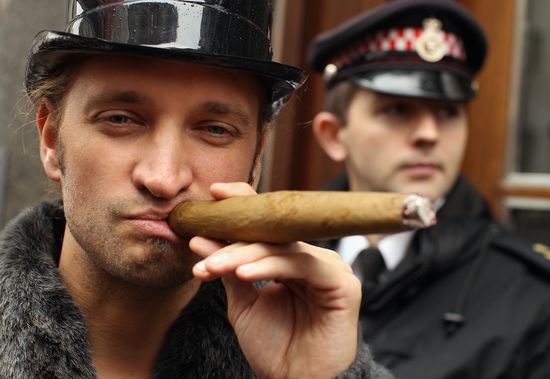
Herman Cain’s Sense Of Humor

John McWhorter defends it: 

Unfortunately, when [Cain] says that his Secret Service handle could be "Cornbread," or greets an enthusiastic audience with the theatrically humble expression "Shucky ducky," commentators get their hackles up. Read the op-ed written by Brown University’s Ulli Ryder last week in the New York Daily News and you would think that Cain is himself a racist, encouraging insulting "stereotypes". The truth is much simpler—namely, he is exposing (in some cases, introducing) the country to an authentic thread of black culture. Cain isn’t a self-hating minstrel. Quite the opposite: He’s a black man from the South actually comfortable enough to be himself on the national stage. … More than anything, Cain shows an affinity and comfort with the particular sense of humor rooted in black American experience. 

The Developing World Develops

Charles Kenny relays some good news:

Africa has been going gangbusters — though you probably haven't noticed, since the whole region of 49 countries still has a combined economy smaller than the state of Texas. Yet within the club of economies that doubled in size were no less than eight from sub-Saharan Africa, the region traditionally written off as a hopeless economic backwater. Indeed, that region took 17 of the top 40 spots in the decade's global GDP growth rankings; its GDP is 66 percent larger than it was in 2000. Populations have expanded there, too, by around 28 percent over the decade — but even accounting for more people, the average income in the region is about a third higher than it was 10 years ago.