"Memo to the Republican field: You’re running for president. Of the United States. Of America. Start acting like it. Stop proposing nonsense tax plans that won’t work. Stop making ridiculous attention-getting ads that might be minimally acceptable if you were running for county supervisor in Oklahoma. Stop saying you’re going to build a US-Mexico border fence you know perfectly well you’re not going to build. Give the GOP electorate and the American people some credit. This country is in terrible shape. They know it. You know it. They want solutions. You're providing comedy," – John Podhoretz, in the New York Post.
Month: October 2011
Romney Aims To Please, Fails
Erik Loomis doesn't understand Romney's latest flip-flop. Nor does Pejman Yousefzadeh:
[A]nyone want to explain why Mitt Romney–who I thought had learned something from his mistakes in the 2008 campaign–has decided to give credence to all of the charges that he is a flip-flopper, with no core convictions of his own? If you go to Ohio as a Republican Presidential candidate, you have to be prepared to answer questions regarding what the Republican Governor of the state is doing to address an issue as politically sensitive as collective bargaining. Unfortunately, Romney chose instead to look unprepared, unprincipled, and completely afraid of taking a stand.
How American Spending Has Changed
Since the recession began.
The GOP Brand
Frum thinks it's in tatters:
The identification of the GOP as mouthpiece for the selfish interests of the wealthy is a stubborn image, difficult to overcome at the best of times. For three years, however, Republican leaders have been doing their utmost to confirm the stereotype – and to quash and quell any attempt to counter that stereotype. Did we really spend months and months arguing that one of the things most wrong with the US tax code is that the poor and unemployed pay too little tax? Yes we did. Head shake. Face slap.
The Daily Wrap

Today on the Dish, white evangelicals doubled down as support for marriage equality deepened, real GDP finally returned to its pre-recession peak, and we collected blogger reax to the news. Andrew clarified his sense of hell, Mormonism isn't obviously Christian, and we revisited the Mormon Jesus's appearance in the Americas. In our video feature, Andrew revealed his secrets to longevity with HIV.
Herman Cain arrived at something of a foreign policy doctrine, the Hermanator's candidacy is without historical parallel (and yet he doesn't have a chance), and Karl Rove clung to his own abating influence. Perry's "plans" are geared toward primary voters and not analysts or economists, he considered skipping some of the debates, and shifting costs around is not the same as controlling costs.
The Arab Spring didn't come out of the blue, the SCAF is holding Egypt back, and it's possible that poorly-designed architecture provoked the London rioters.
The Oakland police unloaded on peaceful protests, we wondered if OWS would survive winter, and the U.S. is losing ground on social mobility. Obama may not deserve the blame for the medical marijuana crackdown in California, we accepted Internal Realism in baseball, and gay couples are raising children in every corner of America. Relocating, with movers, is for the rich, readers complicated Toby Ord's unbridled celebration of population growth, and scientists "think God's thoughts after Him." Siri is incapable of conversing with the Scots, compassion is central to Confucian ethics, and we should vaccinate ourselves for others too. Andrew and our readers shared their favorite renditions of the Star Spangled Banner, and we assessed Groupon's declining value before its IPO. We deconstructed bigotry, borrowing basic concepts should be legal, and older people don't watch horror movies because they have stimulation fatigue.
Hathos alert: 90's edition here, VFYW here, MHB here, and FOTD here.
— M.A.
Must The National Anthem Be Triumphant? Ctd
Favorite renditions are pouring in from readers. The second-most recommended, behind Marvin Gaye's:
A reader comments:
Want to talk about a national anthem that is unorthodox? The Star Spangled Banner discussion begins and ends with Jimi Hendrix. It's frustrated, psychedelic, tragic, yet also inspiring and downright beautiful. The improvisational madness that comes off of Rockets Red Glare and Bombs Bursting In Air perfectly captures not only the words they follow, but absolutely everything that America was undergoing at that time in history.
He came under plenty of criticism for it, too. His response? "I’m an American, so I played it. I thought it was beautiful."
Another:
Two weeks after Whitney Houston sang her version at the 1991 Super Bowl (and two weeks closer to the imminent deployment of ground forces in Desert Storm), Branford Marsalis and Bruce Hornsby played a version at the 1991 NBA All-Star game. Pensive, nuanced, moving in ways that triumphant versions by definition can't even consider, and perfect for the moment even for a marquee sporting event. It's always been my favorite.
Another from the Gulf War era:
How about the anthem at the 1991 NHL All-Star game at the old Chicago Stadium? To me, this is the ultimate in patriotic displays. The Chicago Stadium was incredibly loud, you could barely hear yourself think from all the cheering.
Another:
I've always loved when the three members of the Grateful Dead sang the national anthem in Candlestick Park in 1993.
Another recommends the "pitchy and somber" performance by Billy Joel in 2007. Another:
I’m sure you guys have seen this, but I can’t watch performances of the national anthem without thinking of Maya Rudolph’s impressive rendition.
Another:
I couldn't find a recording, but Rena Marie got into all kinds of hot water here in Denver for her version!
Another:
Fortunately, as a young musician growing up in Chicago, I got to see and hear it done the right way. At the opening nights for the Chicago Symphony Orchestra and the Lyric Opera, the conductor leads the audience, the orchestra plays, everyone stands (including the CSO cellos!) and everyone sings. To hear the anthem sung with vigor by 3000+ citizens is a very inspiring thing. As it should be. Here's a YouTube of the CSO and their current music director Riccardo Muti starting the 2010 season. It's hand-held, outdoors and slightly abridged, but speaks for itself. And by the way, a brisk tempo and snappy rhythms are the way the piece was written. Muti gets it right and, when I was younger, so did the CSO's Hungarian-English music director Sir Georg Solti. Go figure.
Another symphonic submission:
As a composer and huge fan of all of Igor Stravinsky’s music, my favorite story about the Star Spangled Banner has to be Stravinsky’s infamous connection to the tune. As the story goes, in 1943, Stravinsky got it in his head to write an arrangement of the national anthem. His arrangement is fairly conventional and far from the sounds of many of his other works. But Stravinsky’s reputation was as an iconoclastic bad boy. His Petrushka and Rite of Spring were well known by then (the Rite being particularly lodged in the public’s imagination as the piece that caused a riot in Paris upon its premiere.)
The apocryphal story continues that some folks in Boston heard that he planned on having the arrangement performed, so the town council passed a law restricting any rearrangement of the national anthem in whole or in part. The Boston police seemed to have contacted Stravinsky on about January 15, 1944 to warn him that MA could impose a $100 fine for a performance. The incident soon was mythologized into how Stravinsky was supposedly arrested for playing the music.
Here’s a YouTube of the arrangement’s performance. I find it a bit triumphant – except for the middle section ("and the rockets’ red glare…"), which is rather mournful to my ear. I rather like the Stravinsky arrangement, though.
Another adds to my comments on the moving rendition posted earlier today:
It always brightens my day (and brings a tear to my eye) to see this wonderful assist by Mo Cheeks – he truly showed class and empathy. However, I'd also like to point out how the Portland crowd reacted. Often, when there is an on-court mess-up, the crowd groans/mutters/boos. But this crowd quickly responds to her initial faltering by actively cheering her on, and there is no booing or hooting, before Mo comes out. Beyond a man helping a girl, it's heartening that the fans were literally cheering her on from the beginning. That was truly a great "collective response to failure", which ultimately became a wonderful success.
Another reader points to another assist of a girl by the crowd, when her mic cuts off.
A College Degree Isn’t What It Used To Be
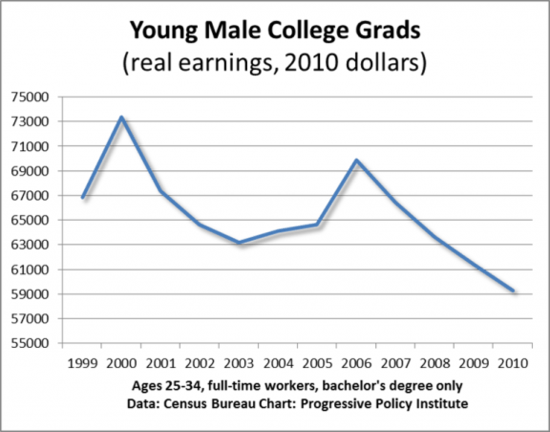
Michael Mandel reports that the "real wages for college graduates continue to plunge." Bradford Plumer has more detail:
College grads are making less money right out of college than they used to, and it’s becoming harder and harder to pay their loans — even as the cost of college is swelling. What’s more, this isn’t a brand-new phenomenon. As Mandel’s earlier research has found, real earnings for young male college graduates have been declining for a while, and they’re now down 19 percent from their peak back in 2000. For young female graduates, earnings are down 16 percent from their peak in 2003.
Chart on earnings for female grads here. Tyler Cowen adds his two cents.
What Are Cain’s Chances?
Nate Silver refused to rule out the possibility that the Hermanator might win the nomination. Matt Glassman counters:
[If Silver's point is] that people saying that Cain has no chance should actually be saying he has “less than a 1% chance” — well, fine. But it’s just semantics, or maybe a criticism about imprecise writing.
But that’s not what bothers me about the article. The real problem is that Nate seems to more or less agree with the people who think Cain has no chance. He concedes that Cain’s chances might be “slim” and then suggests that “slim” might mean slightly less than two percent. In effect, Nate is doing exactly what he claims the analysts shouldn’t be doing: disregarding the polling numbers and putting the vast preponderance of the explanatory weight on the fundamentals, or their intuition. How else can you get the polling front-runner down to 2%? But if it’s “arrogant to say that the man leading in the polls two months before Iowa has no chance,” then it’s probably pretty arrogant to make him a 50 to 1 longshot.
Jonathan Bernstein basically agrees with Glassman.
Face Of The Day

Aboriginal dancers perform for Queen Elizabeth II during her visit to Clontarf Aboriginal College in Perth, Australia on October 27, 2011. The Queen and Duke of Edinburgh are on a 10-day visit to Australia and will travel to Canberra, Brisbane and Melbourne before heading to Perth for the Commonwealth Heads of Government meeting. This is the Queen's 16th official visit to Australia. By Sharon Smith-Pool/Getty Images.
Where Gay Couples Can Adopt, Ctd
A reader writes:
That map is way off, at least on the two states I know about. My home state, Colorado, which the map marks "uncertain," explicitly allows same-sex adoption based on a law adopted in 2007. Nebraska, where a friend lives, is also marked as such, but he has been told specifically he can not adopt or be a foster parent because he is gay.
Another backs him up:
As a lawyer in Colorado, I have represented a same-sex couple (not even legally married) in the adoption of two children.
Colorado law allows for a "second parent adoption" with the consent of the "sole legal parent." Although it is not explicitly for gay couples (theoretically anyone could become the second parent) it is my understanding that it was enacted for that purpose. The way it works is that one of the partners adopts the child and then, after becoming the "sole legal parent" consents to the adoption by the "second parent." The judges in this district have allowed me to do the whole process at one time, i.e., going through the hearing on the first adoption and directly following it with the hearing on the second parent adoption. That way there is no delay and there is no need to go to court twice. It has worked out well for my clients who are extremely happy that each of them has specific parental rights as to their children.
A reader in Michigan writes:
We live in one of the states where same-sex couples are restricted from petitioning for joint adoption. A number of years ago my friend and her partner decided, after many years of unsuccessful artificial insemination attempts, to pursue adoption. This couple had been in a 10-year relationship, both were well-paid professionals and well situated to expand their family. They went through all of the steps for an adoption and finally brought a newborn infant home. Because of the laws in our state, my friend had to adopt the baby as a "single" person.
Two months later my friend’s partner decided that she did not want to be a parent and left the home and the relationship. She did not have an interest in maintaining a relationship with the child.
It is true that long-term straight and gay relationships unfortunately end, and there are people who discover too late that they are not meant to be parents. But the difference this case illuminates is because same-sex marriage is not legal in our state and because joint adoptions by same-sex partners are not allowed in this state, my friend has had no recourse to request support from her former partner. They made the decision to adopt a baby as a family. However, the law has not supported that decision and my friend has had to figure out how to financially, emotionally, and physically be a single parent.
I believe that same-sex marriage and gay adoption is the right answer for all sorts of equality and humane reasons. But I also think that what is all-to-often missing from the discussion is the fact that this legal standing also allows for legal recourse when things go bad (just like they do when straight couples divorce).
 The Dish