Can Brutalist Architecture Help Explain The London Riots?

Brutalist london

Tom Clougherty is intrigued by the connection:

The trouble with so much architecture from the post-war period is that the state was the client – architects designed housing projects with little or no concern for the people who would actually live in them. The design of housing estates did not reflect the way people lived, worked and played.  … Opposition to post-war architecture tends to focus on aesthetic concerns. And, certainly, much of it is appalling ugly, almost to the point that merely looking at it fills you with despair. But its mostly deeply pernicious effect is surely the way in which it has affected people’s behaviour, by forcing them to live in an environment which is cold, desolate and practically inhuman. Naturally, I am not suggesting that post-war architecture caused the riots. But the idea that it was a contributory factor certainly has the ring of truth about it.

Stephen Masty has more

(Photo: The Robin Hood Gardens by Flickr user J@cK!)

Would Block-Granting Medicaid Work?

Rick Perry has frequently proposed doing so. But the consequences are obvious:

Block-granting may be attractive to some federal policymakers as a way to cut federal Medicaid costs.  But states would be left holding the bag when federal funding proved inadequate; they’d be the ones who would have to increase their own funding or make the tough decisions about which people to drop from coverage or which medical services to curtail.

Shifting costs around is not controlling costs. Not that hard to understand. But Perry, it appears, is truly stupid. His college transcript does not exactly refudiate this.

Chart Of The Day

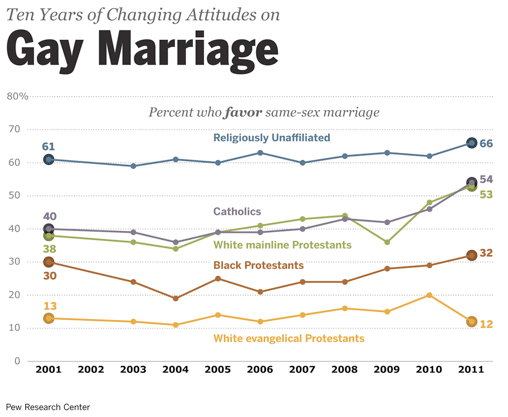
Support for marriage equality over the last ten years, broken down by religion:

Marriage_Religion

Fascinating. As modernity deepens, and white evangelicals dig deeper into fundamentalist denial, we may not have a truly divided society, just one with a persistent, oppositionist, counter-cultural rump. I hope some Republicans understand that this could in fact be the fate of the GOP if they continue on their current path.

Will The GOP Keep The House?

Probably. The Democrats need to win back 25 seats to take control. Not easy:

In the 10 elections since 1952 in which the president’s party did not control the House, the largest seat gain for either party has been 21. It would seem that in the past 60 years voters have been unwilling to reward or blame either party too greatly when faced with split government. They tend to like the status quo.

How Heartless Are The Chinese? Ctd

A reader writes:

No, Confucianism does not discourage a Good Samaritanism. Here’s Mencius (Confucius’ immediate successor) on an topic clearly relevant to the shameful recent story (and to your commentator’s Mencius08 “If people witness a child about to fall down a well, they would experience a feeling of fear and sorrow instantaneously without an exception. This feeling is generated not because they want to gain friendship with the child’s parents, nor because they look for the praise of their neighbors and friends, nor because they don’t like to hear the child’s scream of seeking help.” Instead, Mencius argues that this feeling of compassion (ren) is innate in a person, and that as a result, all people have a mind that cannot stand to see others suffer. Moreover, Mencius argues, “…without a mind directed by compassion one is not human.” Clearly here Mencius is suggesting that by nature as humans we are not driven by guanxi, but by compassion for fellow humans. This is completely consistent with a Good Samaritan ethic.

Now, of course, both Confucius and Mencius would agree that it requires effort to make sure that one’s innate “heart” is cultivated so that what it feels results in action, and they would also agree that most people unfortunately do not do this cultivation work. It is very clear that if Confucius and Mencius had seen that video, they would be ashamed and proclaim that all of those people had lost their humanity.

Another writes:

I’m a student of China by profession, and the last thing I would do is propose that there’s ever a single “Chinese” way of looking at things. But we get China absolutely wrong if we imagine that there have been no strong and important cultural strands of a “Samaritan” kind in Chinese history. Mencius, whose works were part of Neo-Confucian orthodoxy in China from the twelfth century on, famously treated the fact that (as he assumed) anybody seeing a child about to fall into a well would feel an instant sense of horror, and a non-calculating desire to help, as one his proofs of the goodness of human nature. 

Chinese Buddhists prayed and still pray for the salvation of all human or even all sentient souls, regardless of whether they knew the people they were praying for; and many of these prayers and their surrounding rituals have made their way into general religious life and have been participated in by people who wouldn’t have considered themselves specifically Buddhist.

At least over the last thousand years of Chinese history, Chinese governments and voluntary associations frequently made provision (and spent money) for charitable purposes (free medicines, free medical care, free grain in famine, etc.) for strangers or for all poor citizens, not just for kinsmen or members of a defined community more specific than all of China. In phases when Chinese states were expansionist, they sometimes justified expansion, as European and American states have done, by the need to bring the benefits of Chinese civilization to other peoples – an odd form of charity, one might argue, but definitely aimed at strangers and definitely involving expense and other self-sacrifice.

An argument that “the Chinese are just different from us” rarely gets us very far – especially when we can find plenty of examples of public callousness just as horrifying in our own recent history, as some other readers have pointed out with examples.

For more on Mencius, a reader recommends an article by Dr. Jeffrey Richey of Berea College. Another recommends the book The Hypothetical Mandarin: Sympathy, Modernity, and Chinese Pain.

Is Groupon Doomed? Ctd

As Groupon approaches its initial public offering, Michelle Conlin contemplates the company's rise and fall:

Groupon shows what can happen when a startup experiences steroidal growth in an unproven industry. To its defenders, the Chicago company is a victim of its success, its stumbles emblematic of a business in infancy. After all, Groupon has hordes of fans who rave about the company's deals and its liberal refund policy. But critics say the issues Groupon is facing are symptomatic of something more troubling: questionable accounting, an overvalued business model and an industry that is turning into the digital equivalent of junk mail.

Rocky Agrawal compares Groupon's business model to the sub-prime lending crisis. Larry Dignan tells a different story, insisting that the company has bounced back based on a strong third quarter:

What changed? First, Groupon had to become more disciplined or its roadshow would have been drowned out by people thinking the company was a Ponzi scheme. The other notable item may have been its rollout of a global enterprise planning system and other tools from the likes of Salesforce.com. … With better financial and visibility systems–actually anything other than random spreadsheets and e-mails–Groupon is able to reconcile its results and drive revenue better. There are no guarantees that Groupon will be a juggernaut–or a Google-like growth machine–but it's clear the company looks more grown up now.

Previous Groupon coverage herehere and here

Moving Is A Luxury

Rod Dreher found out firsthand. He got estimates for moving his three-bedroom apartment's belongings from Pennsylvania to Louisiana:

Eight thousand dollars, just to transport our stuff from here to there. And that was the best bid. Did you know that states impose tariffs to move your stuff into and out of particular states? We discovered that to hire someone to cart our stuff over the Pennsylvania state lines adds something like $1,300 to the cost of the move, because of a state-imposed tariff. And moving into Louisiana adds $300 to the bill, because of state tariffs. I had no idea.

Vaccinate Yourself For Others

A Centers For Disease Control panel is recommending the HPV vaccine for boys. Amy Davidson is on board:

Vaccinating boys keeps them from getting sick, and that may be the main way this is sold. But, as the C.D.C. panel noted, it "may also provide indirect protection of women." One would think that raising boys to be men who protect women (and other men), directly or indirectly, would be a conservative priority as well.

Dan Savage has been touting this issue on his slog and lovecast.