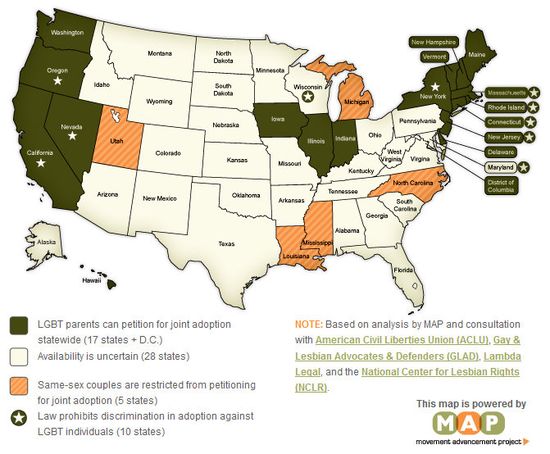
Where Gay Couples Can Adopt

In a map:

Adoption_Map

A recent report (pdf) on same-sex adoption collects basic facts on gay and lesbian families:

Same-sex couples live in virtually all counties (99.3%) across the U.S., and 96% of counties in the U.S. have same-sex couples raising children. Not surprisingly, places like New York City, Los Angeles and the San Francisco Bay Area have the highest concentration of same-sex couples raising children, primarily because those areas have the highest concentration of same-sex couples (that is, both with and without children). However, this doesn’t mean that same-sex couples in these areas are more likely to be raising children than those in other areas. In fact, California and New York don’t even make the list of the top 10 states where same-sex couples are most likely to be raising children. Surprisingly, the state at the top of the list is Mississippi.

More highlights from the report here.

(Hat tip: Joe My God)

The Arab Spring Was A Long Time Coming

Ellen Lust hypothesizes as to why the revolutions happened when they did:

I suggest the answer lies in shifting our focus from a search for immediate causal factors to a greater recognition of micro- and meso-level transitions—that is, gradual, interrelated changes in political, economic and social spheres that, like slowly moving tectonic plates, eventually create the conditions conducive to earth-shattering events. The point is not simply to recognize the incrementalism of change or unintended consequences of social, economic and political reforms that have often been implemented in the region, but to urge us to pay greater attention to the "shifting web of conditions that define the terrain on which new institutions and actors arise, old actors activate or change their claims, and all pursue iterative contests."[iv] Attention to these factors does not pinpoint precisely the emergence of uprisings across the Arab world, but it certainly makes them less surprising.

Will Cold Kill The Occupation?

The temperature in NYC is dropping:

Organizers admit that the protests may not be able to survive the winter in their current form. As temperatures drop, the bustling mini-community downtown will probably be reduced to a small group of shivering, hard-core occupiers. And when that happens, the 99 percent will start looking less like a movement, and more like a winter survival course.

The occupation has already seen more than a half-dozen cases of hypothermia as nighttime temperatures have dipped into the forties.

7 Billion Not Enough For You? Ctd

A reader writes:

What a breathtakingly ballsy simplification of population growth by Toby Ord. Apparently humanity's capacity for invention and creativity is a linear function of population. Who knew? Based on that single flimsy argument, the quality of life for each human on the planet will also increase accordingly. Never mind pesky issues such as dwindling food supply, waste management, the increased risk of serious ecological disasters, and social tensions which naturally arise  in dense population areas.

Any complex system has its natural limits, and the Earth is no exception. Whether or not we have reached that point (or exceeded it) should be the true focus of the debate. But to basically declare outright that the Earth is nowhere near this limit … well, I find it a bit rich. Already there have been some serious ecological disasters – witness the pollution and extreme overfishing of the world's oceans, for one. I find the phrase "so long as we can find the resources to support it" particularly egregious: I'm sure the US could continue to increase its debt indefinitely so long as it can find investors willing to buy it, and I'm also fairly certain that the price of oil will remain stable so long as there are no disruptions in the supply.

Another piles on:

It seems dangerous to have the "so long as we can find the resources to support it" bit be essentially a throw-away line. I'm not going to argue that a Malthusian end is unavoidable, but there is simple math in the equation of more people = more resources needed to support them. And as climate change impacts become increasingly obvious, flood-drought cycles make previously abundant lands less so, and rising sea levels decrease the amount of land on which we can reside, I think the fact that more people can get value out of new releases on iTunes seems trite. I'm all for arts and culture, but we're also going to have to feed all these people.

Moving Up The Ladder

Mobility

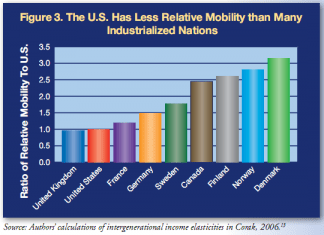
Mark Thoma worries about an ossified America:

A vibrant middle class is essential to mobility. For many people, the middle class serves as a steppingstone to the upper classes both within and across generations. If we continue along the path we are on to an increasingly two-tiered society, and if the middle class continues to experience problems, then there will be less room at the middle tiers of society for those who are trying to move up the ladder. Mobility between the classes will be reduced.

Paul Kelleher thinks Thoma isn't primarily concerned with inequality:

Reading his article, I don't see Thoma complaining about income inequality as such. Rather, I see him worrying about two more specific things. First, he is concerned about the power that those at the top often have to bend public policy toward their interests. Second, he is concerned about stagnant or even reversing living standards for those at the bottom and the middle. These two issues are connected to income inequality, but they are connected only contingently. For it is possible to imagine a society where the living standards of everyone improve significantly and steadily, but where those at the top improve faster than others, and so inequality grows. It is also possible (although perhaps harder) to imagine policy changes that hem in the political clout that greater wealth buys, so that political influence becomes somewhat disconnected from economic status.

(Chart via N. Asher)

A Defense Of Copying

Among other innovations, Apple patented this: Slide_to_unlock Timothy B Lee wants to reform patent laws to encourage the borrowing of good ideas: 

Google and Samsung clearly did “steal” Apple’s technology. A number of key concepts, such as pinch-to-zoom, were first introduced on the iPhone and later incorporated into Android. The iPhone was an innovative product, and obviously Apple’s competitors are going to want to match it feature for feature. The important question isn’t whether such “stealing” occurred, it’s whether we want to live in a world where it’s illegal. Do you want to live in a world where only Apple is allowed to make phones with pinch-to-zoom capability (and dozens of other features) until 2027? I sure don’t.

Yglesias agrees:

I remember well when Microsoft unveiled Windows with its “Recycle Bin” function that happened to be exactly the same as Apple’s longstanding “Trash” function. It was slightly offensive to human dignity that they were copying both the function and the metaphor while slapping a slightly different name on it to seem like they weren’t copying. But the world is a better place for it. It’s a good function and a good metaphor, so as many people as possible should use it.

The Daily Wrap

Americans and inequality
Today on the Dish, Americans moved towards redistributionism, and the theocon blogosphere condescended to the Vatican on inequality. Israel and the EU over-reached, we dreamed up a better pro-life movement, and Andrew entertained the President Hillary scenario. The Mormon debate continued, and we parsed the national anthem further here and here

Karl Rove, et al tried to deflate Herman Cain, but Republicans really like him (they admire his contrariness). The GOP debates are excruciating but worth it, Romney reinvented himself as a champion of the middle class, and Bill Kristol's eyes wandered to Louisiana. A reader alerted us to a glaring pop culture gap, and Republicans would rather grasp at a narrative of Obama's inevitable doom than stand behind an actual candidate. 

We should trust nascent Tunisian democracy, a religiously dominated democracy doesn't mean terrorism, and we can't have both hegemony and democratic revolutions in the Middle East. Google stifled the Green Movement, the laws of war matter, and our policy of neo-imperialism has failed. A moral crisis loomed in China, American power hangs on the rise of developing countries, and Russia simply isn't a threat.

A larger population makes life better, cell phones improve healthcare, and anthropology degrees are for the rich. Scientists neutered mosquitoes in the fight against malaria, over-treatment drives Medicare spending, and electrostimulation is hot

Correction of the day here, cool ad watch here, app of the day here, FOTD here, MHB here, VFYW here, and another VFYW contest winner #73 here

M.A. 

“Trust Tunisia”

That's David Rohde's post-election advice for the West:

The election results in Tunisia should not be feared. I have argued — and will continue to argue — that the danger is not Islam. It is authoritarianism. Secular regimes, such as Syria’s, have proven just as repressive as authoritarian Islamist regimes, like Iran. Islam is not inherently backward nor incompatible with modernity. Salafism is. Constitutions that mandate elections, individual rights and protections for women and minorities are the best defense against authoritarianism in any form. Democratic principals and institutions, not individual leaders, thwart the concentration of power. The West must now trust the democratic process it has long said it supports.

Why Do So Many Republicans Support Cain Or Gingrich?

Dave Weigel's theory:

Cain and Gingrich have learned to make bold pronouncements and endorse wild gimmicks, like Gingrich’s plan to break up courts if they annoy conservatives, or Cain’s 9-9-9 implosion of the tax code. They run their policy shops the way a contrarian editor might run his magazine. It works. Bill O’Sullivan, the treasurer of Texas Tea Party Patriots, explains that Cain and Gingrich have won over the party’s base because they barrel through the normal constraints of campaigns and the “glorified spelling bees” that are media-sponsored debates.