The Pop Culture Gap

A reader writes:

First Herman Cain doesn't know what SimCity is, and now the New York Times' book reviewer has no grasp of Angry Birds. When we talk about the growing gap between the haves and have-nots, we should also examine the gap between the people who pay attention to culture and the media and politicians who try to shape it. Here's Mitt Romney's half-assed attempt to seem human when talking about books, TV and movies. Here's Rick Perry asking folks to follow him on "Tweeter".

I am the 99 percent: I shop at Wal-Mart, eat at McDonald's, watch TV and surf the internet. Sheesh.

Does Qaddafi’s Death Reveal The Core Of War?

That's Jonathan Jones' view:

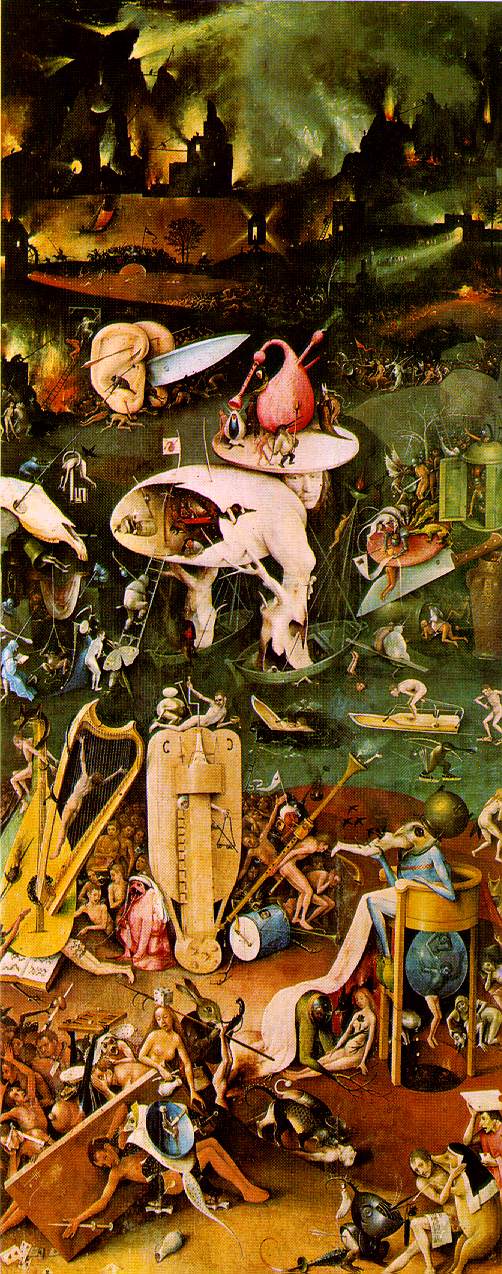
When I look at this photograph what do I see? War. War and nothing else. How many times do we need to be told that war is hell? The phrase has lost all meaning for us. Think about what hell is. Hell, in paintings by Bosch, is chaos. It is meaningless, monstrous, and lacks any place of safety or redemption. This picture of Gaddafi dead is a day in the life of hell, also known as war: a corpse photographed for souvenirs, displayed to satisfy the oppressed, in a moment of violent gratification. When Nato intervened in Libya what we see in this picture was probably the best – not the worst – outcome on offer. And we should be grimly glad of it. What fantasy makes us long for some impossibly dignified and humane end to a bloody conflict?

Norm Geras is unimpressed:

This, however, is only half the story – the sociology of war, as one might call it. One need only recall that the critical reaction that Jones laments came not only from political actors or media outlets but also from human rights NGOs, to be reminded that, as well as a sociology, there is also a morality of war. It is contained in international conventions that codify the laws of war, and in just war doctrine, the different 'branches' of it. Would we really be better off if there weren't this morality, if wars were just fought without restraints of any kind? It is hard to believe that Jones really thinks so: that he would prefer that there be no rules against murdering prisoners, or torturing and mutilating them, or treating their dead bodies abusively; or that the deliberate bombing of civilians should be seen as an acceptable practice; in short, that in war anything goes. At times this seems to be the subtext implicit in his piece. But it is more likely that he hasn't thought the issue through and just wants to moan about Western attitudes.

I'm with Norm. War is hideous. But the laws of war – evolved over centuries – try to mitigate this in some core respects. Those laws do not celebrate or condone war; they just try to civilize it at the margins. They are not to be despised.

Is America An Empire?

3084889775_67de9286e3_z

Now that we are leaving Iraq, Jonah Goldberg wants to do away with the term:

[C]ontemporary America isn't an empire, at least not in any conventional or traditional sense. Your typical empire invades countries to seize their resources, impose political control and levy taxes. That was true of every empire from the ancient Romans to the Brits and the Soviets. That was never the case with Iraq. For all the blood-for-oil nonsense, if America wanted Iraq's oil it could have saved a lot of blood and simply bought it. Saddam Hussein would have been happy to cut a deal if we only lifted our sanctions. Indeed, the U.S. oil industry never lobbied for an invasion, but it did lobby for an end to sanctions. We never levied taxes in Iraq either.

Jacob Heilbrunn prefers "imperial behavior" rather than "empire" to describe our post-Cold War policy. Larison thinks the shoe fits:

When a government reserves the right to overthrow other governments that oppose its policy goals, it assumes that other states’ sovereignty is so limited that it can and should be violated when it suits the more powerful state. This is how many empires have acted in the past, and so it seems appropriate and accurate to refer to a contemporary American empire. If we call it hegemony instead, the substance of what we are talking about doesn’t change at all, and the criticism of hegemonist policies remains the same. Hegemonists who reject the label of empire really do protest too much.

How about neo-imperial: all the attitude and cost, and none of the alleged benefits?

(Image via Flickr user B MOR Creeeative)

They Can’t Be Primping Jindal – Right?

Turns out there is no end to new-candidate-please mania:

Jindal already has endorsed Rick Perry for president. Party leaders still looking to recruit another candidate might want to consider convincing him to renege on that endorsement. This nomination battle is still volatile enough for one more candidate to blow into the race with hurricane force tailwinds.

Daniel Halper is on board:

The only question would be whether there is time for another candidate to establish himself, raise funds, and establish an effective campaign. But those details have nothing to do with the obvious lack of enthusiasm for the Republican presidential candidates. 

Bill Kristol is still searching for someone, anyone other than the current field. Larison patiently explains all of the legal and practical reasons the field is set. Jamelle Bouie sees Jindal as a real possibility – in 2016. When discussing Jindal, this must always be mentioned.

Must The National Anthem Be Triumphant? Ctd

Readers add to the canon:

Controversy around the National Anthem and baseball dates back to 1968 and Jose Feliciano's glorious rendition at the World Series that got him blacklisted from radio. And would anyone really consider Marvin Gaye's now legendary 1983 NBA All-Star Game version as triumphant? Certainly not traditional, but inspiring in its own unique way. This is what artists do: re-imagine us into thinking about the world in a new and different way. What has always made our nation so great are the grounds of freedom that have made these new visions possible.

Another on Gaye's version:

It's like a love song.  And there's a great back story too.

Another writes:

Personally, my favorite rendition of the Star Spangled Banner is by Sufjan Stevens, who not only changes the arrangements of the song but also the lyrics. Some might call it overly sentimental and bastardization, but for me it perfectly captures both our country's last decade of wars and the resiliency of our country.

Another points to Smokey Robinson's rendition before the 1986 World Series game 5 between Boston and the Mets. Another writes, "I've always liked Laurie Anderson's commentary on the national anthem, preserved by YouTube here." Another offers up some history:

Granted there are times when the Star Spangled Banner is performed and the entire situation is moving and inspiring (such as Whitney Houston's Super Bowl performance). However, even that performance goes against Congress' original intent in recognizing the SSB as our national anthem and the code which was adopted for that purpose. The code, which can be found here [pdf], is very detailed as to how the music should be performed in public. It also gives reasons as to why it is to be performed and what steps should be taken to ensure that the performance of the music meets the standard that Congress had in mind. The original actions taken by Congress came at a time when our nation was in need of ways to draw people together and rally them behind the policies and actions of our government, and in a way it was nothing more than propaganda.

Among music educators and musicians there is some debate currently about what should be done with this song (America the Beautiful is preferred). The SSB is very difficult to sing accurately (as evidenced by the many and varied ways "singers" manage to mutilate it almost daily), and so many of our citizens can't even sing the words correctly! I wonder how many presidential candidates can pull off an acceptable performance. Through the years the meaning and intent of public performances has shifted from being that of pride and reverence to being about ego and flash.

Another:

Our knee-jerk patriots, who want not just to enforce patriotism at sporting events but even determine the tone of that patriotism, need a history lesson. Until the First World War, no one would have dreamt of playing the "Star-Spangled Banner" before a baseball game.  Sports, especially professional sports, were thought to be inherently unworthy of the dignity and gravitas assigned to our national anthem.  Only pro-war patriotic zeal – and the desire of baseball owners to be allowed to continue to play during the conflict – led to the now-unquestioned pairing of flag-waving and jock-sniffing that is so central to one strain of "America Fuck Yeah!" patriotism.

And it only got worse with 9/11: the addition of "God Bless America" to all ballparks on Sundays and some (Yankee Stadium) for every game has led to all sorts of nonsense.  I have been berated more than once for not removing my cap during this latter song, and when I inform my moronic interlocutor that you only take your hat off for the National Anthem, you’d be amazed how many don’t know which song is which.  I now joke that the back of your ticket to a baseball game no longer has a rain check: it has a loyalty oath.

Now, back to what Ring Lardner appropriately called "the World's Serious."

“Are Mormons Christians”? Ctd

A reader writes:

Goldblog declares, “But theological honesty demands that we recognize that Romney would be the first president to be so far outside the Christian denominational mainstream.” Hogwash!  How about some credit where credit is due. Five presidents have been Unitarians: John Adams, Thomas Jefferson, John Quincy Adams, Millard Fillmore, and William Howard Taft – as you recently noted.

‘Tis true. But the notion of a totally new Scripture completing the old would still have struck them as odd. And the modern era is less religiously diverse. But point taken. By the way, a friend did come up with another religion that could be called Christian but also challenged on that basis: Christian Science. Would Americans have a problem with a Christian Scientist president? I’d say that health issues alone would be salient. Another writes:

Maybe this is just because I truly don’t care, but it seems to me that being a Christian is just one of those things.  If the person says they are, they are.  If the religion is on the family tree of Christianity, it’s in no matter how weird it may seem or how many new books they’ve tacked on as holy scripture.  They stay in the family.  Jehovah’s Witnesses are just heretical Baptists, who are just heretical Anglicans, who are just heretical Catholics, who (in the eyes of some) are just Orthodox heretics, and the whole lot would be called heretics by the Gnostics, who of course are just heretical Jews.  Joseph Smith attended Sunday school at a Western Presbyterian Church, and started his religion during a period of innovation/upheaval in the American Christian community.  He came from the Christian community and considered himself a part of Christianity.  That’s good enough for me.

A Mormon reader writes:

Every time I have been asked if I am Christian or am told that I am not Christian, my first question back to the person is what they mean by “Christian”?

I find it interesting that I have run into almost as many different definitions of “Christian” as times I have been asked the question. The issue, as I see it, is that people are using different definitions of “Christian” when discussing Mormons and our beliefs. There are some people who say that the word “Christian” means a person or a church that believes Jesus Christ is the savior of mankind and focuses worship on such, or something similar to that. Under this definition, it is hard to claim that Mormons aren’t Christians, as we believe in the New Testament and in the divinity of Jesus Christ and His power to save.

That there is some other doctrinal differences with Mormonism seems to me to be irrelevant to this definition of Christianity given the primacy of faith in Christ, repentance, and baptism in the Mormon church that is consistent with other Christian faiths. But don’t all Christian faiths have some differences in doctrine with all the other Christian faiths that differentiate them from the other churches?

However, many people that I have talked to use a definition of “Christian” that essentially covers the Catholic Church and all churches that are derived from or which left Catholicism. I have also heard definitions that include belief in the Nicene Creed, the Trinity, or other specific aspects of doctrine as the definitive characteristic. Under this definition, Mormons most definitely are not Christian, nor do we consider ourselves such. But if this is the definition that is being used to disqualify Mormons as Christian, it would be great if people would overtly define the term so that it is not conflated with the first definition I talked about. As it is, people just throw the term around as if everyone is operating on the same definition, which just leads to confusion.

Another:

Yesterday, I came across this while looking at the reasons behind the Vatican stopping LDS from copying Catholic church records. In the article, this tidbit about baptism is interesting (seems to me that recognizing baptism is the starting point to recognizing whether that faith is a Christian one):

[T]heological differences have cropped up between Mormons and Catholics in the past. In 2001 the Vatican’s doctrinal congregation issued a ruling that baptism conferred by the Church of Jesus Christ of Latter-day Saints cannot be considered a valid Christian baptism, thus requiring converts from that religion to Catholicism to receive a Catholic baptism. “We don’t have an issue with the fact that the Catholic Church doesn’t recognize our baptisms, because we don’t recognize theirs,” Otterson said. “It’s a difference of belief.” …

When issuing its 2001 ruling, the Vatican said that even though the Mormon baptismal rite refers to the Father, Son and Holy Spirit, the church’s beliefs about the identity of the three persons are so different from Catholic and mainline Christian belief that the rite cannot be regarded as a Christian baptism.

As far as I can remember, the Catholic church recognizes Protestants as being Christian when it comes to allowing a “mixed marriage” to occur within the RC church. If I remember correctly, you are allowed to marry someone of another faith within the church, if that non-Catholic is a baptized Christian. If not, the person has to be baptized in the Christian or RC faith. (Though admittedly I’ve not followed doctrine as closely as I used to.)

Another asks:

Ever heard of Rudolph Steiner’s anthroposophy? It’s an East-West fusion, injecting karma and reincarnation into Christianity, but anthroposophists very much consider themselves Christians, celebrate Christian festivals (especially medieval near-forgotten ones), read daily from the Bible, etc. The NYT had a front-page story this weekend about a Steinerite school, but the tech reporter didn’t seem to know what he was dealing with.

Indeed I do. My nursery school was a Steiner school. Lots of God and crystals and flowers and non-violence. My main accomplishment: being one of the very, very few who ever got spanked and sent home. One teacher in an art class always always always said everything we drew or painted was wonderful. So I deliberately drew a crappy picture – a rainbow entirely of black and brown – to test her sincerity. Sure enough, she said it was wonderful, whereupon I tore up the painting I had made, declaring it bad. This, apparently, was not a common or approved reaction. I should add that I have only the vaguest memory of this, so if it’s inaccurate, blame my mum.

Maybe our entire lives are prefigured by one day in nursery school.
Are The Debates Irrelevant?

H.W. Brands says we'd be better off without them: 

Candidates are rarely tested on the most critical quality required of a president: sound judgment on serious issues. The debate marathon that has marked the Republican season so far has been especially unhelpful. This reality show of campaigning bears as little resemblance to real life – in this case, the real life of responsible governing – as reality shows typically do. In fact the debates have probably diminished voters' chances of choosing an effective president. Debates reward candidates for one-line zingers rather than thoughtful responses, and they condition voters to expect slogans for solutions to complex problems. Intra-party slugfests like the Republican series drive discussions to the extremes, making more difficult the inter-party compromises that will be necessary to get the economy moving and the deficit under control.  

I have to say that, regardless of their limitations, exposing these candidates to hours of questioning does help inform us about who they are in an as uncontrolled a setting as we can imagine. It was the only time when we got to see Sarah Palin without a protective filter. Perry's awful performances have also helped reveal the dumb-as-a-post, lazier-than-thou bullshit that can work for a crony-ridden Texas governor, but not on a national level. Yes, I know they can be excruciating at times. But they help show human beings in a few precious moments off-script. Their emotional temperament comes across. And that matters.

How Heartless Are The Chinese?

Reflecting on last week's tragic hit-and-run accident in China, George Conger criticizes the media for assuming a Christian mindset: 

[W]e in the West still live in Christendom. By this I mean that a Western journalist can assume that his audience has a shared Judeo-Christian worldview on base moral matters. One of these is the Good Samaritan ethic. … Were the 18 bystanders moral monsters, or were they acting according to a different faith code?

Conger suggests that Confucianism discourages the Samaritan ethic. Lijia Zhang proposes a related theory: 

The fundamental problem, in my view, lies in one word that describes a state of mind: shaoguanxianshi, meaning don't get involved if it's not your business. In our culture, there's a lack of willingness to show compassion to strangers. We are brought up to show kindness to people in our network of guanxi, family and friends and business associates, but not particularly to strangers, especially if such kindness may potentially damage your interest.

Electric In The Sack, Ctd

A reader writes:

E-sex (sex with electric stimulation) is pretty popular in the BDSM world, which itself is more popular than people think. I know of BDSM events every weekend that regularly attract 300 to 1500 people (at least three a year within walking distance of the US capitol). There are events just for people who like e-sex. I ran a BDSM club in a non-major city that had over 3000 members. That was over 10 years ago. And I have been doing e-sex way longer than that.

You CAN do it above the waist. Violet wands can be used anywhere except eyeballs. And it's not that expensive to get started. I got my first e-sex piece of equipment at a pawn shop for $10 and I still have it, although it now has over 20 attachments and some of them cost about $200 each.

Why do people do it? Why do people have sex to begin with? It's hot, it may be the only way some people can get off (men with sexual dysfunction particularly benefit from electric anal stimulation), the interaction feeds the soul (extreme trust is pretty much a requirement when you do edgier sex), to overcome boredom, or just because. I mean, it's not illegal, and no cute little animals are ever involved. Hot sex between consenting adults. What's not to like?