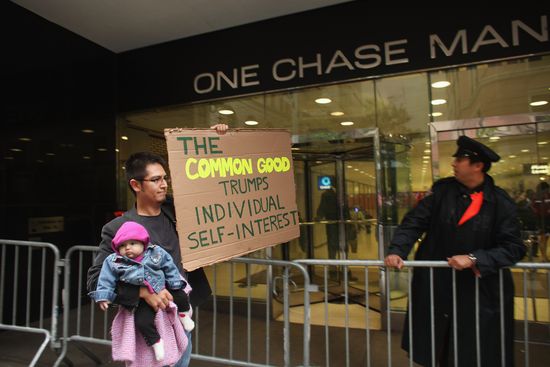
When Theocons Attack! Vatican Edition.

129086796

You knew the Church's effective endorsement of Occupy Wall Street would prompt a sudden outbreak of heterodoxy on the theocon right, didn't you? I mean any Catholic challenge to Randian orthodoxy in the GOP must be smacked down quickly, right? And, sure enough, the theocon blogosphere rises as one in dissent. K-Lo dismisses the document in line with decades of Catholic social teaching as a "bureaucratic curial note." George Weigel reassures conservative Catholics by claiming that the document is meaningless:


The truth of the matter is that “the Vatican” — whether that phrase is intended to mean the Pope, the Holy See, the Church’s teaching authority, or the Church’s central structures of governance — called for precisely nothing in this document. The document is a “Note” from a rather small office in the Roman Curia. The document’s specific recommendations do not necessarily reflect the settled views of the senior authorities of the Holy See; indeed, Fr. Federico Lombardi, the press spokesman for the Vatican, was noticeably circumspect in his comments on the document and its weight. As indeed he ought to have been. The document doesn’t speak for the Pope, it doesn’t speak for “the Vatican,” and it doesn’t speak for the Catholic Church. 

But the slightest off-hand comment by the Pope – if it benefits the GOP – is treated as weightily as an Encyclical. These people are so transparent. When it suits their interests, on sex, marriage and mores, the theocons love BXII. When it doesn't suit their interests, on the Iraq war, torture, the environment, economic inequality, they move on. And they call others "cafeteria Catholics." Samuel Gregg pens an open criticism of the Vatican's analysis in NRO, just as those damned relativist "faux-Catholics" liberals do all the time in, say, Commonweal:

[T]he text makes a legitimate point about the effects of a disjunction between the financial sector and the rest of the economy. It fails, however, to note that one major reason for this disjunction has been the dissolution of any tie between money and an external object of value that regulates the quantity of money and credit in circulation in the “real” economy. … Second, this document displays no recognition of the role played by moral hazard in generating the 2008 crisis or the need to prevent similar situations from arising in the future. …Third, given this text’s subject matter, it reflects one very strange omission.Nowhere does it contain a detailed discussion of the high levels of public debt and deficits in many developed economies, the clear-and-present danger they represent to the global financial system, and their negative impact upon the prospects for economic growth.

These are fair points. When liberals make them in other contexts, however, they're attacked as outliers and not real Catholics. In the hard-right Crisis magazine, Jeffrey Tucker condescends:

The Vatican seems to be growing in intellectual sophistication over worldly affairs. Now it gets economic matters half right. Sadly, being half right on something this important can lead to permanent calamity. To return to the original metaphor, the patient should thank the doctor for discovering the illness, but flee the poisonous “cure.”

Nicholas G. Hahn III simply argues that government is the problem, not reckless financiers:

The Council concludes its document with a reference to the Tower of Babel "where selfishness and divisions endure." Yet, the real towers of Babel these days are precisely the kind of bureaucratic authorities the Council seeks to proliferate. Perhaps once it ceases its own incompetent babble on financial reform, the Council will see that the real selfishness and divisions — and an idolatry of government — exist in itself.

Richard A. Viguerie goes all Beck:

Outside the classroom of a major university, it would be hard to find a more Marxism-based economic plan than the one espoused in today’s statement. Not only does it legitimize the various “Occupy” crowds, its criticism of capitalism goes beyond the Council’s past commentary on economics to call for nothing less than the abolition of economic freedom and the establishment of a new world economic system managed by the United Nations.

Rod Dreher is "deeply" troubled, and calls it "sinister utopianism, full stop." He adds

On a more practical level, it seems to me that they’re calling for the European Unionization of the planet at precisely the time when the EU is falling apart. Correct me if I’m wrong, but isn’t the EU designed to be precisely what the Vatican dreams of? … Is this really what the world wants and needs replicated on a global scale? Are the American people, the Russian people, and the Chinese people (to name but three) really prepared to relinquish sovereignty for the Vatican’s vision of a global superstate? The question is risible. What is so troubling, at least to me, is that this vision is accepted as a good and noble thing for humanity by the men in the Vatican. The problems they point out with the current system are very real. But their proposed solution would be a nightmare.

He finds, however, as one must, that it's consistent with a recent papal encyclical, which renders Weigel's spin all the more hackish:

[A] cursory reading of the encyclical suggests to me that yesterday’s statement from the Pontifical Council for Justice and Peace, while not formally a binding Church teaching in the way a papal encyclical is, nevertheless is undeniably grounded in Benedict’s clear and authoritative teaching. I hope I’m wrong about this, but it seems pretty clear to me that Lee Penn’s analysis is more sound than those conservative admirers of Benedict’s who wish to dismiss the Justice and Peace council’s teaching as a one-off from the Church Left.

Score one for Rod's intellectual honesty. Score zero for the GOP reactionaries who are just as much cafeteria Catholics as any church liberal – and in many respects, more so.

(Photo: An 'Occupy Wall Street' protester marches in front of the Chase Manhattan Bank headquarters on October 12, 2011 in New York City. By Spencer Platt/Getty.)

Obama Is Bad At Politics?

So argues Ramesh Ponnuru:

Obama never had to fight for and win the votes of people who don’t agree with him. Both his biggest political setback and his biggest political accomplishment — his defeat by Bobby Rush in a 2000 U.S. House primary and his victory over Hillary Clinton for the Democratic presidential nomination in 2008 — came during struggles within a liberal universe.

Alex Massie thinks there is something to this:

Obama struggles to understand why anyone would disagree with him. He lacks the empathy the greatest politicians enjoy (politicians here should not be confused with statesmen). He's not a Reagan or a Clinton or a Blair. He is, in some respects, much more normal than any of them. But he is also a product of his environment and that environment has been wholly liberal ever since he was a child.

Peter Feaver piles on:

For professional politicians, one worthwhile goal may be to describe the policy arguments of your opponents in a manner that they would recognize the arguments as (more or less) their own. … So I would ask: When was the last time President Obama described the views of his opponents in such a fashion? You'll be hard pressed to think of a single example. And until he can do this more consistently, his capacity to persuade the undecided, let alone those who disagree with him, will be quite limited. And if he cannot effectively persuade people who aren't already Obama cheerleaders, it's hard to see how he can lead effectively.

Obama did this constantly during the 2008 debates. In fact, I cannot think of a recent president who has consistently outlined respectfully ideas he disagrees with. It's almost a rhetorical trope, for Pete's sake. And the deficit-cutting deal Obama was willing to strike with Republicans didn't just pay lip service to GOP ideas, it embraced them.

Republicans have simply been unwilling to give Obama anything – even if it means rejecting legislation Republicans have long supported. The drumbeat of hysterical, hyperbolic criticism of the president is an attempt, I suspect, to create a sense of his inevitable doom. Because making a positive argument for a Perry, Romney or Cain is so, well, tough.

When Will The Herman Cain Bubble Pop?

Cain is still leading in national polls. Kornacki asks for patience:

[I]t can take a while for the critical coverage and commentary that Cain is now facing to sink in and fully register in polls. Recall that the first survey released after Perry’s most widely-panned debate performance on September 23 still put the Texan in first place, by seven points. The scrutiny on Cain is not letting up; he’s currently in a war of words with Karl Rove, who has been questioning his seriousness as a candidate. So let’s see how Cain is holding up when the next wave of data is released later this week and early next week.

Daniel Stone catches Cain in a tax snafu here. I regard Cain's dominance as just the latest sign of the degeneracy on the American right. He's the ultimate candidate for a Palinized party: based on talk radio, uninterested in government, ruled by unreason, propelled by resentment, fixated on power. Maybe Cain is the dynamite to reveal this circus masquerading as a political party as the farce it has become.

Correction Of The Day

A reader writes:

You wrote in your column, "The idea that Jesus dropped by Missouri after his Resurrection…" – Mormons don't believe this and I laughed out loud when I read it. You're confusing the location they believe he "dropped by after his Resurrection" (which is South America) with the location where Mormons originally set-up their home base (Missouri) after leaving New York.

They believe the ancient civilizations of South America are who Christ was referring to when he said "And other sheep I have, which are not of this fold: them also I must bring, and they shall hear my voice; and there shall be one fold, and one shepherd" and that those people are who he visited after he was resurrected. This is why Mormon historians are so interested in South America – especially with the Aztec myth about a "white God" who visited them and promised to return, and the allegation that Cortes exploited this myth when he conquered them.

Constructing A Better Pro-Life Movement

As Herman Cain makes another monumental flop, Frum thinks that the politics of abortion could mirror those of Prohibition. In a later post, he dreams of a reformed pro-life movement:

Imagine if we had a pro-life movement that said the following: “We’re not trying to change any laws. But we want you to take a look at these pictures of the child in the 19FETUSBLeonNeal:Gettywomb and decide for yourself that abortion is wrong. We will study why particular women have particular abortions and see if there are things we can collectively do to reduce the pressures that cause women to end their pregnancies in this way. We will measure our success not by what we are able to criminalize, but by reductions in abortion’s frequency. We’re already 1/3 of the way to our goal, as compared to 1980, and with continued effort we hope to achieve continuing reductions in the future.”

Such a statement would involve some considerable changes in the thinking of the pro-life movement. It would mean the end of abortion’s signifier as a symbol of everything that is wrong with the modern world. It would sever abortion from the larger debate over sexuality and spirituality–just as alcohol has been separated from debates over ethnicity and spirituality. And it would define success in terms of abortion reduction rather than abortion prohibition.

That is a movement I would enthusiastically support. But notice the key distinction here: between persuasion and prohibition. That is really the nub of my distinction between Christianity and Christianism. Christianity is something that must be freely chosen to be real; it cannot be imposed by law; and its chief goal is the extraordinarily fraught attempt to live our own lives as Jesus taught us, not to control other people's lives to improve our own.

A Christianity that was prepared to accept legal, safe and rare abortions as a political matter would have far more clout with its argument about the sanctity of human life than one that seeks to control the bodies and souls of fellow citizens by the coercion of the law. And it would also be spared the absurdities of regarding the usual cycle of reproduction – in which countless fertilized eggs are flushed out of a woman's body – as some sort of mass murder, as these "personhood" amendments would mandate.

Same too, by the way, with civil marriage. Imagine if Christians said they would never interfere with a fellow citizen's civil equality but still insisted on the uniqueness and superiority of the heterosexual, exclusively procreative model. I think it would be much more persuasive.

Can The EU Survive?

Phil Levy runs through five scenarios for the immediate future, none of which seem likely to succeed. His bottom line:

[T]here are options like the implausible “hold tight and hope for growth” or the dubious “join together in a political and fiscal union.” Or European leaders could face up to the underlying structural problems of the euro and step back from the current level of integration. Not that such a move would be easy. It would be not so much “rip the Band-Aid off” as “sever the gangrenous limb.” It’s not hard to see why they are approaching such a decision tentatively and looking askance at those who urge them to Just Do It.

The European Union over-reached with the euro. And I very much doubt that Europe’s elites – as distinct from their populations – will relinquish it easily. An entire generation of German and French leaders have invested their entire lives and political careers in the project born from the 314px-Jean_Monnet_bust_in_the_Peace_Palaceashes of the Second World War. To see it unravel would unearth so many ghosts, raise so many questions, re-set history to reality, not abstraction, and consign their beloved “Europe” to a has-been hodge-podge of post-industrial, demographically declining nation states. At least that’s how they see things. I, for one, have no problem with good old nation-states, with their own currencies, freely trading and traveling.

The EU was a fantastic and thoroughly noble concept designed somehow as a proportionate response to the European suicide of 1914 – 1945. In that sense, it lingers as a Burkean cautionary tale. Even when a political project is noble and well-intentioned, even when it attempts to right past wrongs, it has to be grafted onto the existing cultures and deep histories of its actual human environment. Europe simply does not have the common political culture that a single federal state, like the US, has. There was a collective experience of devastation which gave the illusion of a common political culture in the later 1940s, but the depth of each country’s culture and history could not be simply defined away. And such an artificial, unitary behemoth cannot provide a genuine and meaningful federal legislature or executive (although some judicial functions can operate alongside national norms). To give it a common currency was to pile one last straw onto this already utopian dream. You could see it in the euro notes/bills themselves. There are only abstract architectural designs on them – no European patriots every European could champion: no Shakespeare or Michelangelo, no Mozart or Einstein. Just pillars.

This isn’t obvious just in retrospect; it was argued at the time; and Britain’s pragmatic refusal to be coopted was one of my native land’s smartest calls in recent times (though it too was close). Sometimes the more moral and noble the cause the more doomed the project.

To which allow me to add a provocative parallel. The other political construct designed in a noble experiment to right the wrongs of the past, and specifically the hideous wrongs of the Second World War, was the state of Israel. Grafting an entirely new concept onto a land even more steeped in history than Europe was, in retrospect, as inspiring as it was based on denial. And like the EU, the project seemed possible for a while – even a smashing success. But also like the EU, Israel over-reached in pursuit of a more perfect union. The annexation of the West Bank is, in some respects, like the adoption of the euro. It made the concept purer at the expense of making it implode. But Israel, unlike the EU, was far more tenuous. From the beginning to now, it can only sustain itself through massive military superiority. It has far less legitimacy in its neighborhood than the EU, for all its profound flaws, has in its.

Which, one wonders, will survive the longest? The EU or Israel?

(Bust: Jean Monnet, chief intellectual and political architect of European Union.)

Must The National Anthem Be Triumphant? Ctd

A reader writes:

I am so glad that you picked up the Deschanel/National Anthem question. I just watched the video of it earlier today and was so pleased. The part of the song that we sing the most – the first stanza – is really a series of questions. This form betrays the seriousness and uncertainty present in the hymn, and I am always touched by the searching tone of it, especially the last question: "Oh, say does that star-spangled banner yet wave; O'er the land of the free and the home of the brave?". It is a meditation of concern on whether or not we are going to make it, not a triumphant ode to having already done so. We would do well to recover this reflection right now! So, I say Deschanel was dead on in her approach.

Another agrees:

Zooey sang it like she meant it. Even the way she softened the ends of most of the lines gave the audience room to hear themselves singing along, and isn't that supposed the be the point?

Her job was not to deliver an aria to a silent hall; it was to lead the crowd in singing the song. However dramatic or pleasing Whitney Houston's rendition might have been, you can't sing along to it. You can only listen. Which would be great on an album, but is exactly wrong at the start of a ballgame. Singing the national anthem is supposed to be a participatory ritual, not a spectator sport.

Update from a reader:

Along those lines, the Portland Timbers, a team new to Major League Soccer this year, just went ahead and let the fans sing the national anthem at their first home game this year. It was pretty neat.

Another:

As for that Whitney Houston rendition, I remember it well – it was Super Bowl XXV, where the Bills lost after Scott Norwood's last-second Field Goal attempt missed wide right. It was also during Gulf War I, and public patriotism was high at that time, so it really resonated. I was ultimately disappointed to learn that Houston's rendition was lip-synced. It's a rather common practice, but it still diminishes it for me for some reason.

Another points out:

Almost immediately after you posted the Zooey Dechanel anthem rendition, it was pulled off YouTube for violating a copyright of MLB Advanced Media. Isn't there something against laying claim to the national freaking anthem? And to have it done by the purveyors of the national pastime seems doubly egregious.

Romney Won’t Cut His Own Taxes

Chait explains why Romney can't match Perry's tax pander:

Romney is a rich businessman, and his wealth creates a vulnerability in a potential matchup with President Obama, who will no doubt paint him as looking out for the interests of his fellow richies. In response to that vulnerability, Romney has shrewdly gone out of his way to paint himself as a defender of the middle class. He is not proposing any additional tax cuts for the rich (beyond those implemented by George W. Bush) or tax increases for the lower half of the income distribution, setting himself apart from many fellow partisans.