Chart Of The Day

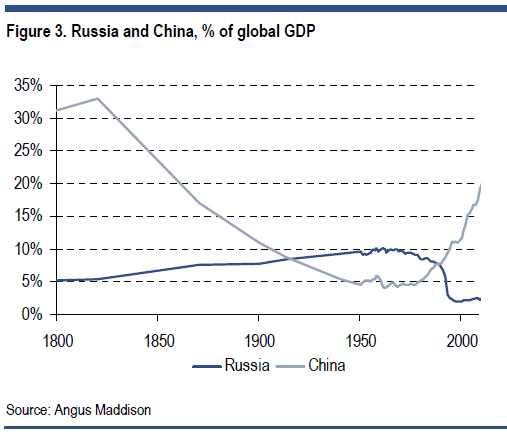
Russia-and-China-percentage-of-global-GDP

A new report argues that Russia isn't much of a threat:

Even after a decade long boom in commodity prices, Russia is still only 2.5% of global GDP using the Angus Maddison data or 3% using the IMF data. As the population is at best flat and GDP per capita is no longer rising at much faster than the global average, Russia will likely struggle to increase much from this level. And without a larger share of GDP, Russia is unlikely to present an imperialist threat.

Degrees Are Not All Created Equal

Razib Khan wants public universities to focus more on science, technology, engineering and mathematics (STEM) education. His case against majors such as anthropology:

Those without social capital derived from family connections need to accrue specialized technical skills to compensate for their deficit. Upper class and upper middle class individuals with an entree into white collar jobs by virtue of their class status can afford to focus on becoming more polished. Everyone should not be given the same advice, because not everyone starts from the same life circumstances.

Mobile Medicine

How cell phones are improving healthcare:

Armed with a $5000 grant, a backpack full of old phones, and a laptop running a GSM modem and the open-source group-texting software called FrontlineSMS, Nesbit started working with the hospital and community health workers [in rural Malawi] to coordinate patient care. The system they put in place allowed Mtanga and others to text in the information on those medical charts rather than making the hours-long trek. Patients could text their symptoms to doctors, cutting down on unnecessary visits for minor ailments and freeing up space for those in need of serious care. Within six months of the system going live, the number of patients being treated for tuberculosis doubled, more than 1200 hours in travel time were eliminated, and emergency services became available in the area for the first time. The operating costs in those six months: $500, Nesbit says.

7 Billion Not Enough For You?

Toby Ord welcomes population growth:

[A]lmost all of the press focuses on the downsides of population growth but neglects the upsides. These upsides may even outweigh the downsides, making a larger population a good thing overall. One example is the rapidly growing information economy. If someone makes a hammer, only a few people get the benefit, but if someone records a new song, writes a computer program, or invents a new technology, everyone can benefit. These activities thus produce more value the more people we have. With twice as many people doing jobs like these, we could all get roughly twice the benefits (more art, culture, science, technology), or they could work roughly half as many hours. A larger population thus has the potential to make life much better, so long as we can find the resources to support it.

Previous thoughts on overpopulation here.

The View From Your Window Contest, Ctd

We have another winner to add to yesterday's results.  For some inexplicable reason, this winning entry was marked as spam when it was sent to us on Sunday and only a subsequent email last night alerted us to the mishap. Our reader (who should have been the sole winner, given his precision) writes:

After the "which window was which issue" in Edinburgh, and with last week’s view being too non-descript for me, I was so looking forward to this week’s VFYW contest. What a great way to laze away a Sunday morning.  So, let’s see if this works:

The photo had all the look and feel of an urban street in North Africa or, perhaps, the Middle East, and given the low number of entries last week, I thought you might go for something topical.  That’s what lead me immediately to Image002Libya.  Figuring I’d go to Tripoli last, I first tried Sirte (which looked promising, but not quite right), then Misrata (whose streets didn’t appear to have any of the parallel parking lots set off the road by concrete as depicted in the VFYW), and then, finally, to Benghazi.  Perfect!

Here’s the building: The Alnoran Hotel (also spelled al Noran, Al Nooran, Alnouran, and the Nouran), on Al Jazayer (Algeria) Street, in Benghazi, Libya. And, given the size of the view and the angle, the window (which appears to be in the hallway/stairwell).

I think you’re likely going back to 300-400 entries this week.  So, good luck.

What Cain Has Going For Him

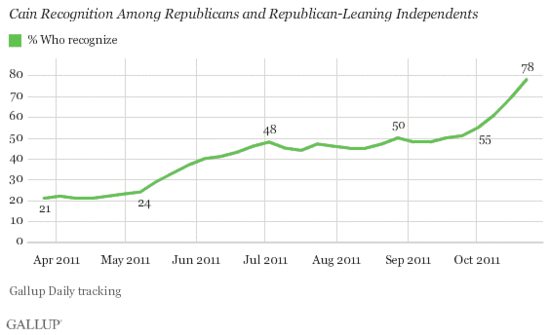
Know_Cain

GOP voters like him best:

Cain is in the enviable position of having the highest percentage of overall favorable opinions among Republicans and the lowest percentage of overall unfavorable opinions. Almost three-quarters have a broadly favorable view of Cain, and 16% have an unfavorable view. Romney, Gingrich, Santorum, and Perry are viewed unfavorably by 24% to 29% of Republicans who recognize them. Bachmann, Paul, and Huntsman are all viewed unfavorably by more than a third of Republicans who know them.

Winning The War On Malaria

By creating sterile mosquitoes:

Current technologies we use against mosquitoes simply are not adequate: existing measures are losing the war. None are easy and even fewer are affordable for vulnerable individuals and governments charged with mosquito control. They do not fully protect, and their use entails direct risks to human health and the environment. So the choice of implementing [genetically modified] mosquitoes is not a choice of no risk versus risk, it is a matter of choosing the least risky among all existing choices in a war against very real continuing disease risk.

Others are less sanguine. Awhile back Rory Lynott tallied some of the ridiculous things scientists are trying in order to bring down the mosquito population.

The Daily Wrap

Today on the Dish, Andrew reflected on hell as a temporal, phenomenological reality. He reviewed Obama's big mistake, and elaborated on the Mormon question. Evan Smith senses that we've reached peak-Romney, and we delved into the Bain Capital founder's role in the corporate takeover economy. Perry plunged into birtherism, his new plan isn't exactly a profile in flat tax courage, and the Texas miracle was government-sponsored.

Qaddafi died in an ugly (but ultimately "convenient") lynching, Larison insisted that the war is still a failure, and a Republican congressman called out the GOP on Iraq. Our experience in Iraq shouldn't necessarily inform post-war reconstruction in Libya, Friedersdorf exposed the neocons on Iran, and we sized up Netanyahu's "crazy-quilt" coalition. War leaves material remains, and the Pentagon subsidizes competition for our own defense industry.

Occupy has a history, we followed OWS on Facebook, and Ken Makovsky predicted that the movement would escalate. It's virtually impossible to put yourself through college (debt-free), the debate over border security serves as a deliberate distraction, and scientists are having a hard time tracking down a control group that hasn't used cell phones. The star-spangled banner isn't about swagger, small businesses are relatively unproductive, and Erica Grieder championed boring efficiency measures. Musicians are still getting screwed over, religious beards express masculinity, and parents are only slightly more likely to oppose marijuana legalization than non-parents. We discussed the ethics of sweatshops, America's young demographics represent a critical advantage, and human beings can't sit still. Sam Harris probed questions surrounding science and consciousness, the GOP lost Pat Robertson, and a father read a virtual bedtime story. 

Hathos RED ALERT here (related quote for the day here), FOTD here, MHB here, VFYW here, and VFYW contest winner #73 here

M.A.

The Occupation Will Grow?

4bacd5a1-b815-405a-b973-b227a7139331

Ken Makovsky thinks so:

Regardless of the reasons, business and government are making a mistake not responding, just because of the growing size of the group and the media attention they are getting.   In the same way that people were individually affected by the military draft during the Vietnam War protests, today’s taxpayers have been individually affected by the bank bailouts and the mortgage crisis.  The Vietnam War protests grew exponentially, bringing significant social changes and, if nothing else, ended the draft and brought down a president.  The current protests will pick up speed the longer there is no response.

On the other hand, Dan Drezner reads an n+1 dispatch as evidence that the movement isn't likely to expand its base.

(Photo via TDW)

Real Border Enforcement

Frum says it requires cracking down on the employers of illegal immigrants:

Today’s debate over a fence on the Mexican border is a distraction, and I’d suggest: a deliberate distraction. Any fence will be tangled in litigation: it took 11 years of lawyering to build just 14 miles of fence between San Diego and Tijuana. Enforcement must take place in the workplace – and that is precisely where the most powerful lobbies in US society wish to prevent it from occurring. I think it is powerfully symbolic that the most strident voice demanding a fence, lethally electrified no less, is that of Republican candidate for president Herman Cain – a past chief lobbyist for the National Restaurant Association, one of the most powerful of the anti-enforcement lobbies in Washington.

Friedersdorf seconds.