Faces Of The Day

130247464

A Thai woman holds her dog waiting for transport along the newly flooded streets near the Chao Phraya river in Bangkok on October 25, 2011. Hundreds of factories closed in the central Thai province of Ayutthaya and Nonthaburi as the flood waters began to reach Bangkok. Around 350 people have died in flood-related incidents since late July according to the Department of Disaster Prevention and Mitigation, with Thailand experiencing the worst flooding in 50 years. By Paula Bronstein/Getty Images.

The Old Cell Phone/Cancer Debate

A new study shows no link between the two. But it's likely the issue will never be resolved completely:

Brain tumors are extremely rare and strike for mostly unknown reasons, and they can take decades to develop. Cell phones have only been used heavily for the past decade or so, which means that enough time may not have yet passed for the potential impacts of cell phone use to show up in brain cancer statistics. At the same time, cell phones have become virtually ubiquitous. There are more than 5 billion cell phone subscriptions in the world, which means it's becoming nearly impossible for scientists to find a control group that hasn't used mobile phones.

Domestic Weapons Of Mass Destruction

Buildings

Eyal Weizman unearths a new realm of study:

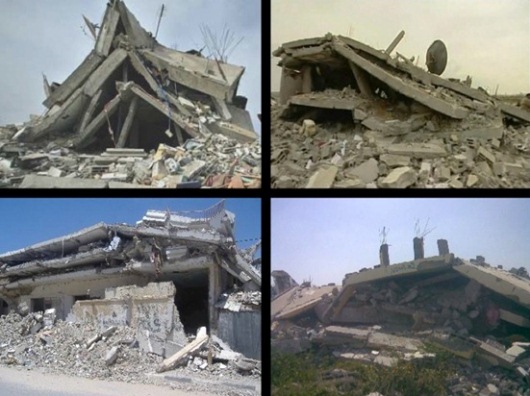
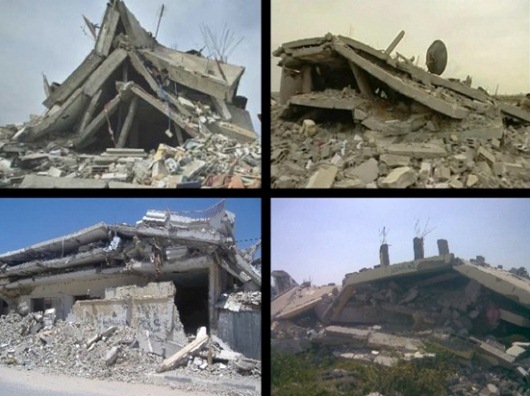
The Gaza War killed almost 1,400 people and destroyed or damaged about 10,000 buildings. A lot of the people who died, died in or because of the destruction of buildings, lacerations from flying debris, or people crushed by their own homes. The city is not only the site of the violence, it is also the means of the killing. Most people died in their own homes. And after the attack ended, and this conflict moved into the legal domain, it was the rubble itself which stood as a testimony of what had happened. …

Whereas a lot of previous analysis of conflicts has been more skewed towards human interviews and testimonies of victims and others, here you see a massive shift towards the "speech of things". In the Goldstone Report this is very much the case, and you are told that it is the case because, "things do not lie". There are 188 testimonies by Gazans in that report. But if you look, you will see that these are only there to corroborate what is leading the research: the material forensics evidence.

Misha Lepetic digs deeper.

Quotes For The Day

"Group selection brings about virtue, and — this is an oversimplification, but— individual selection, which is competing with it, creates sin. That, in a nutshell, is an explanation of the human condition. Our quarrelsomeness, our intense concentration on groups and on rivalries, down to the last junior-soccer-league game, the whole thing falls into place, in my opinion. Theories of kin selection didn’t do the job at all, but now I think we are close to making sense out of what human beings do and why they can’t settle down," – E.O. Wilson.

"All humanity's troubles come from not knowing how to sit still in one room," – Blaise Pascal.

Libya Through Iraq-Tinted Glasses

GT_IRAQ_111024

Dov Zakheim critiques L. Paul Bremer's attempt to give advice to Libya based on his Iraq "experience":

Leave aside Bremer's controversial decisions to disband the Iraqi Army and to maximize the extent of de-Ba'athification, neither of which he mentions, and both of which many analysts (myself included) consider to have been major blunders that led to the sectarian violence that plagued the country for the ensuing four years. Bremer asserts that it was only with the trial and death of Saddam that Iraqis stopped fearing a return of the old regime. But he does not mention that it was not until the surge of forces into Iraq, which was not completed until the middle of the following year, that Iraq began to return to a semblance of stability.

Evidently even with Saddam gone, the population did not believe that political change was "lasting." The violence continued until the influx of American troops, coupled with the Sunni Awakening, seemed to promise that political change was not a pipe dream. And, for all we know, the violence may return once American troops depart in a few months' time.

Doug Saunders thinks Libya is too unique to make cross-national comparisons all that useful.

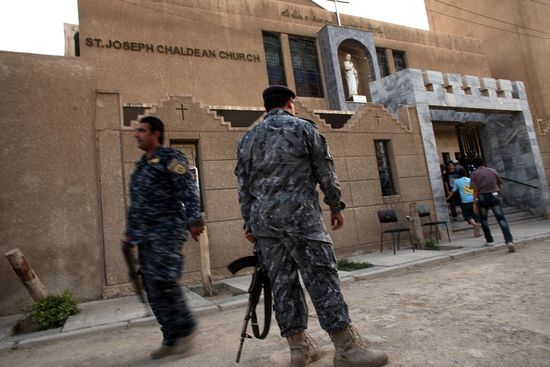
(Photo: An Iraqi police officers stands guard outside of St. Joseph Chaldean Church following a Sunday service on July 24, 2011 in Baghdad, Iraq. Forming one of the oldest Christian communities of the Middle East, Iraqi Christians have been targeted for attack since 2003, with numerous abductions, murders and threats for them to leave Iraq. Christians across the Middle East have been experiencing similar threats to their communities and businesses as the Arab Spring unleashes pent-up hostilities and economic uncertainty. By Spencer Platt/Getty Images.)

A “Bizarre Formula” Ctd

A reader writes:

Supporting Israel's defense infrastructure has also has the bizarre unintended consequence of funding competition for our own defense industry. As you know, the DoD funds (via grants and contracted employment) a large number of small start-up companies in the US who focus primarily on security-related technology (i.e. encryption, computer networking, communications, etc.). If these companies are successful, they then transition their products/applications for sale to private enterprises and general consumers. These innovative small companies become the "job creators" the GOP likes to celebrate so much.

Of course, Israel also funds small Israeli companies in similar defense-related industries. But note they they can do this to a higher degree as they are being supported by an outside entity – the US government.

These small software and technology companies, if successful, then go on to compete in the open markets with similarly situated US companies. In the past, their products tended to be less expensive because they are more subsidized by their government and have greater access to a cheaper labor force. In a DoD-funded company I worked for, we competed with an Israeli company for a number of years. Since they could under-cut our prices, it was a struggle. Eventually they bought us out, took our patent portfolio, and eliminated the US operation.

Buyouts happen all over corporate America, of course. However, in this case, the US government (read: taxpayers) helped fund two companies which competed with one another. Investment sunk in to the American company was essentially lost when its technology was purchased by the Israeli company. Jobs created by US government funding, direct and indirect, will now go to Israel. Additionally, any further US government purchases of products/technology developed by my previous company will now go to the Israeli company.

I don't mind competing in a free market, but the playing field here seems a bit tilted. (And I can't express how frustrating it is to be labeled "anti-Israel" when I mention the above example. Substitute any other country in the above account and I would still think we are getting a raw deal.) As a side note, the principal owner of our company did very well as a result of selling the company. He is now a member of the 1%. The rest of us are among the glut of engineers and technical staff that are still looking for work.

Virtual Dad

An airman pre-recorded a message for his daughter:

Some details from the mother:

[O]ur kitten knocked something off the shelf in the living room and it made a noise. She was trying to get daddy's attention to tell him "silly kitty."

Sam Biddle reflects on the footage:

Unlike a video chat or message between two people with developed brains, I doubt a two year old can really comprehend what’s going on. Does she think he’s really there? Does she think he’s inside the screen? She repeatedly tries to talk to him, though of course hugs him like he’s a computer, not like a human. It’s a strange mix of childhood adorableness, developmental psychology, and tech. 

Romney The Revolutionary?

Benjamin Wallace-Wells credits Mitt with a great deal of business innovation:

Our economy went through a remarkable shift during the eighties as Wall Street reclaimed control of American business and sought to remake it in its own image. Romney developed one of the tools that made this possible, pioneering the use of takeovers to change the way a business functioned, remaking it in the name of efficiency. "Whatever you think of his politics, you have to give him credit," says Steven Kaplan, a professor of finance and entrepreneurship at the University of Chicago. "He came up with a model that was very successful and very innovative and that now everybody uses." The protests going on at Zuccotti Park now have raised the question of whether that transition was worth it.

Will Wilkinson is skeptical. Update from a reader with experience in the takeover sector:

As an attorney who practiced with the leading New York takeover law firm in the '80s, I can assure you that the idea that Romney was a seminal player in the takeover world is pure nonsense.  He was at best a bit player in the takeover game, utilizing strategies developed by other bigger players and their law firms.  Most of the companies he was involved with ended up bankrupt or otherwise weakened.  Yes, he made money taking huge fees from the companies, and firing lots of middle-class workers in the process - that's all part of the Wall Street game – but he didn't remake the takeover world.