The Libyan War Was A Failure?

That's Larison's belief:

When dictatorships are violently overthrown, their successor regimes tend to devolve into some form of authoritarian government. Political culture, weak institutions, and post-conflict disorder all make it unlikely that Libya will be that much freer in the years to come than it was under Gadhafi. As in Iraq, it is questionable whether the possible gains will be worth the real losses that have already been and will continue to be suffered. As in Kosovo, which is often wrongly held up as a model of "successful" intervention, the post-war regime is liable to be criminal and corrupt. Twenty years ago, the liberation of Eritrea and Ethiopia from the brutal dictatorship of Mengistu was an inspiring story that very soon degenerated into authoritarianism and war. There is no reason to think that Libya's story will be all that different.

Well, we'll see, won't we? I fear Daniel is right but hope he's wrong.

How Bibi Stays In Power

GT_COALITION_111025

Hussein Ibish gives a primer on Israeli coalition politics and their consequences:

Coalition building in parliamentary democracies frequently involves jockeying for positions between party leaders based on the number of votes they can produce in the legislature. But Netanyahu has managed to create an ideologically crazy-quilt coalition that is nonetheless one of the most stable in Israel's history precisely because all of its members get exactly what they need … Well-managed quota systems make for very good politics, particularly when the goal is staying in power by making sure everybody has a “taste.” But it makes bold decision-making almost impossible. Netanyahu, even if he were inclined to make concessions on peace, is a self-condemned hostage to this structure.

Sari Bashi thinks the Shalit deal gives Netanyahu some room for a concession on the Gaza blockade:

Shalit's release provides Israel the opportunity to allow rational self-interest — and respect for individual rights — to guide its policy toward the million and a half Palestinians living in Gaza and to allow them to travel and transfer goods, subject to individual security screenings. Whether Netanyahu presents the policy as an extension of his promise of "economic peace" to Gaza or a continuation of the easing of the closure that began last year, he would benefit from ample political cover. The people of Gaza deserve a chance to access the resources they need to build a healthy, prosperous society, integrated with the West Bank and able to live in peace next to Israel.

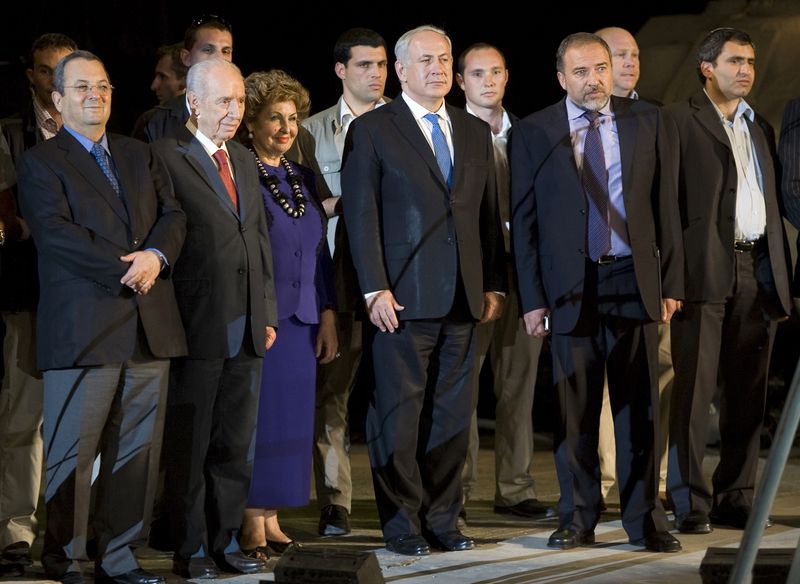
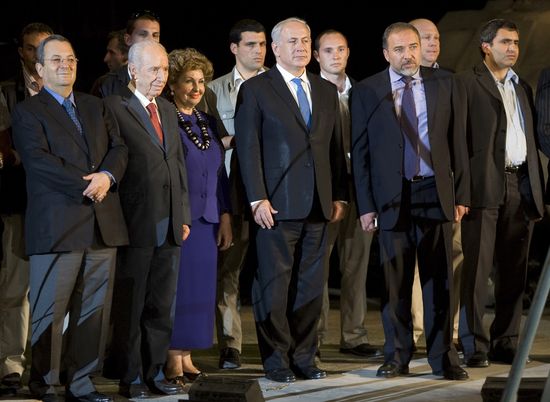
(Photo: Israeli Defence Minister Ehud Barak, President Shimon Peres, Immigrant Absorption Minister Sofa Landver, Prime Minister Benjamin Netanyahu and Foreign Minister Avigdor Liberman attend a ceremony that honored World War II veterans. By Jonathan Nackstrand-Pool/Getty Images.)

In Support Of Terrible Working Conditions

Matt Zwolinski's and Benjamin Powell's new paper defends sweatshops. Zwolinski explains his position:

I support sweatshops because I believe that they are good for the poor, not because I believe that interfering with them violates the non-aggression principle, or a natural right to freedom of contract, or whatever.  If you could convince me otherwise – if you could convince me that the policies I advocate set back the autonomy and welfare of the poor rather than advance them – then I would change my mind.

Must The National Anthem Be Triumphant?

A solemn Zooey Deschanel sang the national anthem at the World Series on Sunday night. Colbert bait! Natasha Vargas-Cooper and Jay Caspian Kang wonder if it was "the least inspired national anthem ever":

What did baseball and America do to deserve this? Jesus Christ, what if this sort of pallid spectacle has come to represent our cultural arrested development? I’m not ready for this sexless sort of knock-kneed kiddie bullshit. I thought Fox would be our beachhead in unapologetic American bravado! The national anthem should be sung by someone with swagger, drama, a full-boom voice that stirs even the most numbed-out bro to take off his damn backwards hat.

Jason Heid, who attended the game, was moved by Deschanel's somber interpretation: 

[I] loved the sense of melancholy with which Deschanel infused the familiar song. It felt almost like a funeral dirge … No, Deschanel didn’t deliver a triumphant version of the song, like this fantastic Whitney Houston performance [below]. But what she gave us was unique and perfectly appropriate to lyrics that were, after all, written during an uncertain time of war.

“Are Mormons Christians?”

Goldblog says no:

Mormons themselves contend that “Christ is at the center of our worship, study, service and faith,” as a statement released by the church after Jeffress’s comment put it. But theological honesty demands that we recognize that Romney would be the first president to be so far outside the Christian denominational mainstream. There is much in Mormonism that stands in opposition to Christian doctrine, including the belief that the Book of Mormon completes the Christian Bible. Christianity had an established creed about 1,500 years before Joseph Smith appeared in upstate New York with a new truth, codified in the Book of Mormon, which he said was revealed to him by an angel named Moroni.

Then there's the small matter of the Trinity. An interesting question would be what other modern off-shoots of Christianity are there that are this different theologically and yet still recognizably Christian.  Jehovah's Witnesses? Not much else comes to mind. I wrote my pay-walled column on this last week. Among the points:

The idea that Jesus dropped by Missouri after his Resurrection, or that until the 1970s, Africans and African-Americans were regarded as an inferior race by doctrine, or that Jesus' Second Coming will likely happen – again! – in Missouri as well: these seem to fade in salience only in front of living, breathing Mormons, whose transparent niceness, cheeriness, good values, strong families and work ethic make you forget all the loopiness. And aren't all religions a little odd, anyway? No one asks a Catholic politician if he believes that the Virgin Mary was literally whooshed up into the skies rather than die – and yet that is held to be an infallible doctrine. Is it stranger to believe in the Holy Trinity or that the three parts of God are actually separate gods? At times it seems as if the Church of Latter Day Saints suffers mainly because it is a new religion – Scientology plus a century or so.

I have zero concerns about a Mormon president. In fact, as a demonstration of this country's religious freedom, I take it as an added value to a Romney presidency, just as Obama's race is to his. But Romney's problem is that his party has ruled out any clear distinction between religion and politics, and insists on a public religiosity that all but begs that these theological issues be front and center. He cannot pull a Kennedy, as Huntsman did eloquently on Colbert last night, and hope to win. There's a reason Perry is still ramping up his campaign.

Previous Dish on this topic from Romney's last campaign here and here.
Occupy The Social Networks

Occupy_Web

A study on OWS Facebook postings:

[As of October 17th a] total of 911,822 posts or comments had been contributed to occupy related Facebook pages. Daily Occupy activity on Facebook peaked on October 11th with 64,410 posts. On the day when 129 people associated with Occupy Boston were arrested, 20,912 people contributed to 64,410 posts or comments on 352 Occupy related pages.

About That Texas Miracle … Ctd

Mitchell Schnurman shows how government spending and public borrowing stimulated Rick Perry's economy: 

The state’s jobs growth … owes much to government spending and its fiscal sibling, public borrowing. Cities and school districts have been the big drivers, and that’s simpatico with the Texas ethos of a weak, decentralized government. But don’t discount the feds, whose defense buildup alone has tripled the billions of dollars in contracts flowing to the state. How many realize that Texas has a greater share of government workers than the rest of America? Or that under Perry, state debt grew faster than national debt? And that Texas was willing to spend and borrow for unemployment benefits—not once, but twice, under Perry’s watch? 

Zeke Miller has more on Perry's derelict oversight of a publicly-funded loan program in the 1990s. Previous coverage of the Texas "non-miracle" here, herehere, and here

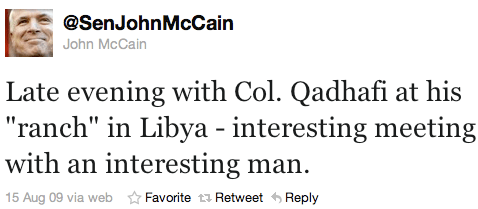
Qaddafi’s Death Was Convenient

Picture_8

For the West:

Qaddafi was, quite simply, a man who knew too much. Taken alive, he would have almost certainly have been handed over to the International Criminal Court (ICC), which had indicted him — along with his son, Saif al-Islam, and brother-in-law and military intelligence chief Abdullah Senussi (whereabouts unknown) — for crimes against humanity in late June. Imagine the stir he would have made in The Hague. There, along with any number of fantasies and false accusations, he would almost certainly have revealed the extent of his intimate relations with French President Nicolas Sarkozy and British Prime Minister Tony Blair, the details of his government's collaboration with Western intelligence services in counterterrorism, with the European Union in limiting migration from Libyan shores, and in the granting of major contracts to big Western oil and construction firms.

Barbara Walter thinks the ICC also might explain why Qaddafi didn't accept exile.

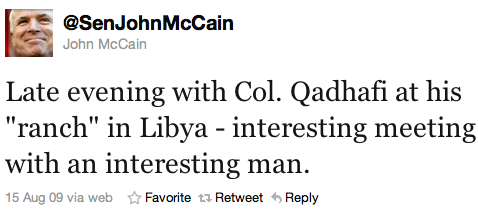
(Screenshot by Justin Elliott.)

The Demographic Dividend

Labor force growth

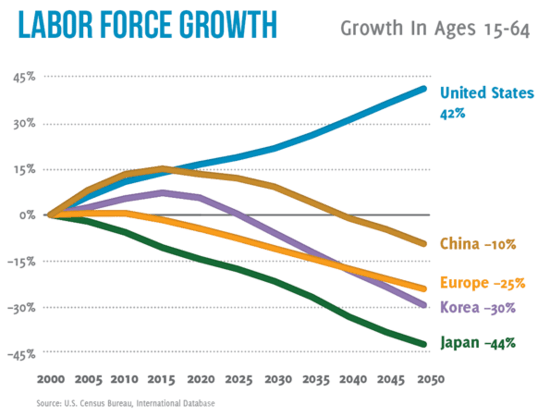
Joel Kotkin sees an opportunity: 

Within the next four decades, most of the developed countries in East Asia, as well as Europe, will become veritable old-age homes: A third or more of their populations will be over 65. … In comparison, the percentage of the population over 65 will be only one in five in the United States. The reasons for this divergence with other advanced countries likely includes such things as continuing immigration, greater space, larger houses, a strong aspirational culture and a higher degree of religious affiliation.

Whatever the cause, a younger demography could lead to a relatively brighter future for America than is now commonly assumed. In the near future, the U.S. could reap a potential critical advantage from a particularly large baby ‘boomlet’ among the Millennial generation, the children of the boomers. This next surge in population may be delayed if tough economic times continue, but over time it will translate into a growing workforce, sustained consumer spending and produce a youthful population likely to push innovation.