The "Awwcupy Wall Street" tumblr is, indeed, Aww inducing:
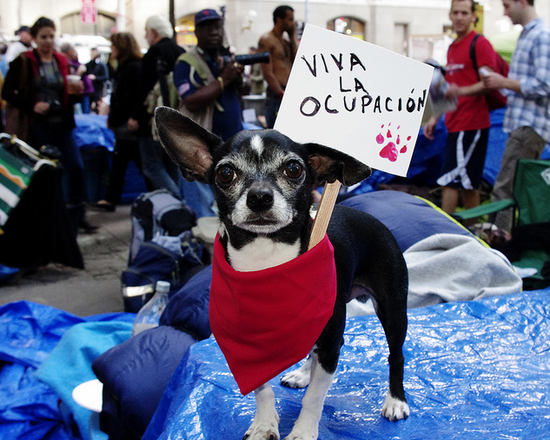
But the conservative answer is ready! From "Mewwvement Conservatives":
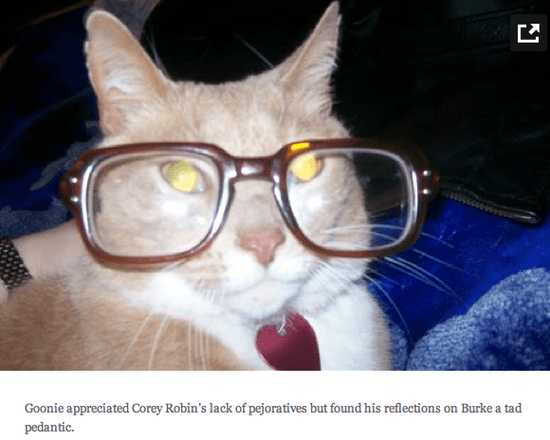
The "Awwcupy Wall Street" tumblr is, indeed, Aww inducing:
But the conservative answer is ready! From "Mewwvement Conservatives":
Dan Zak profiles an Iraqi translator waiting on a visa:
Working checkpoints and security patrols with U.S. forces, he faced both rocket attacks and suspicious neighbors. He became close friends with American soldiers. He received certificates of appreciation and letters of commendation from U.S. officers, who praised him as “dependable” and “fearless.” In June of last year, fed up with the poor water and electrical services of the Iraqi government, he applied for a visa and relocation through the U.S. office of the International Organization for Migration. Two months ago he received a letter saying that he was on the waiting list for a first interview.
“You do a good job for someone and what do you expect?” he said. “You expect them to do a good job for you. I feel frustrated because I worked for them for four years and there are many guys who worked with them for six months and are right now in the United States. No, there is no justice about this.”
Reihan brings the conversation about the 99% back to the basics:
While 15.1 percent of people living in the U.S. are in poverty, the poverty rate for families is 13.2 percent. That is much lower than the poverty rate for single people living alone or with roommates, which stands at 22.9 percent. A big part of the evolving poverty picture is that people are staying single longer than they did in years past. … Married-couple households have a poverty rate of 6.2 percent. Female-headed single-parent households, in contrast, have a poverty rate of 31.6 percent, while the far smaller number of male-headed single-parent households have a poverty rate of 15.8 percent.
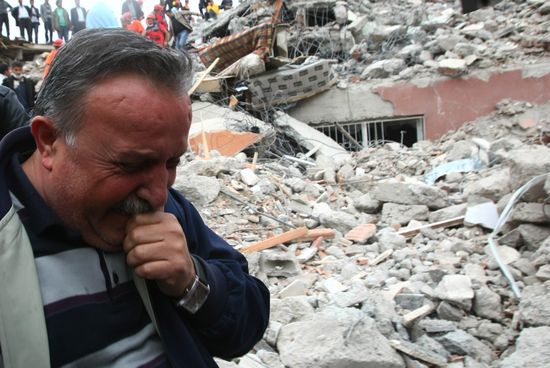
A victim's relative cries as rescue workers take part in an operation to salvage people from a collapsed building following an earthquake in the province of Van, eastern Turkey, on October 24, 2011. Rescuers scrambled through the rubble in a desperate search for survivors of an earthquake that killed at least 272 people in Turkey. By Adem Altan/AFP/Getty Images)
A reader writes:
The photo that you had up of the little penguins wearing protective sweaters was wonderful. I just read about a similar man-made project for hermit crabs. There's a shell shortage and they're getting desperate:
Hermit crabs don’t make their own shells. They scavenge their homes. And now, hermit crabs are facing a housing shortage as the worldwide shell supply is decreasing. With a shell shortage, hermit crabs around the world are being forced to stick their butts into bottles, shotgun shells, and anything else they can find. This is not acceptable. As a community, we can reach out to this vulnerable species and offer our digital design skills and 3D printing capabilities and give hermit crabs another option: 3D printed shells.
Tim Carney advances it:
These banks' credit is rated higher than they would be in a free market, meaning they profit from the expectation of a bailout, if necessary. So banks profit largely through activities that do not create value or efficiencies. They profit through financial games that rest on government favors. Many Occupy Wall Street protestors demonize all profit. Conservatives defend profit-seeking as the engine that creates prosperity for all of society. But the big banks have rigged the game so that they profit without creating value. In fact, they profit from activities that weaken the economy by creating instability.
The power and beauty of water:
Well-connected GOP operatives in New Hampshire, Florida and South Carolina say they see little or no evidence of Cain’s campaign in those key early primary states, and some are even unable to name who is leading his localized efforts just a little more than two months before voters are expected to cast the first ballots.
Freddie DeBoer isn't celebrating Qaddafi's death:
Here is what I know more than anything else: no one who cares for Libyans themselves could see this turn of events as an ending, a conclusion, or a victory. The future is Libya could not be more unsettled, more dangerous, more precarious. What happens next is what is important, in the next month, the next six, the next year, the next five. Will a new flowering of democracy and freedom take hold? Will a new reigning military junta take hold, as appears to have happened in Egypt? Will a newly repressive Islamist state develop? Nobody knows. Nobody will know, for a long time. Those declaring victory today are doing it because they have achieved what they wanted, which is a justification for limitless American military aggression, and support for Barack Obama, one of the most unapologetic militarists in American political history.
Oh, please. "Limitless" American military aggression is the lesson of the Libya war? Obama is an "unapologetic militarist"? Chill. But yes, as we noted earlier today, there are some truly worrying straws in the wind right now, as Brian Ulrich explains:
I do not regret the fall of Qadhafi, but the road ahead remains difficult, far more difficult than in Tunisia or Egypt. Libya is divided and without strong institutions that can manage the transition. If under Qadhafi the west was favored, the TNC is drawn mainly from the east, and the patronage connections are sure to bring about an uncomfortable reallocation of national resources in that direction. Right now there is celebration and giddy proclamations about the future, but for Libya's sake, national reconciliation needs to be around the corner.
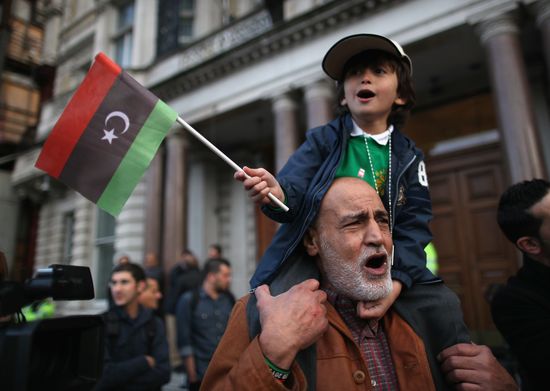
(Photo: Libyans celebrate outside the Libyan embassy in Knightsbridge on October 20, 2011 in London, England. News emerged today that the former Libyan leader Col Muammar Gaddafi was killed after an assault on his home town of Sirte in Libya. By Dan Kitwood/Getty Images)
Evgeny Morozov and Jeff Jarvis have been duking it out over Jarvis's new book on Internet culture. Megan Garber gleans a larger lesson:
The precise thing that makes idea-driven books so valuable to readers — their immersive qualities, the intimate, one-on-one relationship they facilitate between authors and readers — also make them pretty lousy as actual sharers of ideas. Books don’t go viral. The precise thing that makes them lucrative to authors and publishers — their ability to contain ideas, to wall them off from the non-book-buying world — limits their ability to act as vessels of virality. How can books be expected to share ideas when the very point of their existence is containment?
She uses the author as celebrity and technology as book tour to examine the options. Jarvis responded:
Start with Kevin Kelly’s 2006 essay in The New York Times Magazine arguing that authors would come to support themselves with performance — and John Updike’s appalled reaction to this “pretty grisly scenario.” I’m not suggesting that authors become merely actors after their books are done. I’m suggesting, as Garber does, that talks, events, symposia, blogs, hangouts… — discussion with smart people in any form — should come before the book. The process becomes the product; the book (if there is one) is a byproduct.
That is how I came to write Virtually Normal. It began as a two-page essay, then, after dozens of talks at colleges, it became an 8,000 word piece, then, after more discussion and back and forth, it became a book. And then the book became the basis for a national education campaign on same-sex marriage, which I then built on with an anthology. Ditto The Conservative Soul, which was nourished by countless threads and arguments on this blog. And my prep for a forthcoming book on Christianity is being partly informed by some of the debates we have had on this blog.
I think of a book as that moment in a conversation, when we stop, regroup and lay out an argument in a single sitting. It puts down a marker. And it's viral across generations, whereas blog posts are designed to evaporate into the intellectual ether.
 The Dish