Can The Economy Be Fixed?

In reviewing two new books on the 2008 collapse, Brian Collins has his doubts:

[T]he 2008 financial crisis was the result of two more or less mutually reinforcing conditions: First, a major reorganization of the global economic order in the late twentieth century; and, second, the inherent limits of what economics can say about the outcome of such shifts. The great insight here is that, along with whatever reckless self-interest was at work, the crisis occurred and persists because an alternative was and is mostly unthinkable.

The author of one of those books, Yanis Varoufakis, has a new TED talk on the European economy. 

Our Capacity To Know

2667984_f42e1dae88_o

David Eagleman reminds us of our limits:

Our brains have evolved to deal with issues at our own scales: mates, rivers, apples, rabbits, and so on. Our brains simply weren't built to understand the fabric of reality at the very small scales (quantum mechanics) or the very large (the cosmos). As Blaise Pascal put it, "Man is equally incapable of seeing the nothingness from which he emerges and the infinity in which he is engulfed."

(Photo by Zach Klein)

Preference Shouldn’t Be Legislated

Michael De Dora watches Ken Burns's Prohibition and differentiates between morality and preference:

Alcohol consumption is not intrinsically a moral issue. It is an issue of preference, which is not a valid domain of law. Alcohol consumption only becomes a moral, and thus a legal, issue when it is abused and causes harm to others and/or society. When it does, we have laws to handle those situations. For instance, drunk driving is illegal and punishable. The difference between these two factors must always be kept in mind, because legislating preference is unethical and should be illegal, while legislating morality is what we ought to do.

One Way To Get Transparency In The Church

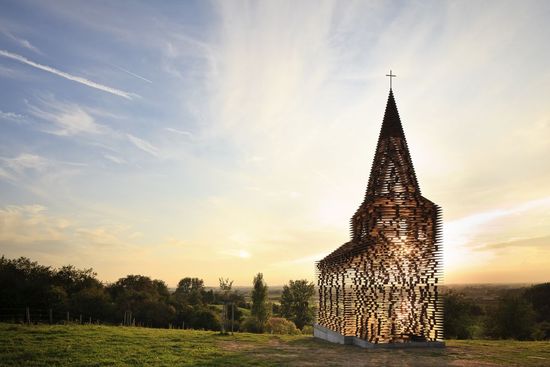
See-through church

A stunning piece of "see-through" architecture in Belgium: 

The church is 10 meters high and is made of 100 layers and 2000 columns of steel. Depending on the perspective of the viewer, the church is either perceived as a massive building or seems to dissolve – partly or entirely – in the landscape. On the other hand, looking at the landscape from within the church, the surrounding countryside is redefined by abstract lines. The design of the church is based on the architecture of the multitude of churches in the region, but through the use of horizontal plates, the concept of the traditional church is transformed into a transparent object of art.

(Photo by Kristof Vrancken)

Pick A Date, Any Date

Patrick Dillon weighs history's offerings to choose the best time and place to be alive:

Anyone who dislikes pain, prefers their operations under anaesthetic, and has no wish to die of smallpox, might well choose to live now. We can balance that by awarding ourselves perpetual good health, but it’s harder to level the playing field when it comes to gender. Not many modern women, however frustrated with their lot, would choose to go back to long skirts, tight corsets and a general assumption that they are stupid. The same may apply to any European who isn’t white, and to anyone in the less affluent three-quarters of society. My children once went on a school trip to Apsley House, the Duke of Wellington’s home. I thought they were going to learn about lords; instead they were taught what it was like being a servant. Transport most of us to ancient Rome and we’ll find ourselves in a poorhouse or slave barracks. To give our question a chance, we have to assume that we can do our time travel, if not first-class, then in premium economy, switching genders if we feel like it, to land somewhere moderately comfortable.

Faces Of The Day

GT_MONKS_111019

Sangey, 6, and Tenzin, 7, rest after hours of prayer at the Dechen Phodrang monastery October 18, 2011 in Thimphu, Bhutan. About 375 monks reside at the government-run monastery that also doubles as a childcare facility for under-privileged and orphaned males. The monks average about 10 hours of study a day waking up at 5:00 am.  By Paula Bronstein/Getty Images.

Facts vs Feelings

We won't be able to solve the healthcare crisis until we address the tension between the two:

Comparing costs and benefits may be rational, but human risk perception is not. The way we judge danger, and figure out how to keep ourselves safe and alive, is not a purely fact-based, coldly objective process of cognitive analytical reason. It is a subconscious, instinctive, emotional process, the principal objective of which is not to serve some greater common good, but to keep each of us alive. The ‘thinking’ part of our brain may accept that the system can’t afford everything for everybody, but the thinking part of our brain is only one part, and not the most influential part, of the way we figure out threats to our health and safety. Ultimately risk perception is a mix of the facts and how those facts feel, and the brain puts more emphasis on the feelings than the facts.

Why Wouldn’t Poor People Want Redistribution?

Support for "spreading the wealth" has plummeted during the recession. One reason why:

[P]eople exhibit a fundamental loathing for being near or in last place – what we call "last place aversion." This fear can lead people near the bottom of the income distribution to oppose redistribution because it might allow people at the very bottom to catch up with them or even leapfrog past them.

The Pace Of Progress

Over a decade ago, Ray Kurzweil argued that Singularity – the melding of mind with machine – was just around the corner. He also coined the "Law of Accelerating Returns":

So we won't experience 100 years of progress in the 21st century—it will be more like 20,000 years of progress (at today's rate). The "returns," such as chip speed and cost-effectiveness, also increase exponentially. There's even exponential growth in the rate of exponential growth. 

Paul Allen and Mark Greaves counter with their idea of the "complexity brake":

The closer we look at the brain, the greater the degree of neural variation we find. Understanding the neural structure of the human brain is getting harder as we learn more. Put another way, the more we learn, the more we realize there is to know, and the more we have to go back and revise our earlier understandings. We believe that one day this steady increase in complexity will end—the brain is, after all, a finite set of neurons and operates according to physical principles. But for the foreseeable future, it is the complexity brake and arrival of powerful new theories, rather than the Law of Accelerating Returns, that will govern the pace of scientific progress required to achieve the singularity.