Selling Marriage

Stacia L. Brown thinks deeply about how matrimony is depicted in ads:

[L]ike most unmarried people, there’s a part of me that will always romanticize marriage. If I marry, I will have some minor, irrational expectation that roughly 75% of my marital experience will evoke the emotions these commercials capture. Ideally, I want to be with someone who makes me feel that, regardless of the unforeseen–triumph, tragedy, great gain, profound loss, joy, sickness, treatment, remission–there simply isn’t anyone else with whom I’d rather be.

I haven’t married, in part, because of this. I am expecting something more spectacular than I’ve experienced.

The Origins Of Ritual

They're found in play, says Robert Bellah:

If one believes, as I do, that the earliest form of religion was ritual, one might see how play among humans with cultural capacities might develop into ritual. Ritual has many of the features of play: it has no obvious function, it is an end in itself, it enacts events, but symbolically, as in pretend play, and it takes place in a relaxed field, where hunger, predators and procreation are kept at bay.

Imagining The Multiverse

Bubble_vanvleet_900

Sean Carroll takes the idea of many universes seriously, even if they can't be observed yet:

We find ourselves surrounded by an opaque barrier past which we can’t see—the Big Bang. The distant universe might be uniform, or it might be full of different universes scattered throughout space. The conditions of our local environment might be the unique consequence of fundamental laws of physics, or they might just be one possibility out of a staggering number.

Right now we don’t know, and that’s fine. That’s how science works; the fun questions are the ones we can’t yet answer. The proper scientific approach is to take every reasonable possibility seriously, no matter how heretical it may seem, and to work as hard as we can to match our theoretical speculations to the cold data of our experiments.

(Image: The Bubble Nebula by Larry Van Vleet via NASA's Astronomy Picture of the Day)

What Makes A Choice Free?

Gary Gutting contends that it's not a question of facts but of intentions and meanings:

The fact that I raised my arm can be established by scientific observation—even by the impersonal mechanism of a camera.  But whether I meant to wave in greeting or to threaten an attack is a matter of interpretation that goes beyond what we can scientifically observe.  Similarly, scientific observations can show that a brain event caused a choice.  But whether the choice was free requires knowing the meaning of freedom.  If we know that a free choice must be unpredictable, or uncaused, or caused but not compelled, then an experiment can tell us whether a given choice is free.  But an experiment cannot of itself tell us that a choice is free, anymore than a photograph by itself can record a threat.

The Ups And Downs Of The Bible

2011-10-sentiment

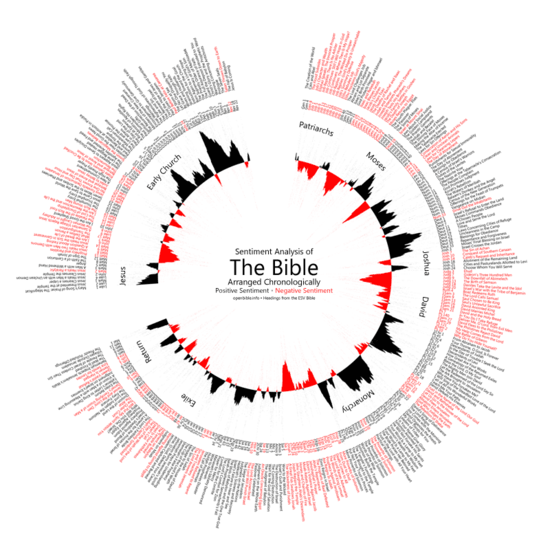
The Good Book was charted using "sentiment analysis," which marks when positive and negative events occurred:

Things start off well with creation, turn negative with Job and the patriarchs, improve again with Moses, dip with the period of the judges, recover with David, and have a mixed record (especially negative when Samaria is around) during the monarchy. … In the New Testament, things start off fine with Jesus, then quickly turn negative as opposition to his message grows. The story of the early church, especially in the epistles, is largely positive.

(Hat tip: Flowing Data)

Unshackled By Science

Marcelo Gessler defends the value of scientific knowledge for non-scientists:

[S]cience is more than a collection of explanations about the natural world: science is a means to freedom, offering people a way to control their destiny, to choose wisely in what to believe. As Galileo insisted at the dawn of modern science, "Think for yourself! Don't take what people tell you at face value. To not bow blindly to dogma!" And mind you, Galileo was a religious man. Being pro-science does not necessarily makes you anti-religion. Paraphrasing Galileo, "if God gave us a mind to understand the world, He surely would be most pleased if we did so."

What Ever Happened To Hell? Ctd

Fewer and fewer Catholics believe in hell. Dreher is disturbed:

[W]e moderns want to say Hell does not exist because it does not fit our therapeutic ideas of what religion should be. But you cannot edit Hell out of Scripture, especially because Jesus spoke of it as real. If He had never done so, and if Scripture was silent on the reality of Hell, that would be one thing. I’m not saying, "Hooray, Hell exists!" by any means. If I happen to arrive in Heaven and discover that Hell doesn’t exist, or that Hell exists but no one but the Devil is in there, I will rejoice. My point is simply that loss of a belief in Hell is indicative of a shift of our way of thinking about religion from prophetic (calling us to turn from our sins) to therapeutic (telling us that we’re okay, no matter what we do).

On the same subject, a reader flags the above video and writes:

It's not just Catholics who are shifting away from a belief in hell. I'm starting to see the shift with evangelicals as well, although they often loathe to admit it. The most prominent example is Rob Bell, pastor of the huge Mars Hill Bible Church in Michigan and author of this book that created a lot of waves.

I watched the reaction to Bell's Love Wins with fascination. A few of the usual suspects dismissed it out of hand. But a number of those usual suspects (i.e., the ones that believe in hell) didn't agree with the book but acknowledged Bell is sparking a worthwhile "conversation" about the issue.

This is a sea change from a decade ago, when pastor Carlton Pearson essentially preached the same thing as Bell and was swiftly denounced. Almost overnight, he turned into a pariah in the evangelical community, and his book revealed (somewhat inadvertently) that he's still somewhat bitter about it.

I think what is happening is that young people, much like in the debate about gay marriage, are no longer accepting the same tired, illogical, and decidedly un-Christian arguments about the existence of hell. Young people are concentrating instead on making the current world a better place instead of fixating on the dreaded existential one.

A Hodgepodge Philosophy

Andrew Taggart experiments with something he calls "public philosophy," drawn from an idea of philosophy as public education:

Commonplace books, popular from the Renaissance up through the seventeenth century, were scrapbooks of maxims, drawings, lists, inspirational quotations, and marginal notes. By design, they were meant to be hodgepodge: a recipe here, a line from Horace there. In this serendipity there was exquisite beauty. … I wonder whether we could retain something of the magic and surprise of the commonplace book but also order the bits and pieces so that they appear as if they were making an argument, giving us a better, more holistic way of seeing things, or leading us down a path toward higher understanding? I wonder whether the parts can be gathered together into a synthetic whole.

Sounds like blogging. 

How Much Has To Be True?

That's the question posed by Brian LePort:

[I]t seems among evangelicals there are many who would say that it doesn’t matter if the "sun stood still" as Joshua led Israel in war or if Jonah and Job are real people, but the Exodus and the Resurrection have to have been real events. One reason why I think the debate over the historicity of Adam and Eve has been so intense is because Christians are wrestling with the implications of this teaching. What would it mean to Christian anthropology, gender and race relations, marriage, our doctrines of sin and atonement, and even eschatology? What would you argue must have happened?

Tom Verenna proffers a guess:

The difficulty in this question is in deciding, for yourself, which is more important: the historical truth or the theological truth?  I am certain that early Christian minimalists didn’t care for the historical reality of the Gospels–if they did, there would not be four canonical ones (and there certainly would be dozens of noncanonical ones!).  The theological message above all else seems to have been more valuable a truth and thus why we have multiple theological messages in the narratives (even between the epistles and pastorals).  The historical value of the text was only useful when it suited the functions of the theology.

Gavin R turns the question into a true/false quiz.