Today on the Dish, American involvement in Iraq came to a close, and Andrew declared the mission accomplished. Neoconservative irresponsibility returned (it's at the forefront of Mitt Romney's campaign), and we caught an ugly glimpse of how Fox News will eventually account for the democratic revolutions in the Middle East.
Bachmann's New Hampshire staff ran for the hills, Perry brought the flat tax back, and Mitt emboldened the Texas governor as a real alternative. Cain is pro-choice (but "anti-abortion"), readers shared mixed reviews of Godfather's pizza, and Jon Huntsman skewered his field.
Lindsey Graham championed infrastructure spending…in Libya, Ackerman envisioned R2P post-Qaddafi, and Andrew gave Hillary a well-deserved shout-out. We puzzled over Qaddafi's "dirty" end, brushed up on Tunisian party politics, and Egyptian liberals reflected on their incipient democratic culture.
The drug war escalated in Michigan, achievement gap-closing can be counterproductive, and Rubio embellished his political origin story. We examined regulations surrounding exotic pet ownership, a pheasant hunter defended his sport, Google redirected us to Google +, and there's more to gay sex than you think. TNC explored cathartic cinematic revenge (and readers responded here), we admired Siri's wit, and baseball players donned potent jewelry. Men aren't funnier than women, women gossip while men bite like playing dogs, and millennials with no prospects make things anyway. A wife's heart beat sustained her husband, penguins got cozy, and we checked in on gay adoption and parenthood. In our video feature, Andrew talked Bill Maher (update on the forthcoming AAA archive here).
Chart of the day here, dissent of the day here (dissent to the dissent of the day here), VFYW here, FOTD here, and MHB here.
Thursday on the Dish, a reader deftly summed up the tale of two presidents, Obama's messaging failed, and Andrew told the real story of the last three years. Qaddafi is dead (the tyrant's final moments here, blogger reax here, and Hillary's reaction to the news here).
Ambiguity beleaguers R2P, Hamas failed a core test, and many Middle Eastern autocracies still retain key structural advantages. Matt Duss sparred with Islamaphobes in their own magazine, Panetta went native at the Pentagon, and the riots in Greece turned bloody. An Israeli novelist drew a distinction between his ethnicity and his religion, and Ali Abunimah pooh-poohed the post-Qaddafi celebrations.
Austin Frakt speculated about Obamacare's legacy, Republicans tend to blame Bush more than Democrats blame Obama, but we can put off fretting over Obama's approval numbers until February. We wondered if the GOP field was exceptionally weak as a totally unserious candidate took the lead in Iowa, the problem with Godfather's pizza is that it doesn't taste good, and Cain's position on abortionflummoxed the right (and everybody else). Romney and Perry rarely disappoint (but neither do the British tabloids), readers shared Mormon "secrets," and a conservative demanded an annulment. Santorum still doesn't have an argument on marriage, and Palin had the gall to criticize her former colleagues for not answering questions from the media.
Blue-collar whites rallied around OWS as Lessig pointed the occupiers to K Street, and Frum confronted the challenges of inequality and growth in America. Timothy Zick didn't want OWS to let the Tea Party set the terms of the debate, Wall Street seems, er, conflicted about Obama, and Geithner "decimated" Rubio and not the other way around. Rohan Poojara lobbied for legislation to keep American-educated immigrants in the U.S., liberals were divided on border security, and someone read a bit too much into the Twitter hashtag. Susan Sarandon called Pope Benedict a Nazi, a Google car drove itself, city parking garages drive bad behavior, and the earth is getting heated fast. Siri grappled with the inane, focus groups don't make great product planners, and progressive grooms-to-be suffered through wedding plans. Andrew eats meat in spite of it all, and unfortunately he's still on the injured list.

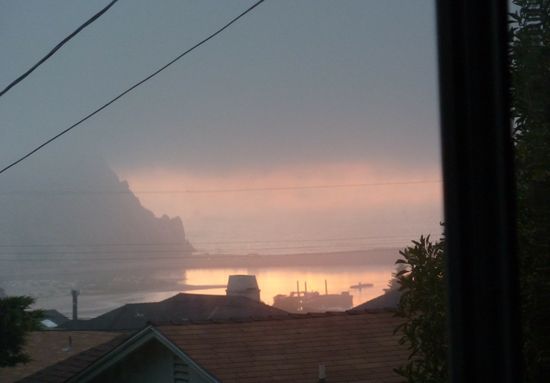
Reykjavik, Iceland, 10.49 am
Wednesday on the Dish, Andrew had a "meep meep" moment after the fifth Republican debate since Labor Day, and we corralled extensive blogger reax here and reader reax here (more on the Dish's new polling feature here and here). Dana Milbank lamented Huntsman's failure to gain traction, the Tea Party ditched entitlement reform, and Romney carefully avoided the subject of Medicare. Mitt condescended to Perry before a sympathetic audience, Cain's plan rewards the rich and punishes everyone else, and the businessman addressed concerns that 9-9-9 was lifted from SimCity. We checked in on the AJA, and in our AAA video, Andrew considered the immediate future of pot legalization.
Jonathan Rue held out for nuance in the debate surrounding America's role in the world, Joshua Stacker blamed the SCAF for Egypt's woes, and the U.S. killed a 16-year-old American citizen in Yemen. Netanyahu's deal bolstered Hamas and undermined the PA, we remembered Shalit's American counterpart, and we assessed Obama's first chosen war. Shalit was subjected to a disturbing final "interview," Palestine's geography narrowed over time, and Walter Pincus urged the U.S. to reevaluate foreign aid to Israel. A terrible video of a toddler left for dead on the street sparked outrage and introspection in China, our relationship with Uzbekistan proved consequential, and the North Pole is quickly losing ice.
We explored the legal history of protest sleepovers, Jack Balkin wanted OWS to adopt its own constitutional arguments, and a sitcom captured the spirit of the movement. OWS and the Tea Party have different "styles," Jonathan Bernstein made an important contribution to the Annals of Chutzpah, and the Amish sustained a functioning anarchy. Scientists used Google Earth to map the spread of disease, white men clung to capital punishment, and Siri led the way to real AI. Density drives economic growth, comic books peaked during WWII, folding paper did the math, and a large parrot got frisky with a photographer. Readers weighed in on spousal relationships and parenting, airlines are in the black again, and writing about yourself shouldn't be "all about you."
Dissent of the day here, tweet of the day here, VFYW here, MHB here, and FOTD here.
Will's Sign at Occupy Times Square, quote by Conor Friedersdorf from John Grace on Vimeo.
Tuesday on the Dish, Andrew live-blogged the Nevada debate and we collected reax here. Herman Cain and his 9-9-9 plan faced serious scrutiny, Cain blurred the line between comedy and actual policy proposals, and he worshipped "the perfect conservative." Rick Perry's campaign ads reflect an impressively high production value, Harry Schliefer anticipated that Perry would recapture Cain's support as the Hermanator embarked on book tour, and the Texas governor contemplated his own rise and fall. Gingrich rode a fake following to frontrunner-status in the Twitter primary, and the "giant, gaseous asshole" won an award for faux intellectualism. The indignant anti-Romney right tried to suppress the inevitability narrative, and Andrew took on the Mormon question. In our video feature, he explained that he doesn't have a filter (except for the rotoscoping).
Friedersdorf infiltrated OWS as the protests took hold in countries with high youth unemployment, Calvin and Hobbes illustrated Wall Street's baffling business model, and we recognized the demonstrators in South Park. OWS doesn't need the NYT, Beinart admired the movement's powerful populist instincts, and we assessed its marginal anti-Semitism.
Tunisia readied for democratic elections, the Israeli police and military condoned terrorism, and a victim of the LRA confronted Limbaugh's brazen storytelling. Montag put forth an enterprising solution to our futile war against Afghanistan's drug trade, Jeremy Salt made excuses for Syria's unforgivable mukhabarat state, and Rachel Abrams celebrated Gilad Shalit's freedom with a sickening diatribe.
Bruce Bartlett joined the Dish in championing Reagan-style tax reform, Peter Frase witnessed the unhealthy convergence of partisanship and ideology, and Douthat noted that Pinker's thesis on violence neglects the brutal history of the "civilizing process." Joel Kotkin predicted that China's growth would fizzle, criminals harnessed the social ingenuity of "flash mobs" for ill, and Bryan Caplan explained why a bad husband is incapable of being a good father. Andrew defended David Brooks against the Straussian charge, marijuana legalization achieved record public support, and Sam Harris pondered the evolving reality of consciousness. Readers invoked Felix Feneon's "Novels in Three Lines," we delved into the tricky morality of pheasant killing, and sociology students were tested on Jay-Z. Uzbekistan was forced to assert its geopolitical relevance, housing prices affect birth rates, and a baby was introduced to the world of Angry Birds.
Dissent of the day here, app of the day here, MHB here, FOTD here, VFYW here, and VFYW contest winner #72 here.
Monday on the Dish, Andrew warned of the dire economic consequences of extreme inequality, and he reflected on the Occupy movement's mounting global resonance. OWS proliferated in the liberal West (dispatch from a reader-demonstrator in L.A. here), both OWS and the Tea Party have some explaining to do, and philosophers stood in solidarity with the former. The 99 percent have something of a PR problem, a Democratic PAC launched an OWS-inspired attack on an incumbent House Republican, and an NYPD officer struck a demonstrator brutally and out of the blue.
Herman Cain claimed to be ignorant of the neoconservative movement, he didn't want to throw his advisers "under the bus," and he probably doesn't bring enough "pay" to play. Unfortunately for Cain, knowledge of foreign affairs is decidedly cumulative, and there's not much the blogosphere can do to legitimize Perry's "jobs plan." We read Romney's lips, wondered which way Jim DeMint would go, and our readers pushed back against Paul's "baby in a bucket" story. Perry's Christianist allies are still sounding their anti-Mormon alarms, Steve Clemons stood up for Huntsman's sensible foreign policy, and Andrew extolled the virtues of the British parliamentary system in our AAA video (don't miss the bonus analysis after the jump).
The president preached sanity at the dedication of the MLK memorial, he deployed an intervention in Uganda, and we considered the legal questions surrounding the mini-war. The Supreme Leader would have "no problem" ending Iran's presidential system, Hamas is rapidly losing ground, and our withdrawal deadline in Iraq is still up in the air.
The author Teju Cole tweeted "small fates," we recovered American exceptionalism from the dangers of bad theology, and TNC contemplated patriotism and gratitude. Readers voted on voting, a preventative approach to healthcare drives down long-term costs, and Felix Salmon made the case for economically efficient taxes. Free trade comes with a cost, widespread deleveraging is crippling demand, and optimism isn't always the best frame of mind. Hot stewardesses still fly outside the U.S., we brushed up on photosynthesis as changing leaves peaked, and hair crimes tested Amish core principles.
TWSS of the day here, hathos alert here, creepy ad watch here, MHB here, VFYW here, FOTD here, and charming presidential pick-up lines here.
– M.A.

 The Dish