Among Egypt’s Liberals

Michael Totten reflects on his most recent visit to the country:

Egypt does feel more pluralistic to me now than it did just a few years ago, and a few years ago it was more pluralistic—if still authoritarian—than during the early days of Nasser's rule. At the same time, the country is terribly weighed down by despotic traditions and habits that go back thousands of years. Which means that these three figures [Gamal Abdel Gawad Soltan, Hala Mustafa, and Ezzedine Choukri Fishere], who are among the more sober of Egypt's liberals, are probably correct in declining to characterize the country's nascent culture as democratic. It is not so easy to pitch 7,000 years of heavy history over the side.

Is Romney Being Baited?

Perry goes Bruckheimer with a new negative ad:

Romney is hitting back with a negative ad of his own and an anti-Perry website, on top of the frequent attacks during debates. Nate Silver thinks Romney targeting Perry is a mistake:

Mr. Romney is right if he thinks that Mr. Perry remains the biggest threat to taking the Republican nomination from him. I say this as someone who takes Herman Cain’s chances fairly seriously and recoils at the frequent assertions without evidence that he has no chance of winning the nomination. But Mr. Perry’s advantages in terms of the fundamentals — his fund-raising, his respectable number of endorsements, his credentials and experience — are enough to outweigh Mr. Cain’s edge in the polls, especially at a time when most voters remain weakly attached to their current choices.

But it is precisely because Mr. Perry is the more threatening candidate that Mr. Romney might want to think twice about helping to position Mr. Perry as the "anti-Romney" choice …

Dissent To The Dissent Of The Day

A reader writes:

I'm a long-time reader, proud contributor of a View from Your Window selection, and reporter at Bloomberg News. Your dissent of the day reader today is wrong.
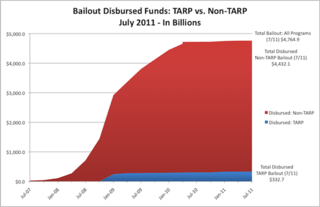
TarpThe reader mentions the opposition from the Fed and the Clearing House to releasing details of the Fed emergency lending programs such as the Primary Dealer Credit Facility, among others. We at Bloomberg News sued the Fed and took the case to the Supreme Court. When the Obama administration decided not to pursue the case, Bloomberg won the data, in effect (the provision in Dodd-Frank by Sanders was done at the request of Mark Pittman, a fantastic reporter at Bloomberg who spearheaded this effort but unfortunately died a few years ago before he could see the work to its completion). I was one of the reporters to dig into the thousands of pages released.

There were some very risky moves by the Fed at the height of the 2008 crisis, no doubt about it. I wrote about the government accepting defaulted debt as collateral in return for cash, for example. Scary times, but as you have noted, they were necessary measure to prevent a recession from becoming a depression.

The idea that because TARP is a small part of the bailout, and you therefore can't say taxpayers didn't lose money on the emergency help from the Fed, is wrong. Fed Chairman Ben Bernanke testified to the Senate Banking Committee on July 21, 2010, saying: "Importantly, our broad-based programs achieved their intended purposes with no loss to taxpayers. All of the loans extended through the multiborrower facilities that have come due have been repaid in full, with interest."

I don't know the point of your reader's dissent. To merely say that the government action was much larger than TARP is true but offers no insight. You are right to say the financial loans made to Wall Street were repaid with interest (and that the automaker loans are the only ones to have not be fully repaid yet).

Update from the original dissenter:

I do not claim to have greater financial expertise than a reporter for Bloomberg News, but I have to object to his characterization of my argument. Let's be clear. I wrote a dissent. I was responding to your assertion that we had been "paid back" by the banks, with interest. My position was (is) that to make that kind of statement buys into an incomplete and, in my opinion, mythologized version of "The Bailout."

I might have oversimplified things by making it appear as if the $16 trillion number was entirely comprised of loans to banks, while that was not my intent. But to focus on accounting misses my fundamental point: The Bailout is many, many times larger than the $700 billion figure which is so often quoted. The government's stake in the recovery caused by the crisis is in the trillions, is still ongoing, and could grow ever larger.

While blame for this situation can be cast upon W's administration, Fannie and Freddie, overzealous mortgagors, and even on the lowered lending standards Clinton introduced, there is one group who unquestionably precipitated the crisis who has not been held accountable: Wall Street. The Street screams at any attempt to saddle it with blame or address its excesses, but look at what it wrought! To say they have "repaid" their debts when there will be a tab in the trillions, across multiple industries, for an indefinite time into the future, is to mischaracterize The Bailout and Wall Street's accountability. It's enough to make you frustrated and angry.

And that's what my dissent concerned: your response to a sign held by a protester, a protestor at an event expressing a sense of frustration and anger with the consequences felt throughout an entire society – entire world – of actions by an unaccountable industry. Our entire world is different. Theirs has stayed exactly the same. We cannot point to TARP and interest payments and say, "Ah, thank you, we are repaid." That was my argument. What I said was true. I like to think it had at least a shred of insight.
The End Of The War? Ctd

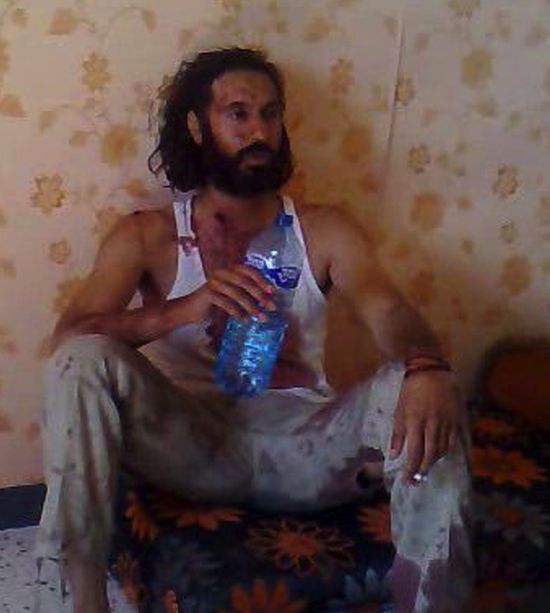
Of course, skepticism is due – with respect to contractors, diplomats, some out-of-country military trainers, aid, etc. And a great deal of concern is merited about the nature of the new regime emerging in Libya – especially the fact that some, but not all, in the administration were eager to stay a while longer. Nonetheless, this week saw two wars effectively ended – one inherited, the other not. That doesn't happen often – about as often as government programs simply being abolished. The good news is that the drawdown in Afghanistan is also continuing.

Again, I think of the actual record of this president. He has drastically tightened the noose around Assad and Khamenei and avoided the war the neocons so desperately want with Tehran. And he has ended the war in Iraq as he promised to, and concluded a war with a victory many of us doubted at the get-go, without another quagmire, and with considerable allied and Arab support.

We sometimes forget that he began as an anti-war candidate when the Great Recession was a twinkle in a credit default swap trader's eye. And when I hear people whining about his betrayals or their disappointments, I just hope they note that against great odds, the Iraq war is over without our running for cover. Given the core contradiction of the conflict and the bungling of the occupation: not so shabby. Given his core reason for running for president, mission accomplished.

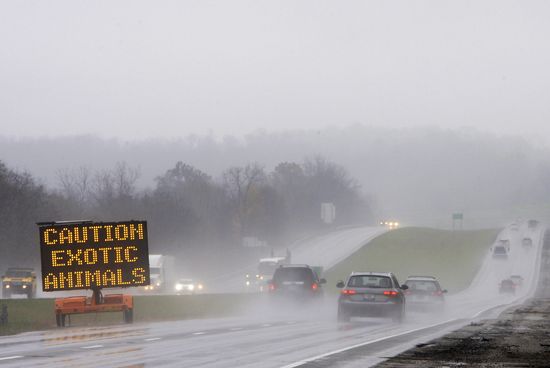
Exotic Pets Gone Wild

GT_EXOTICANIMALS_111020

Reacting to the bizarre tragedy of this heavily-reported story out of Ohio, Jennifer LaFleur explores the legal issues surrounding the private ownership of exotic animals:  

State laws regulating ownership of exotic species vary widely. Arkansas, for example, bans the ownership of “large carnivores” but grandfathered in people who already owned such creatures so they could keep them. In Delaware, owners of “non-native wild animals” must obtain a permit. The law excludes venomous snakes. Some states require owners of exotics to register them, but that doesn’t always happen. According to a 2004 Dallas Morning News report, more than two years after Texas required registration of exotic animals, only 89 were on the state’s list. Yet Texas has an estimated 3,500 tigers alone – more than live in India.

Susan Orlean makes the case for prohibition:

Wild animals don’t want to be owned. They’re wild. They are not pets; they are not our friends; they are not objects. No scenario makes private ownership of wild animals reasonable or fair. … There will always be vain, obsessive people who want to own rare and extraordinary things whatever the cost; there will always be people for whom owning beautiful, dangerous animals brings a sense of power and magic. It must be like having a comet in your backyard, a piece of the universe that is dazzling and untouchable right outside your door. But animals live and die and breed and feel pain and can inflict pain. There is no excuse for any individual to own them, period. 

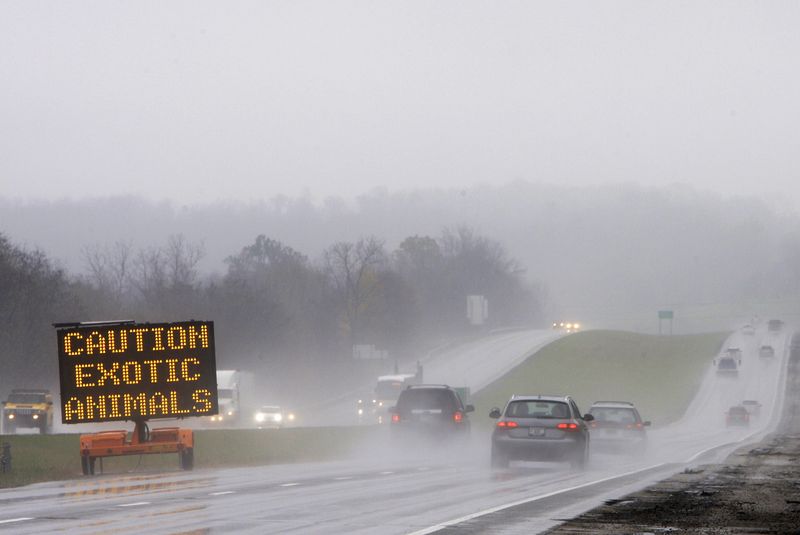
(Photo: A sign warns passing motorists about exotic animals on the loose from a wildlife preserve October 19, 2011 in Zanesville, Ohio. Muskingum County Animal Farm owner Terry Thompson was found dead Tuesday evening after deputies received calls reporting wild animals on the loose west of Zanesville. The preserve kept exotic animals such as lions, tigers, cheetahs, wolves, bears, giraffes and camels. By Jay LaPrete/Getty Images.)

A Kinder, Gentler Islamism?

Jason Brownlee previews Tunisia's elections, which are scheduled to take place Sunday. He profiles Ennahda, Tunisia’s biggest Islamic party:

In their campaign members of Ennahda have gone to great lengths to convey their commitment to democracy. (Alternatively, one could say the party’s campaign reflects the group’s preexisting commitment to democracy). Official statements and campaign flyers in Tunis suggest Ennahda is the only party to place a woman (Dr. Saad Abdel Rahim, who does not wear the head scarf) at the top of one of its district level lists. Abdel Rahim’s spot could be interpreted as a token gesture, except that it meshes with a broader program based on transparency, non-violence, and rotation of power over the long term.

As Said Ferjani, a member of the party’s political bureau explained to me at Ennahda headquarters, the group realizes it enjoys widespread popularity now , but this will not always be the case. Hence Ennahda’s stated goal is to help build a system that will be equitable and competitive over successive rounds, institutionalizing both uncertainty and fairness for the long haul. Ennahda’s interest in establishing a stable playing field for future elections may help explain why the group embraces international observers from the Carter Center and the EU, and why it rejected claims from some Tunisian politicians that election monitoring infringes on national sovereignty.

Props To Hilldog

129717479

A reader writes:

I understood your reasons for not advocating intervention in Libya and your reservations going forward, and I also appreciate how you recognize the incredible progress that has been achieved thus far (one of the great virtues of a real-life blog).  This has been a major development for the Obama administration. People were already coining the "Obama doctrine," offering Libya as an example of how the US can rethink its role and still deliver on strategic (and even moral) imperatives, and that case has only grown stronger in the past weeks. 

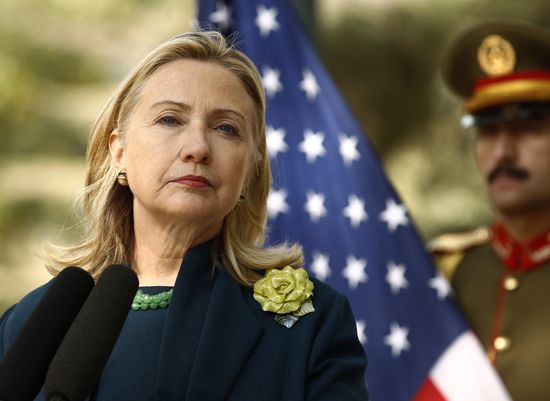
But I think it's important to remember Hilary Clinton in all this. As you've noted several times in the past, Obama was very reluctant to proceed and it was Hillary, at the center of it, who fought hard to change his mind. 

I say this only to highlight what an exceptional cabinet member can do for a president and the administration.  I think a shout-out to Hillary Clinton is much deserved from you, given the dismissive ways you reduced Hillary's perspective (collective "Clinton Guilt"?) as trusted advisor to the president, an advisor who can account for events unfolding where the executive cannot dedicate full focus or appear physically to assess for him/herself.  I know you have nodded to her great performance as Secretary of State in the past, but on Libya you've been quiet. Given your past treatment, I think a nice hat tip is in order.  Surely Obama and Hillary shared a fist bump on news of Qaddafi's death, so restrained celebration or recognition would not be out of context.

(Photo: U.S. Secretary of State Hillary Clinton listens to a question during a press conference with Afghan President Hamid Karzai at the Presidential Palace in Kabul on October 20, 2011. By Kevin Lamarque/AFP/Getty Images)

Vengeance Through Film, Ctd

A reader writes:

I didn't like Inglourious Basterds, but for the life of me I couldn't figure out why.  Then I read this article by Jonathan Rosenbaum, wherein he quotes the author Daniel Mendelsohn "Do you really want audiences cheering for a revenge that turns Jews into Nazis, that makes Jews into 'sickening' perpetrators?"  The inherent problem with revenge fantasies and revenge films is that they play to the basest parts of who we are. 

We are, or should be, civilized.  And that means that we do not seek revenge.  We cannot go out willy nilly and start killing everyone who ever hurt us.  And for the most part we don't.  Tarantino never mentioned it but one reason that Hitler and many of his followers were so eager for the slaughter of the Jews was due to a misguided sense of revenge: the Jews did all this to us, now it's payback time. 

The alternative to revenge is justice, something that is more civilized but far less cinematic.  When bin Laden was killed, the president said "Justice has been done."  He was exactly right.  We didn't parade the man around, riddle him with hundreds of bullets, display his carcass for the whole world to see (or fly a giant banner saying "Mission Accomplished).  We shot him, buried him – done and done.  Killing someone, even evil men like Hitler and bin Laden, should never be pleasurable, but obviously Tarantino hasn't quite figured that out yet.

Update from a reader:

Your reader missed the point about that movie.  It was a fantasy about killing the killers before they could finish murdering 6 million people. It would have been a revenge fantasy if the Nazis had been killed AFTER the war. One of the painful parts of that history is that Jews were powerless to stop the murder of so many of their own.  What's wrong with a movie that imagines that history otherwise?