How Will Occupy Wall Street End?

Dahlia Lithwick thinks the media hostility to OWS guarantees the press's irrelevance. Kevin Drum isn't so sure:

As weeks drift into months, and the OWS movement continues to shun the very idea of alliance building, political action, or stronger messaging, it looks more and more as if it's going to drift into irrelevance without accomplishing anything. Heavy-handed police action could change that, of course, but at this point it sort of looks to me as if its most promising destiny is to be v1.0 of whatever springs up in its wake. 

This weekend's snow made the occupation harder to sustain:

Some electric pumps and heaters would have come in handy, but the city confiscated Occupy Wall Streets' generators and gasoline [Friday], citing them as fire code violations. If they continue to be banned, the movement will lack in heat sources once the cold weather settles in more permanently.

You Can’t Get The Money Out Of Politics

Seth Masket argues that campaign finance reform has failed:

If you want to know who contributed to the campaign of a president or a senator or a state legislator, it's not as easy to figure it out as it used to be. All these webs of committees that have cropped up to get around campaign finance limits end up obscuring the path of the money. … The end result is that these reforms designed to reduce the role of money in campaigns not only don't end up reducing the role of money in campaigns, but they actually reduce accountability and transparency.

The Mark Of Cain?

Polls_of_polls

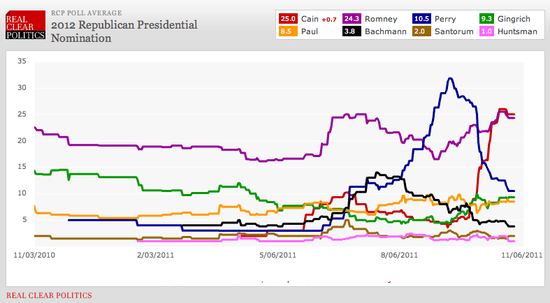
Politico reports that Cain has been accused of sexual harassment by two women. And it's pretty clear he's going to have to cop to it:

He was then asked, “Have you ever been accused, sir, in your life of harassment by a woman?”

He breathed audibly, glared at the reporter and stayed silent for several seconds. After the question was repeated three times, he responded by asking the reporter, “Have you ever been accused of sexual harassment?”

That's not the answer of a man falsely accused, it seems to me. And the financial payments to two women are a clear indication of impropriety that bordered, if not transgressed, the legal line. Dave Weigel compares the allegations to the Clarence Thomas/Anita Hill brouhaha: 

It's one thing for a movement hero or SCOTUS nominee to get in trouble, because everyone stands to lose if he's taken down. Quite the opposite is true if a presidential candidate is in trouble — countless people stand to gain from the coming dogpile. Two: This isn't a one-day story. Politico protected the names of the sources while leaving a Hansel and Gretel trail for others to follow. 

Noreen Malone analyzes the Republican reaction:

At least so far, the accusations don't appear to be damaging him too much on the right—in fact, conservatives seem to be rallying around Cain."These are nothing more than allegations at the moment; let's not rush to judgment until all the facts are in," went one typical response on TownHall. The Drudge Report linked prominently to one video of Ann Coulter saying"They are terrified of strong, black, conservative men," …

John Cassidy wonders whether Politico's story will hold up:

[I]f more details do emerge, and particularly if either of the women comes into the spotlight and puts a face on the allegations, Cain’s bubble will have popped in spectacular fashion.

The issue here is that sexual harassment is rarely a one-off deal. It's usually a pattern of behavior. This may open a veritable can of accusations. And I should add that respecting the privacy of people's consensual sex lives, in all their messiness, is not the same as alleged sexual harassment. My insta-view, subject to revision after many more details come out, is that this kind of thing is a pretty moral wound for a candidate with this sudden a rise and shallowness of support. But how he handles it will tell us the most. Candor? Apology? Defiance? Here's one thing worth looking out for: any deployment of the race card.

Poll of polls chart from RCP.

Obama On Cannabis

F9nyco05-um-ww_mfbuo9q

He first treated legalization as a joke; then asked for suggestions from the public for policies for his administration. Of the top ten petitions, five had something to do with marijuana. A majority of Americans now favor an end to prohibition, as the graph shows above. But the Obama administration regurgitates the standard prohibitionist crap, issuing its public response on the Friday afternoon before Halloween. 74,000 signed the petition to treat marijuana as alcohol. The drug czar does not even grapple with the central question posed by the most popular petition on the site. Instead we get this:

According to scientists at the National Institutes of Health– the world's largest source of drug abuse research – marijuana use is associated with addiction, respiratory disease, and cognitive impairment. We know from an array of treatment admission information and Federal data that marijuana use is a significant source for voluntary drug treatment admissions and visits to emergency rooms. Studies also reveal that marijuana potency has almost tripled over the past 20 years, raising serious concerns about what this means for public health – especially among young people who use the drug because research shows their brains continue to develop well into their 20's. Simply put, it is not a benign drug.

Notice the weasel words: "associated with addiction." I.e. nowhere near as addictive as alcohol, even using an expansive definition of "addiction." Exercize is also "associated with addiction," as Nick Kristof Barack_obama_smoking_weed_picture.0.0.0x0.611x404_i9mothere are, of course, vaporizers to avoid the smoke issue.
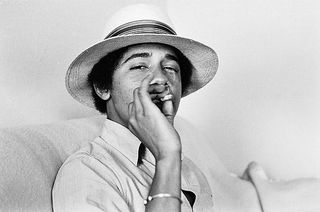
Cigarettes are related to "respiratory disease" in a much, much, much more dangerous way because so much more tobacco is smoked. Why is tobacco not illegal? Alcohol gives you cognitive impairment. How many visits to emergency rooms occur because of alcohol in some way? And how more serious than a freaked out stoner getting paranoid? None of the arguments manages to explain why marijuana, unlike nicotine or alcohol, remains illegal, with all the disastrous effects that has with respect to Prohibition. Marijuana arrests are also highly skewed to racial minorities. Again, there's no White House concern about this. This comes after the California federal crackdown on medical marijuana, even if it was not a function of direction from Washington, DC. Happily, Eric Holder now has a lawsuit on his hands over the matter.

What's infuriating is this administration's refusal to have a serious debate about this, to actually engage the salient arguments of legalizers. We just have a defensive crouch, and an insult to large numbers of Obama voters and supporters, who, unlike this nicotine-addicted president, do not take the question of prohibition as a joke.
The Ups And Downs Of Fostering Kids

Benjamin J. Dueholm, who fostered a little girl and two boys, struggles with stingy public support for foster families:

Why people choose to become foster parents is something of a mystery. In the sparse literature on foster parents and their motivations, they report unfulfilled desires for biological children and the intention to adopt, a sense of obligation toward a family member entering the system, or the usefully vague "altruistic motivations." One factor that turns up consistently is knowing a foster parent or being related to a foster child. Despite lingering popular impressions to the contrary, money does not seem to motivate many foster parents to participate. In most states, including Illinois, foster care reimbursement rates lag well behind the average cost of raising a child.

This leaves child welfare advocates with a dilemma. Raising the board rates for foster children might attract and retain more foster parents, as well as ensure a better level of care. But it’s hard to argue for this when a substantial portion of the electorate considers foster parents to be in it for the money, and doubly hard to argue for it under conditions of severe austerity for safety net programs. (I have heard that some people do manage to turn fostering into a kind of cottage industry; I find it hard to imagine how.) 

Dueholm highlights another paragraph from his piece.

Nobody To Blame But Ourselves

Jonah Lehrer reviews Thinking, Fast and Slow, a new book by Nobel Prize-winning psychologist Daniel Kahneman:

Teaching people about the hazards of multitasking doesn’t lead to less texting in the car; learning about the weakness of the will doesn’t increase the success of diets; knowing that most people are overconfident about the future doesn’t make us more realistic. The problem isn’t that we’re stupid—it’s that we’re so damn stubborn. … [Kahneman's] greatest legacy, perhaps, is also his bleakest: By categorizing our cognitive flaws, documenting not just our errors but also their embarrassing predictability, he has revealed the hollowness of a very ancient aspiration. Knowing thyself is not enough. Not even close. 

An Illustrated Guide To Depression

Sadness

Allie Brosh gives a poignant and oddly hilarious first-hand account:

[T]rying to use willpower to overcome the apathetic sort of sadness that accompanies depression is like a person with no arms trying to punch themselves until their hands grow back.  A fundamental component of the plan is missing and it isn't going to work. 

We previously highlighted Brosh's brilliant webcomic here.

Don’t Blame The Bankers?

Nicole Lapin examines the makeup of the 1%:

Financial services professionals (a.k.a. "Wall Street") average $311k/year — so they technically don’t make it into the top 1% if you look at the mean. … The biggest chunk of the "top 1%" are executives and managers outside financial services at 31%; medical professionals make up 16%; financial services professionals make up 14%; 9% lawyers.

Nona Willis Aronowitz concentrates on the 31% that are executives and managers:

Yes, tax codes matter, but CEOs and boards are the ones making the salaries and doling out bonuses. They're the ones with the most direct power to redistribute the wealth and give their employees decent pay and benefits.