The Daily Wrap

Untold obama
Today on the Dish, a reader deftly summed up the tale of two presidents, Obama's messaging failed, and Andrew told the real story of the last three years. Qaddafi is dead (the tyrant's final moments here, blogger reax here, and Hillary's reaction to the news here). 

Ambiguity beleaguers R2P, Hamas failed a core test, and many Middle Eastern autocracies still retain key structural advantages. Matt Duss sparred with Islamaphobes in their own magazine, Panetta went native at the Pentagon, and the riots in Greece turned bloody. An Israeli novelist drew a distinction between his ethnicity and his religion, and Ali Abunimah pooh-poohed the post-Qaddafi celebrations. 

Austin Frakt speculated about Obamacare's legacy, Republicans tend to blame Bush more than Democrats blame Obama, but we can put off fretting over Obama's approval numbers until February. We wondered if the GOP field was exceptionally weak as a totally unserious candidate took the lead in Iowa, the problem with Godfather's pizza is that it doesn't taste good, and Cain's position on abortion flummoxed the right (and everybody else). Romney and Perry rarely disappoint (but neither do the British tabloids), readers shared Mormon "secrets," and a conservative demanded an annulment. Santorum still doesn't have an argument on marriage, and Palin had the gall to criticize her former colleagues for not answering questions from the media. 

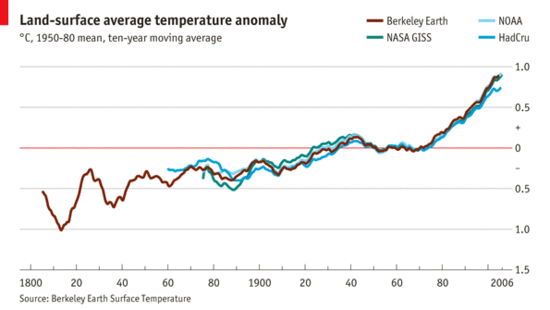
Blue-collar whites rallied around OWS as Lessig pointed the occupiers to K Street, and Frum confronted the challenges of inequality and growth in America. Timothy Zick didn't want OWS to let the Tea Party set the terms of the debate, Wall Street seems, er, conflicted about Obama, and Geithner "decimated" Rubio and not the other way around. Rohan Poojara lobbied for legislation to keep American-educated immigrants in the U.S., liberals were divided on border security, and someone read a bit too much into the Twitter hashtag. Susan Sarandon called Pope Benedict a Nazi, a Google car drove itself, city parking garages drive bad behavior, and the earth is getting heated fast. Siri grappled with the inane, focus groups don't make great product planners, and progressive grooms-to-be suffered through wedding plans. Andrew eats meat in spite of it all, and unfortunately he's still on the injured list.

Chart of the day here, VFYW here, FOTD here, and MHB here

M.A.

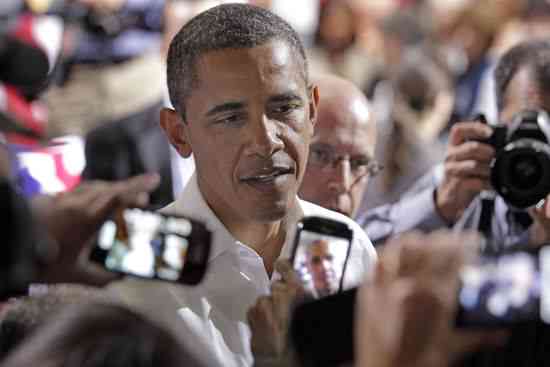
(Photo: U.S. President Barack Obama speaks with people at a fire station October 19, 2011 in Chesterfield County, Virginia. Obama was on the final day of his three-day bus tour through North Carolina and Virginia to push for his Jobs Bill. By Jay Paul/Getty Images.)
Qaddafi’s Last Moments

Disturbing footage allegedly showing the former leader bloodied and captured:

Other videos claiming to show Qaddafi dead are making rounds. Jon Lee Anderson considers the importance of the videos:

Whatever the circumstances that made them possible, the images of dead Qaddafis are bound to have a huge effect amongst Libyans, just as did the audio broadcasts of Muammar Qaddafi’s recorded voice these past weeks. The persistence of Qaddafi’s voice—unmistakably his, defiant and threatening, very much alive—was even more unsettling than if he had maintained a televisual presence, somehow, because it allowed him to cling to his aura of invincibility that had been built up over forty years. Invisible, Qaddafi could be everywhere and nowhere at once, a potential phoenix yet to arise from Libya’s ashes. The image of Qaddafi dying or dead on the ground, being kicked by his killers, however, has put paid to all that. 

“Occupy The Constitution” Ctd

Timothy Zick counters Balkin:

The fact that the movement could be about the Constitution does not mean that it ought to be, or that this is the most effective means of garnering public support for its agenda.  Many successful social movements have rooted claims in constitutional text and principle.  The Tea Party is only the most recent example.  The Tea Party’s complaints map very well onto current debates over [things] like the extent of federal power and federalism. … Among other difficulties, [OWS] defining themselves as an anti-Tea Party constitutional movement allows the Tea Party to define the agenda and set the terms of debate.  

Why Didn’t Bigger Name Republicans Run? Ctd

3007952

Massie rejects the notion that the current crop of GOP presidential hopefuls is uniquely weak:

This ain't a compelling squadron of candidates but it's not, I think, unusually thin since most years the choice is pretty quickly winnowed to two or at most three semi-plausible candidates. That's happened this time too even if, like the Demcrats in 2004 (albeit in more favourable circumstaces for the opposition) few people are much enthused by the choice available. 

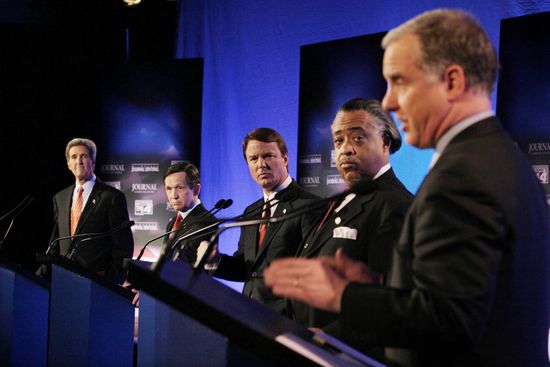
(Photo: Sen. John Kerry (D-MA), Rep. Dennis Kucinich, (D-OH) Sen. John Edwards (D-NC), and Rev. Al Sharpton watch Gov. Howard Dean during a Democratic Presidential Debate February 15, 2004 at Marquette University in Milwaukee, Wisconsin. By David Hume Kennerly/Getty Images)

Beefing Up Border Control Is Bipartisan

Ryan Bonneville struggles with the fact that many liberals want strong border control. Kevin Drum defends his position:

My position on immigration is fairly simple: I think we should allow more legal immigration, and we should make the process of obtaining citizenship (or at least a green card) less Byzantine than it is now. At the same time, we should make it harder to come into the country illegally. I don't think much of the fence, for both symbolic and practical reasons, but employer penalties and better border patrols are both demonstrably effective. Lower the price of legal immigration and raise the price of illegal immigration: that's the formula. Eventually you'll find a balance of costs that keeps illegal immigration at a low enough level that it's not worth spending more on. Then you're done.

Yglesias disagrees.

Cain’s Abortion Muddle

The right is starting to worry about Cain's fidelity to pro-life orthodoxy after the above interview. Dan Amira notes this isn't the first time Cain has given this bizarre answer, but Tim Murphy thinks this is just a verbal flub. Amanda Marcotte tries to make sense of Cain's position. So does Amy Sullivan:

[Cain is] not saying there should be no exceptions in law for cases of rape or incest. He’s saying he personally believes women who have been raped should not choose to abort. What the rest of us know, of course, is that the abortion debate is not between those who believe abortion is a wonderful right that should be exercised as often as possible and those who believe abortion is a right but wish women wouldn’t use it. Both of those positions are pro-choice. And so is the stance that Cain describes.

Weigel expects Cain to walk back the remarks. Jonathan Bernstein thinks it's the beginning of the end for the Hermanator:

Republicans certainly would never nominate anyone who was actually pro-choice, and anti-abortion activists won’t forgive anyone who stumbled this badly on the issue, even if he walks it back back (as I expect he will) and clarifies that he misspoke himself and he’s actually 100% pro-life. So this is at the very least a severe blow to his campaign. Given that he’s not a serious candidate, it gives Republicans a clean shot at bashing him for long enough to finally remove him from the top of the polls. As such, it can be seen as a lucky break for Republicans who know that it’s really not a good idea to have a presidential candidate who can’t manage to put three sentences together on most topics without an embarrassing gaffe.