The Untold Story Of The Actual Obama Record

129663017

[Re-posted from earlier today.]

I can't put it better than this longtime Dish reader:

Personally, I am praying that Obama's messaging improves drastically. (It has failed on multiple occasions – not the least of which was during August/September of 2008.)

The truth is that this President has done a good job in what has been one of the most difficult periods of modern history. He saved the economy from ruin (until the Tea Party took over Congress) with a stimulus that was as large as possible given the political realities, presided over a stock market that fairly quickly recouped many of its losses, presided over almost consecutive monthly increases in private sector job growth (unfortunately balanced by monthly decreases in public sector jobs which I attribute to the GOP further starving government), enacted the only meaningful healthcare reform ever in our history, passed financial reform (no matter what the Left says, he did this), saved the auto industry (which Romney is on record opposing), fired the first salvo of the Arab Spring with his address in Cairo no less, drawn down our footprint in Iraq in a responsible way (and headed toward almost total withdrawal), stopped numerous terrorist attacks in this country, stopped torture as policy, repealed DADT, joined the international community in a measured and responsible way to bring down an odious tyrant in Qaddafi, and killed a whole generation of al Qaeda leaders. And taking out Osama bin Laden the way he did will go down as one of the bravest military actions in American history.

I know this President is not popular, and it is very unpopular to defend him in such a way. I don't care. For this country to dump him for anyone on the other side would be a terrible thing. Progress is slow and painful, but we are doing it. Is that fashionable to say? No. Again, I don't care.

Amen. And the way in which the ADD media simply jumps to the next cycle of spinmanship only furthers the amnesia. But the Obama administration also shares some of the blame.

Many of them have been too focused on governing to explain what the fuck they're doing. There's a technocratic arrogance to them at times that is too blind to winning and sustaining arguments and narratives. And this is kinda mind-blowing because the record is so remarkable in retrospect.

If you'd told me in January 2009 that the banks would pay us back the entire bailout and then some, that the auto companies would actually turn around with government help and be a major engine of recovery, that there would be continuous job growth since 2009, however insufficient, after the worst demand collapse since the 1930s, that bin Laden would be dead, Egypt transitioning to democracy, al Qaeda all but decimated as a global threat, and civil rights for gays expanding more rapidly than at any time in history … well I would be expecting a triumphant re-election campaign.

But we are where we are – and the economic pain is real and the president must take his lumps. The good news for those of us who still back Obama and hope for his re-election is that even with all this positive record essentially dismissed and little of it capitalized on politically, Obama is still neck and neck with any likely opponent. And he is his own best messager.

At some point, he needs to shuck off the restraint, and tell the actual story of the last three years – against the fantastic and self-serving lies and delusions we keep hearing in Republican debates and Beltway chatter. If he does it with panache, he won't need a jumpsuit onto an aircraft carrier. And many of his missions may even be accomplished.

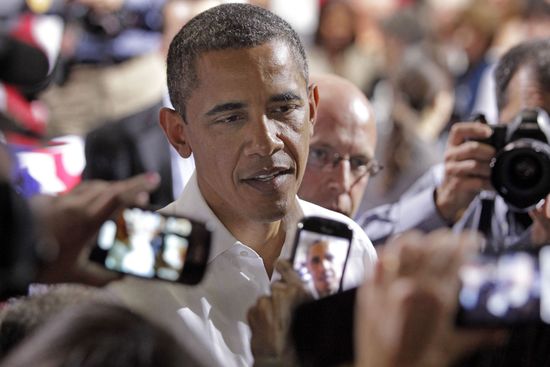
(Photo: U.S. President Barack Obama speaks with people at a fire station October 19, 2011 in Chesterfield County, Virginia. Obama was on the final day of his three-day bus tour through North Carolina and Virginia to push for his Jobs Bill. By Jay Paul/Getty Images.)

The Reality Of Inequality

Frum acknowledges it:

Conceptually, you could imagine a highly unequal society with rapid income mobility. You could imagine a society with little mobility, but in which all classes were getting richer at approximately the same pace. America, however, is a society of widening inequality, hardening class lines, and stagnating living standards for most people. And all of these trends rely on numbers from before the economic crisis and before the election of Barack Obama.

McArdle claims that inequality is falling. Timothy Noah pushes back.

Malkin Award Nominee

“Don’t these people see an echo of the swastika in their new power symbol? Don’t they realize that the early Nazi Party was (among other things, obviously) also overtly anti-capitalist?… As a commenter notes, the symbol may have derived originally from the Twitter “hashtag,” but that in no way diminishes its creepiness. It may “just” be a rotated hashtag, but that doesn’t lessen its significance as a power symbol. The swastika, after all, was “just” a Buddhist good luck marking before the Nazis adopted it and started using it to indicate something else. And how did the Nazis alter it for their purposes? They rotated the Buddhist swastika 45 degrees, to give it a new association. Just as the hashtag sleeve marking has been rotated here,” – Zombie at Pajamas Media, on OWS protestors wearing the Twitter hashtag, #.

(Hat tip: Jillian Rayfield)

Whom Do Americans Blame For The Bad Economy?

Blame_For_Economy

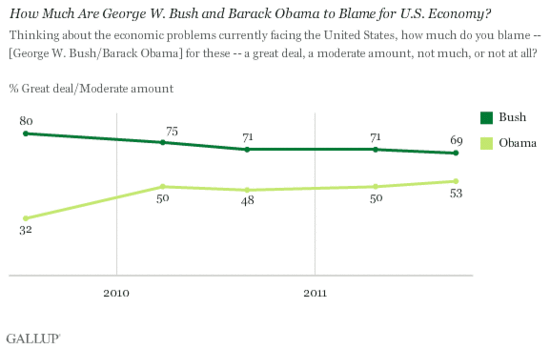
Bush is still the most blamed, but that doesn't mean Obama is sitting pretty:

Former President Bush continues to take a harder hit than President Obama in public perceptions of who is responsible for the nation's ongoing economic problems. However, that is largely because Republicans are more willing to blame Bush than Democrats are to blame Obama. Because most Republicans and Democrats are going to vote for their own party's presidential candidate in 2012, this imbalance won't help Obama much electorally.

More importantly, about 6 in 10 political independents believe both presidents bear considerable blame. That is not good news for Obama.

Is The Middle East Being Remade?

Lucan Way has his doubts [pdf]:

The changes in Europe in 1989 proved so deep and long-lasting because diffusion was backed up by a basic transformation in the regional balance of power and the sudden elimination of a key source of communist stability. Gorbachev’s decision to end the Soviet Union’s extensive backing of communist regimes in Central and Eastern Europe created qualitatively new challenges to authoritarian survival in the region. Like their Central and East European counterparts in 1989, many Arab autocrats now face unprecedented unrest at home. Yet many if not most Middle Eastern autocracies retain the coercive and diplomatic resources that have kept their regimes in place for so long. Elements of the external environment that have bolstered these regimes for generations (for example, U.S. financial support and the Arab-Israeli conflict) have changed little. The upshot is that 2011 in the Middle East is not 1989 in Eastern Europe

Malou Innocent sees a Saudi-Iranian conflict as underlaying regional politics. Meir Javendafar zooms in on how the fallout from the assassination plot could affect the Iranian regime.

Groomzilla

Another plight of the progressive modern male:

I thought I was being generous when I replied "whatever you want" to my fiancée’s every question. I wanted her to be happy with every [wedding] decision, but my agreeableness made it sound like I didn’t care. So I decided to show how much I care. Now I’m frantic over every detail from the guest list to which family members can sit at the same table without brawling. (Yes, we’re inviting Irish people.) My father doesn’t understand this panic and seems to think I’m a total sissy for letting the pressure get to me. In his day, men had no major responsibilities between the proposal and the wedding.

Craig Bridger offers advice to other Groomzillas. ThePlunge.com specializes in it. It's getting no better with the gays, upping the fashion ante as usual.

The Obamacare Blame Game

Austin Frakt makes a series of predictions:

My bet: in hindsight, either side will be able to claim they were right. If health reform is fully implemented, health care spending will still rise more quickly than inflation, the economy, or wages. That won’t necessarily be due to the law–it was expected to rise at least that rapidly anyway–but that won’t stop people from claiming it is. And, if health reform is repealed, health care spending will just as surely rise at a rate faster than inflation, the economy, or wages. We won’t know for sure whether it would have really risen more slowly with reform, but that won’t stop people from claiming that it would have.