A small victory for secularism in Israel produces an interesting reflection on Jewish identity.
Month: October 2011
The Counterfactual Conundrum Of R2P
David Bosco breaks down the politics of the responsibility to protect (R2P):
[T]he doctrine that guided this year’s international intervention in Libya, has a structural problem, at least insofar as it involves military action to prevent atrocities. Early intervention in Rwanda might have saved as many as 500,000 lives, a stunning achievement. But it’s almost certain that such a mission would not have been viewed as a stunning success. The problem is that R2P’s successes will always be ambiguous and debatable, dogged by "what if"s. Its costs, meanwhile, will be painfully evident in the form of military expenditures and casualties, and in whatever unintended consequences may follow an intervention. For that reason, the doctrine will struggle to build a record of success and to cement its place as an international norm.
Consumer Research Doesn’t Work?
That's how Isseki Nagae explains Japanese tech companies losing their market share to Apple:
Large advertising companies have long invested huge sums of money in conducting studies based on research, customer surveys and interviews. I myself have participated in such studies. At the big advertising agencies they round up users and market to them as reps from the manufacturing companies watch, sometimes through one-way mirrors. I’ve heard of some companies that go so far as to base their product planning on the opinions of schoolgirls. Will this type of planning seriously result in a hit product? I don't think so, and (not to put myself in the same category as a god, but) neither did Steve Jobs. I’ve actually been to many of these marketing focus groups, and I can tell you that no great ideas come of them.
The Reverse Brain Drain
Rohan Poojara argues that high-skilled immigration policy needs to be addressed now. His suggestions for immediate reform include "an auction process in which the government sells permits to employers to hire foreign workers":
Revenues raised from the auctions will allow the government to compensate any parties for costs imposed by this freer immigration policy. To prevent abuse, workers will not be tied to a particular employer and will have a clear path to citizenship that should be an incentive for them to invest their savings in the U.S. instead of back home. While there is no such wide-ranging immigration reform bill currently making the rounds in Congress, the "Stopping Trained in America Ph.D.s from leaving the Economy" (S.T.A.P.L.E.) Act, sponsored by Rep. Jeff Flake (R-Ariz.) has bipartisan support and is a step in the right direction. It would remove the numerical cap on H-1B visas and employer-sponsored green cards for foreign Ph.D. students who graduate from American universities in the sciences, technology, engineering, or mathematics.
He follows up here (in response to Mark Krikorian's knee-jerking).
End Parking Subsidies
Yglesias explains why we should abandon ugly, city-owned garages:
In almost every city, regular drivers are richer than transit users. Guaranteeing cheap parking in the city center … has the perverse impact of reducing incentives to live in the city, ensuring suburbanites that they can have convenient access to the center without living in the city limits and contributing to the tax base. And in environmental and congestion terms, it’s the exact reverse of building a train. You’re encouraging bad behavior.
Budapest has the right idea.
The Daily Wrap
Today on the Dish, Andrew had a "meep meep" moment after the fifth Republican debate since Labor Day, and we corralled extensive blogger reax here and reader reax here (more on the Dish's new polling feature here and here). Dana Milbank lamented Huntsman's failure to gain traction, the Tea Party ditched entitlement reform, and Romney carefully avoided the subject of Medicare. Mitt condescended to Perry before a sympathetic audience, Cain's plan rewards the rich and punishes everyone else, and the businessman addressed concerns that 9-9-9 was lifted from SimCity. We checked in on the AJA, and in our AAA video, Andrew considered the immediate future of pot legalization.
Jonathan Rue held out for nuance in the debate surrounding America's role in the world, Joshua Stacker blamed the SCAF for Egypt's woes, and the U.S. killed a 16-year-old American citizen in Yemen. Netanyahu's deal bolstered Hamas and undermined the PA, we remembered Shalit's American counterpart, and we assessed Obama's first chosen war. Shalit was subjected to a disturbing final "interview," Palestine's geography narrowed over time, and Walter Pincus urged the U.S. to reevaluate foreign aid to Israel. A terrible video of a toddler left for dead on the street sparked outrage and introspection in China, our relationship with Uzbekistan proved consequential, and the North Pole is quickly losing ice.
We explored the legal history of protest sleepovers, Jack Balkin wanted OWS to adopt its own constitutional arguments, and a sitcom captured the spirit of the movement. OWS and the Tea Party have different "styles," Jonathan Bernstein made an important contribution to the Annals of Chutzpah, and the Amish sustained a functioning anarchy. Scientists used Google Earth to map the spread of disease, white men clung to capital punishment, and Siri led the way to real AI. Density drives economic growth, comic books peaked during WWII, folding paper did the math, and a large parrot got frisky with a photographer. Readers weighed in on spousal relationships and parenting, airlines are in the black again, and writing about yourself shouldn't be "all about you."
Dissent of the day here, tweet of the day here, VFYW here, MHB here, and FOTD here.
— M.A.
“You’re Being Shagged By A Rare Parrot”
Oh, And About That Jobs Bill …
Bob Friedman thinks it could revive America's entrepreneurs:
Among the very good provisions of the American Jobs Act (AJA) are some that recognize the real job creators of the American economy: the self-employed, and even the unemployed, who often realize the only way they‘ll become employed is to create jobs for themselves. AJA includes pathbreaking provisions for a Self Employment Tax Credit, extends the Self Employment Assistance program to unemployed people in all 50 states, and adds self-employment training and support to re-employment programs. The likely result if passed: hundreds of thousands of new jobs, targeted to those who need them most. The bill would be a first step towards addressing one of the great ironies of public economic policy in the United States—that at this time when the need for jobs and enterprise tops the national agenda, we not only ignore one of the major sources of new jobs and businesses in the economy, but we actually penalize their creation.
Steve Benen blasts the mindset causing Democrats to help block such popular job creation measures:
Fearing that supporting a wildly popular idea might cause them electoral trouble, some “centrist” Democrats are preparing to balk, too. This doesn’t make any sense. I realize that in some circles, there’s a reflexive tendency to blame President Obama for, well, nearly everything. But this serves as a helpful reminder — the White House is pushing a sensible plan to address a brutal jobs crisis. Instead of acting, extremist congressional Republicans are still rejecting literally every idea of any value, and center-right Dems are still more comfortable cowering under the table in a fetal position, hoping the GOP isn’t too mean to them.
OWS And The Tea Party: Culture Matters
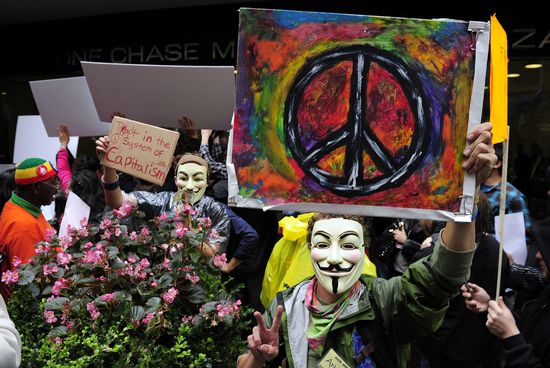
That's part of Andrew Hartmann's explanation for why they just can't get along, despite both being spawned by Wall Street excess:
Tea Party activists dressed up as 18th century patriots and often talked as much about God and Country as about Taxes. OWS activists look like hippies, smoke weed, and often talk as much about the spiritual evils of consumerism as they do about anti-austerity. Style, identity, and culture: these things seem to matter to both sides as much as politics (which is not to argue that these things can replace politics, if reform or revolution be the goals). Style, identity, and culture: these things are as polarized as politics. This is the legacy of the culture wars that helps shape our understanding of the great debate taking place right now.
But why does one side of the debate wear costumes from the 18th Century? Doesn't that clue you in to what they're really about? Two words: cultural panic. The only way they could actually unite with OWS would be if the cultural right re-embraced its early twentieth century suspicion of capitalism as a threat to traditional mores. Which doesn't seem likely any day soon.
(Photo: 'Occupy Wall Street' members stage a protest march in New York, on October 12, 2011. By Emmanuel Dunand/AFP/Getty Images)
The Airlines Turn A Profit
Amazingly enough [NYT]. Daniel Indiviglio focuses on the role of new hidden fees:
If airlines are profitable, then the higher all-in prices they're charging must not have cut demand enough to substantially reduce the number of consumers who can afford to fly. I wonder, though, whether the unforeseen nature of some fees matters here. … [A]s flyers become more acquainted with these fees over the next couple of years, we could begin to see demand decline.
Some might realize that flying isn't as affordable as they believed, after all. If that happens, then revenues will also decline and some of those profits we're seeing now might be reduced as well. But by then, the economy may be stronger. That would mean that incomes will be higher and consumers will find those higher prices more affordable. It also means that demand will rise more generally, since consumers and business people will be more willing to travel. So these profits could be sustainable either way.
 The Dish