Getting Touchy

129591091

Tim Noah translates politician body language: 

"Something to remember about touching is it's a hierarchical gesture," [Elizabeth] Kuhnke advises. "The person who initiates the touch holds the authority. The doctor touches the patient, the teacher touches the student, and the priest," well, never mind what the priest does. The point is that when Romney put his hand on Perry's arm it was not merely to say, "I would like you to stop talking now." It was to say, "I am superior to you and I would like you to stop talking now." 

(Photo by Ethan Miller/Getty)

Is Sleeping A Form Of Protest?

129032886

Dahlia Lithwick checks legal precedents that might apply to Wall Street occupiers:

The case law on sleeping and protesting is both fascinating and hilarious.

The most important case Dunn identifies is Clark v. Community for Creative Non-Violence, a 1984 decision from the Supreme Court about advocates for the homeless who were protesting (and sleeping outdoors) in Lafayette Park, across from the White House, and on the National Mall. The issue for the court was whether denying permits to sleep overnight as part of the protest violated the First Amendment. The court said it was OK to prohibit sleeping. At the same time, it conceded that "overnight sleeping in connection with the demonstration is expressive conduct protected to some extent by the First Amendment." It then got itself out of this legal and logical dead end by finding that the rule barring overnight protests was constitutional because it "narrowly focuses on the Government's substantial interest in maintaining the parks in the heart of our Capital in an attractive and intact condition, readily available to the millions of people who wish to see and enjoy them by their presence."

(Photo: Members of Occupy Wall Street sleep, spending the night on Zuccotti Park near Wall Street in New York, October 11, 2011. Protesters from the Occupy Wall Street movement scheduled a 'Millionaires March' taking their march in front of the homes of some of New York City's wealthiest residents in Manhattan Upper East Side. By Emmanuel Dunand/AFP/Getty Images)

Amish Anarchists?

David Friedman sees Amish communities as "evidence of at least one form of (very structured) anarchy that works": 

It is a very strange form, since the rules that the Amish are under are considerably more constraining—including rules on what styles of clothing they can wear, rules against owning automobiles or flying on airplanes, and much else—than the rules the rest of us are under. But those rules are all voluntarily accepted, and the system that generates them may reasonably be viewed as a competitive system of private law. … It's true, of course, that the Amish are under the rule of the U.S. (or, for a smaller number, Canadian) government. But they receive very few services from government, since they are unwilling to accept most of the conventional forms of government aid and, as pacifists, are unwilling to report crimes against themselves to the police or sue in the government courts to collect debts. Off hand, the only significant benefit I can think of that they get is protection against foreign invasion. 

Face Of The Day

129632795

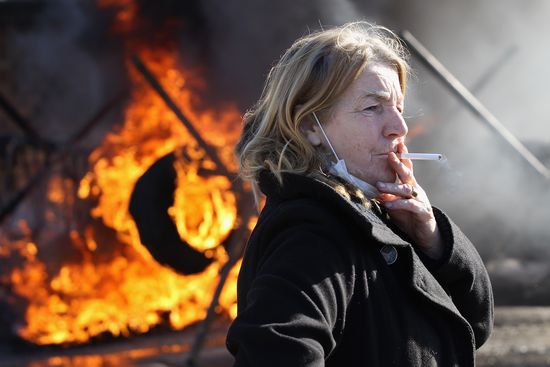
A resident watches the eviction of Dale Farm travellers camp on October 19, 2011 near Basildon, England. Travellers have fought for 10 years to stay on the former scrap-yard site. The local authorities have been given the go-ahead to proceed with the eviction of illegal dwellings after rulings by the Court of Appeal. By Oli Scarff/Getty Images.

Two Captives, Worlds Apart

Lawrence Wright compares Gilad Shalit to Bowe Bergdahl:

In June, 2009, an American soldier, Bowe Bergdahl, was captured by the Taliban. His name is practically unknown. He is still being held, but he is rarely mentioned in the press, political figures never invoke him, his image is rarely seen. He’s an afterthought in the long war in Afghanistan, if indeed he is ever thought of at all.

Ackerman picks up on the same parallel:

[T]he U.S./NATO military command, as much as it wants Bergdahl released, do not make Bergdahl a major public symbol. That would only increase the Taliban’s negotiating position, making it more likely that ISAF would box itself into the corner that Israel just faced. I don’t want to criticize Benjamin Netanyahu for striking the deal with Hamas to release Shalit. The decision must have been agonizing. It’s just important to recognize the steps that led to such an awful decision, and not to repeat them.

When Will True Artificial Intelligence Exist?

Once Siri, or something like it, gets smarter:

Every time an Apple engineer thinks of a clever response for Siri to give to a particular bit of input, that engineer can insert the new pair into Siri’s repertoire instantaneously, so that the very next instant every one of the service’s millions of users will have access to it. Apple engineers can also take a look at the kinds of queries that are popular with Siri users at any given moment, and add canned responses based on what’s trending.

In this way, we can expect Siri’s repertoire of clever comebacks to grow in real-time through the collective effort of hundreds of Apple employees and tens or hundreds of millions of users, until it reaches the point where an adult user will be able to carry out a multipart exchange with the bot that, for all intents and purposes, looks like an intelligent conversation.

(Hat tip: ED Kain)

China Confronts Its Bystanders

A devastating video of a Chinese infant left for dead on the street after being hit by two vans has gone viral:  

A closed-circuit television video obtained by state media shows the toddler wandering along a narrow market street in the city of Foshan when she is struck by a van. As several people walk or cycle by, the child lies in a pool of blood and is then hit by another van. All told local media count 18 people passing by before a trash collector finally picks up the child and gives her to a woman identified as her mother. … China's version of Twitter, Sina Corp.'s Sina Weibo, has drawn 4.4 million comments and organized them under the hash tag "Please end the cold-heartedness."

The above report shows video from before and after the accidents but edits out the striking of the child. Austin Ramzy has more:

Recently China has seen prominent cases of bystanders ignoring injured people. In Wuhan last month an elderly man who had fallen in a market died after he suffocated from a nosebleed. While a large crowd had gathered, no one had offered to help, and he was only taken to the hospital by family members who arrived more than an hour later, according to the official China Daily. As my colleague Hannah Beech reported, one explanation is that many Chinese fear the liability they might incur, because Good Samaritans have sometimes seen the people they intend to help turn on them. In one famous 2007 case in Nanjing, a young man who helped a woman who had fallen while getting off a bus was later sued. The woman claimed that he was the one who pushed her, and a court ruled that he was partly responsible. Other explanations include the so-called "bystander effect," in which crowds make people less likely to help injured people. Still others discuss a decline of morality that has shadowed China's dramatic economic reforms.