
A detail from a much bigger infographic on the evolution of Palestine. Earlier dustups over a similar map here, here, here and here.
A detail from a much bigger infographic on the evolution of Palestine. Earlier dustups over a similar map here, here, here and here.
Frum accuses Perry of not reading his own jobs plan:
Doesn’t Perry understand that his own so-called jobs plan–which is really an industry wish list for enhanced fossil fuels production–is entirely predicated on a doubling of energy prices over the next 18 years?
Jonathan Bernstein's alternate theory:
Perry is confronted with a tough problem, and is taking a sensible way out. The tough problem is that doing policy in the GOP nomination contest is almost impossible. What motivates Tea Partiers and other enthusiastic primary voters? A lot of it is mythical… It's not Rick Perry and Mitt Romney who aren't serious; it's the party they're trying to lead.
A reader writes:
Andrew, I’m used to you painstakingly gathering evidence for your arguments. So where is it that you get the “impression of the OWS crowds is that they express an almost fanatical hatred of anything called a ‘corporation.'” I mean, other than they’re a bunch of dirty hippy kids, is that proof enough?
Nope. Just listening to countless interviews, reading many articles, absorbing as much info as I can. Some proof in the above segment, from the worst kind of hippie. Another reader:
What gave you that impression? As someone who has participated in #occupywallstreet, that is not my impression at all. Have you perhaps bought into the right-wing’s caricature of the movement (however slightly and/or unintentionally)?
Most of the #occupiers are smart enough to not “fanatically hate[ ]” anything. What
they find dispiriting, and the focus of much of their collective outrage, is the manner in which the corporate form is abused by human actors to colonize (for lack of a better term) the political system and to perpetuate class injustice. I feel like such a scold, as the last time I wrote it was to express that I “expect better” of you. But again: I expect better of you, Andrew. You audience is simply too large, and your voice too influential, for me to ignore moments like this in which you propagate unfounded stereotypes from the detached comfort of your blogcave.
As an aside, and for illustrative purposes only, did you fail to notice that the official Facebook page of #occupywallstreet eulogized Steve Jobs upon his death? This is not a movement that fanatically hates corporations.
Another reader calls the above cartoon Sully bait. Another:
But isn’t it also true that pointing out that their world is saturated with corporations proves their point? That point being that corporations have their hand in everything we do and that we’ve grown so complacent that we assume this is the best thing for all of us, even when those corporations act against our well-being. If corporations weren’t saturating our world, OWS would be less necessary. It’s not really a critique to point out that they and all of us have no choice but to let corporations into our lives.
Another:
I just think you are wrong about OWS and corporations. I wish I had more to back this up than just my watching the livestreams all day and night, but here goes:
We don’t want an end to corporations. We want them to hire us.
We just want them to stop being jerks. To return to society the all-for-one spirit that we gave them. To wake everybody up that we are all in this together, not in the splintered, fractured groups we’ve been put in by political abuse. To say enough is enough. Everybody play nice.
Especially the banks and credit card companies. Yes, it’s been oh so amusing, their little parlor game where they try to wring out every dime from the customer that they can (raising rates, fees, etc.) I especially “loved” the last trick BofA ever pulled on me: putting my deposit in last after the checks that day so that everything bounced and I suddenly “owed” them hundreds of dollars. (Hello, local credit union, nice to meet you.) But now it’s time to stop it. I will now use my Mom voice. STOP IT.
I think the world we all hope will emerge is not one without corporations, but one where society serves the needs of the people, corporations and governments alike.
And yes, that world will have my iPhone, and I will meet you at Starbucks. (Not really, their coffee is terrible. Over-roasted beans to get you to buy junk to put in it to kill the bitterness. Flipnotics in Austin is far and away a better coffeeshop.) And I will meet you after WORK and spend some of the money I made, helping a corporation to help society by making good products and treating people fairly.
Yes, there are some kids with End the Fed and No Corporations signs. But I think it’s more of an overdrawn sentiment, a feeling, an emotion, much like my STOP IT. Not to be taken literally, though the young person holding the sign probably thinks it does, with his young, overweening heart. That’s okay too.
One more:
You throw a “fanatic” blanket over all who are part of the OWS crowd, and that is a lot of people. I even have a picture of my 64-year-old conservative mother with a “We are the 99%” sign. She thinks the Republican party left her about a decade ago and they are still in the wilderness. She and my father live with me because they lost their home in 2008. They have both worked my entire life (I am 31 years old) and are both very loving and generous people.
It is not greed or envy that motivates many in the OWS movement but rather the lightning speed with which our social fabric – our opportunity for all society – is coming unraveled, and the fact that no one with the power to do anything about it, who promises to do anything about it, ever does.
Since I’m working on an essay on OWS, I’m grateful for the input. Perhaps the word “fanatical” was too much. But the anti-corporation know-it-all hippiedom is part of this movement, and it’s dumb.
"First of all, I don't even know what SimCity is. Okay? I don't even know what it is. Secondly, it's a lie. That's all I can say. I don't even know what SimCity is," – Herman Cain, on the claim that 9-9-9 is inspired by SimCity's default tax rates.
I'm a little taken aback by the popularity of our first post-debate poll which gives you the chance to add your own questions. Here's the latest question you collectively created:
With so many Mormon "behind closed door" rituals, does Romney really stand a chance with the mainstream electorate?
So far, you say yes by a 3- 1 margin. So far, you're also evenly split on Santorum and Paul's performances. And on whether you can bear to watch the next debate. Heh. I will. They pay me.
You can still vote here – and vote on the new questions if you already voted early on.
Noting that the US now foots 18 percent of Israel's defense budget, WaPo's veteran national security reporter Walter Pincus offers some important context:
Nine days ago, the Israeli cabinet reacted to months of demonstrations against the high cost of living there and agreed to raise taxes on corporations and people with high incomes ($130,000 a year). It also approved cutting more than $850 million, or about 5 percent, from its roughly $16 billion defense budget in each of the next two years. If Israel can reduce its defense spending because of its domestic economic problems, shouldn’t the United States — which must cut military costs because of its major budget deficit — consider reducing its aid to Israel?
Last night's GOP debate revealed that the only thing the GOP will never cut is aid to Israel. They're more attached to it than any other item of discretionary spending – a function of Christianism's grip on the party's soul. MJ Rosenberg seconds Pincus:
Aid to Israel is virtually the only program, domestic or foreign, that is exempt from every budget cutting proposal pending in Congress. No matter that our own military is facing major cuts along with Medicare, cancer research and hundreds of other programs, Israel's friends in Congress in both parties make sure that aid to Israel is protected at current levels.
(Hat tip: Adam Weinstein)
This chart, showing the regressive nature of Cain's tax plan, and other charts like it, are making the rounds:
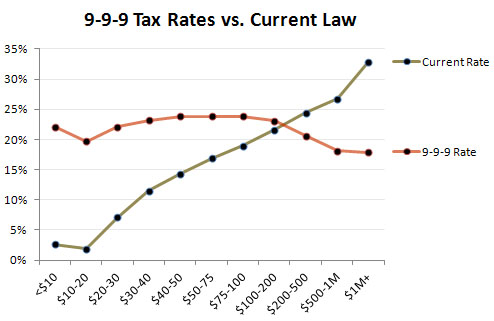
Howard Gleckman looks at how various households would be impacted by 9-9-9:
A middle income household making between about $64,000 and $110,000 would get hit with an average tax increase of about $4,300, lowering its after-tax income by more than 6 percent and increasing its average federal tax rate (including income, payroll, estate and its share of the corporate income tax) from 18.8 percent to 23.7 percent. By contrast, a taxpayer in the top 0.1% (who makes more than $2.7 million) would enjoy an average tax cut of nearly$1.4 million, increasing his after-tax income by nearly 27 percent.
I can see the argument for targeting Al-Awlaki, even if I would prefer the government make its case in public and in detail. But his teenage American son?
Joshua Stacker pushes back against the narrative of Egypt's benevolent military overlords:
Blame for the sorry state of the Egyptian transition should not be shared. The [Supreme Council for the Armed Forces] is disproportionately in charge and it is disproportionately to blame for how the transition has been structured. Whether by initiating new laws against protests, strategically deploying military trials against activists and opponents, continuing to apply Emergency Law, devising electoral laws that encourage social fragmentation, framing clashes with a sectarian hue, or intimidating and censoring the press, Egypt under the SCAF represents an attempt to continue the practices of the Mubarak era despite the social changes unleashed by the revolution's popular mobilization. It is no accident that many of the activists who participated in the January 25 revolution now vehemently oppose the SCAF.
Naturally, they don't really want any:
When it comes to cutting Medicare, Medicaid and Social Security, the [40,000-member Tea Party "commission" on reducing the federal budget deficit] said visitors to the site were "more cautious," and "prefer reductions in peripheral elements," like tightening eligibility for Social Security disability payments and reducing subsidies to teaching hospitals.
Scott Galupo reiterates his previous criticisms:
The Tea Party was a cultural outburst … At this point, anyone who's serious about budget reform needs to ignore the Tea Party. Just pretend it never existed. It can't help you. Its purported concern for budgetary balance was never more than tangentially connected to fiscal reality.
Which is something I've been saying for a very long time. The Tea Party is the Christianist faction in the GOP rebranding itself. The idea that these people actually want to slash Medicare is a fantasy only the Village embraces, because it prefers phony "balance" to the truth.
 The Dish