Nevada Debate Reax: You

You'll notice we added a new feature this morning to gauge reader response to the debate last night beyond our edited reader emails. Your verdict was that Romney did well, followed by Santorum. The rest? Not so much. You're more dismissive of Cain than I was. You think Huntsman was wrong to boycott.

But the interesting thing about this new polling feature is that it allows you to add your own questions, which we then select and add back to the poll. You've added three questions:

Is this the weakest Republican field ever assembled?

Could you ever, under any circumstances, imagine yourself casting a vote for Mitt Romney against Barack Obama?

Will Romney be a tougher debate for Obama than McCain?

Results here. You can vote on all 13 questions here as well. Around 12,000 20,000 Dishheads have voted so far. If you're interested in how many Dish readers intend to vote for the GOP next year, check it out. Full results here.

Nevada Debate Reax II

Pete Spiliakos:

Whenever the other candidates talked about how the two consumption taxes and the flat income tax would increase taxes on the middle-class and working poor, Cain would just talk about how his analysis was different from that of independent observers and common sense. His defense seems to be that the 9-9-9 plan is so simple and transparent that Cain and Cain’s economic team are the only people on Earth who understand how it impacts anybody, so don’t worry your pretty little head if it looks like a tax increase.

PM Carpenter:

Cain’s blunder? That final “9” — the one that more than doubles most states’ sales tax. Had Cain nixed the triad and gone with a duet, he might have survived his fellow rightists’ assaults. It goes without saying that the rest of his plan is idiotically unworkable as well, but that never stopped the right-wing horrors of Reaganomics or W.’s balanced-budgets-through-higher-spending-and-revenue-gutting.

Conor Friedersdorf:

The irony [of Perry attacking Romney for hiring illegal immigrants] is that as a lifelong Texan, and a rich one for some time now, the notion that Perry has never so much as done business with anyone who employs illegal immigrants is laughable. Does he ever eat out? Or take taxis? Does he verify the legal status of every house cleaner, gardener, plumber, locksmith and carpenter who sets foot on his property? How will his donors feel about the notion that anyone who has employed an illegal immigrant deserves censure?

Ed Morrissey:

This is the first debate Romney unquestionably lost.  Perry won to an extent by exceeding expectations and staying in the fight the entire debate, but was it a breakout performance?  Doubtful, although it might be enough to get a few of his supporters back in the fold and regain a little momentum.

Nate Silver:

I’m not intrinsically averse to declaring winners and losers in presidential debates. But there are times when everything is fought more or less to a draw. … it may be best to wait a few days to see which gain traction rather than rush to declare a winner.

David Corn:

Romney is worried about a Perry comeback. I didn’t clock it, but it sure felt as if Romney spent more time with Perry in his sights than Cain. This would suggest that Team Romney considers Cain still the flavor of the nanosecond who will eventually flame out. And if Cain is sucking up the oxygen that would otherwise fuel another anti-Mitt candidate, that’s fine by Romney. In all likelihood, Cain won’t have the money, organization, or staying power to threaten Romney.

Jonathan Chait:

Romney necessarily spends most of his debates playing a character type only loosely related to the actual Romney. He had one delicious, authentic moment when Perry assailed him for employing illegal immigrants. Romney claimed that he had fired them, and described his thinking at the time like so: “I’m running for office, for Pete’s sake, I can’t have illegals!” I am totally convinced this was what Romney was really thinking. With everything else he says, you’re always peeling away the layers of the onion to figure out what the true Romney thinks. Perry, characteristically, was too dim to notice this, but his handlers will probably train him to quote it at the next debate, by which point Romney will have a slick response that leaves Perry flustered.

Mark McKinnon:

Romney was on defense in this debate. A lot. And some blood was drawn. And his hair was mussed. He had it coming from all directions. Gingrich and Santorum attacked on health care. Perry attacked on immigration. But once again, Romney parried fairly effortlessly. He stood his ground and refused to yield. Four years ago, he would have allowed himself to be interrupted. Tonight, he was a battering ram whenever anyone tried to interrupt him. He refused to yield. Which communicates strength. Which is what voters want to see.

John Cassidy:

Welcome to the start of the Republican primaries proper: a no-holds-barred knockout contest between a former moderate Republican governor running as a born-again conservative and a former Democratic campaign manager running as a right-wing fruit cake. From a spectator’s viewpoint, it’s going to be lots of fun once Herman Cain gets out of the way, which he shows every intention of doing.

“An Ice-Free North Pole Within The Next 10-20 Years”?

Stefan Rahmsdorf freaks out:

This loss of ice will not only turn the Arctic ecosystem upside down, affecting many animals that are adapted to a life with sea ice. It will affect all of us. If the Arctic ice disappears in the summer months, we will lose a giant mirror that reflects solar heat back into space and helps keep the planet cool. The ice loss will amplify global warming and upset weather patterns. But the ice loss will amplify warming especially in the Arctic – indeed, this is already happening. Moreover, disproportionate Arctic warming is already affecting one of the most important components of the global climate system: the Greenland Ice Sheet. If this giant structure melts, sea levels worldwide would rise by about seven meters.

Squeezing Shalit For One More Ounce Of Propaganda

Marc Tracy is infuriated by Egyptian TV's interview with Gilad Shalit before his return to Israel. It was, in my view, disgusting:

The "interview" this morning on an Egyptian television network was the final sadistic nail in the coffin of the five-plus years’ captivity of a teenage Israeli soldier.

To be very clear, the interview was not agreed to by Israel—the original plan was for Shalit to be in Egypt for less than 15 minutes, merely an intermediate point between Gaza and Israel—and the Israeli government is shocked and appalled by the propagandistic spectacle (the English-language interviewer asked Shalit leading questions about Egypt’s indispensable role in brokering the deal and whether more Palestinian prisoners should be free). If you watch the video and see this poor kid barely able to keep his eyes open and wanting only to see the family he’s been kept away from for a fifth of his life, you will be shocked and appalled, too. … The hand on Shalit’s shoulder [during the interview] belongs to a Hamas thug standing behind him. At a moment when Shalit must still not have been sure that the deal for his freedom was going to go through, he was subjected to this. Frankly, it’s fucking enraging.

I'm glad that the treatment of prisoners in wartime is getting this amount of attention. Pity it isn't applied consistently.

How To Write About Yourself

Some advice:

There’s a difference between making everything about you and infusing yourself into everything you write. The former is lazy, narcissistic and all too common. The latter is how you develop and define the unique voice that endears you to an audience and makes your words instantly recognizable in a sea of sameness. It’s difficult to strike a balance between TMI and being a cipher, but being compelling involves putting some of yourself (even if it’s only obliquely so) on the page.  You need to figure out how to make that work in your genre through a trial and error process.

E.D. Kain nods.

The Nevada Debate: Reader Reax

Nevada Debate

Answer the quick questions above and submit your own (in the field at the top of the poll, marked "Enter a YES or NO question". Update: We are limiting the questions to 20 this time around, but will allow many more in the future. Thanks to everyone who submitted). A reader writes:

You noted that the crowd last night seemed to side with Romney when Anderson Cooper brought up the recent attacks on his faith. While it would be pleasant to believe there is a new sectarian streak in the GOP, a more likely explanation may lie in the debate's location; Nevada is right next to Utah and has a large Mormon population. Many of those in the crowd were likely Mormon or at least have many Mormon acquaintances. Would Romney's defense of sectarianism have played as well in South Carolina?

Another quotes me:

The moment of hope? Romney's defense of no religious litmus tests in American politics. I wish I could be as certain of the sincerity of this if he weren't a Mormon but an evangelical.

He started what seemed like a forthright defense of the Constitution's ban on a religious test for office. But then he made clear that a candidate could practice whatever faith he or she chose; he pointedly did not say that an atheist could also legitimately hold office. And he closed by saying that it didn't matter what church or synagogue a candidate attended. If he really believe in what he was saying – if he really had any guts in front of the redmeat Republican crowd – he'd have added "mosque" to that sentence.

Another comments on CNN's ridiculous intro:
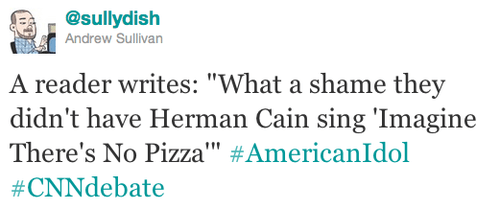
Screen shot 2011-10-19 at 1.58.22 AM

Another makes a really substantive point:

I think one of the reasons Romney's rivals have had trouble attacking him on the similarities between Romneycare and Obamacare is that they risk calling attention to Obamacare's *conservative* nature.

For the past two years, Republicans have been depicting Obamacare as a government takeover of the health care system, with death panels to boot. Probably many conservative voters have no idea that it contains no public insurance programs, because right-wing media has been fostering the idea that it does. So when Romney talks about how his plan used only private insurance companies, his rivals can't say "But so does Obamacare!" because that would be letting the cat out of the bag. They try to contradict his claim that it's market-based – as in Santorum's description of the plan as a "top-down government-run program" – but they know they can't get too specific, because it would expose their lie that either program is government-run.

They'd have to talk about the exchanges, which are clearly not socialized medicine, and when they get to the part about stopping insurance companies from excluding people with preexisting conditions, they'd be put in the awkward position of either straying from GOP orthodoxy or adopting a highly unpopular view (a dilemma that briefly tripped up even Tea Party star Marco Rubio last year). The only concrete major component truly shared by both plans that's easy for Romney's rivals to attack openly is the individual mandate, but they don't want to limit their attack to it. So they're in a perilous position, and skewering Romney on this issue is not as easy as it would first seem.

Another:

Arrggghhh … Anderson Cooper repeats the lie that 47% don't pay taxes. This drives me nuts.  The poor pay sales tax!  The poor pay other taxes. They just don't pay federal income tax.  The host of the debate repeating that lie that 47% of the people don't pay taxes is just sad and misleading.

Another:

Romney said he wanted America to stop borrowing money from the Chinese to give foreign aid to Africa, saying he'd urge the Chinese to give that aid directly. This policy will have two complementary effects: it will decrease American influence and increase Chinese influence around the world. Good thinking, Mitt!

Another:
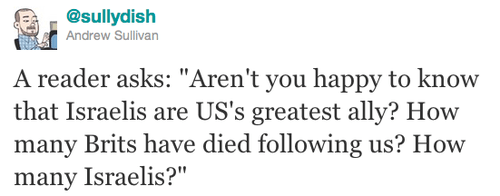
Screen shot 2011-10-19 at 1.56.15 AM

Another adds:

As a Canadian, it burns me a little every time I hear this.  I wonder how many GOP candidates know that Canada is America's largest trading partner and largest source of energy.  I see what the US does for Israel, but what the hell does Israel do for the US??  Nothing, as far as I can tell.

Another:

I love how Michele Bachmann blasted Obama for allegedly betraying Israel by being the first president to put "daylight" between the US and Israel, but in the very next breath insists that the US should never, under any circumstances, negotiate with terrorists – harkening back to the question posed about Israel negotiating with Hamas to release a single IDF soldier for 1,000 Palestinian soldiers.  That sounds like a lot of "daylight" to me!

Another digs deep:

Gingrich: He suffers from looking out of shape, frankly. He often seems interested in making interesting points of facts about something or other in a knowledgable tone. He is good to have in the debates because his discussions of the history of healthcare or immigration law, etc, basically clue Bachman, Perry, and Cain in to what they're talking about. I'd say he is occasionally appreciated as a debate participant, but no one takes him seriously as a candidate.

Paul: Like Gingrich, he's good to have in the debate. The other candidates take cues from how the audience reacts to some of Paul's remarks. For instance, when Paul came out in defense of the middle class and took a swing at Wall Street, the audience roared approval. I'll guarantee that the other candidates took notice. Toward the end, for instance, Cain contrasted himself with Romney by pointing out that Romney's business experience was "Wall Street" while his own was "Main Street". As for Paul himself, he could actually make himself more popular if he would just quit bringing up the Fed all the time.

Santorum: He seems like he got into politics because he was told when he was in high school that he did well on the debate team. He just looks like that guy. Romney looks like the guy who was quarterbacking the football team while Santorum was earning gold stars on the debate club and then Romney turned out to have higher SAT scores than him as well. Who could have predicted it? If Santorum is right about Perry and the letter that he wrote in support of TARP, then Perry is probably going to become a laughing stock.

Bachmann: The only thing I remember about her was that she had no idea about how to relate to the setting. She never chimed in naturally. She never spoke in a normal tone of voice. She constantly seemed to be speaking in platitudes and she seemed to think that she was on TV and not in a debate. She has failed to realize that being on TV in this day and age of reality TV means you have to act more real, not more like a robot with makeup.

Cain: He could up his game, I think. He appears to be still adjusting to the fact that, as a frontrunner, he has to become less of a quips and sound-bites person (incessantly repeating "apples and oranges," for instance) and have more real explanations. What I like about him, though, is that he is very sensitive to what plays well and adjusts nicely. He shares this with Romney, and I wonder if it is because they have had to survive the shark-infested business environment. He appears to operate by testing the waters with bold statements, and then moderating his position according the variety of response he receives. His good-natured personality lets him get away with it.

So, for instance, he tested how his bold "electrified fence" remarks on the immigration wall played, then was willing to backtrack a bit. He tested how his remarks on Wall Street played during this debate and then adjusted a bit when Paul pushed back by saying he was blaming the victim. So he's good and he improvises well, but he needs to be better informed and prepared in terms of the facts and issues. One gets the sense that he is a follower and poll-reader, not a focused visionary.

Romney: In him I see a guy who is practical. No one is quite sure what he thinks about abortion or healthcare, etc., but most people don't have any idea what they think themselves about healthcare anyway, and abortion is also not a black-and-white issue for most people. What is clear about Romney, though, is that he is intelligent, able to take charge, emotionally aware, and seems to be in command of facts. I don't view him as either a Democrat or a Republican, really. I see in him a practical and successful businessman who has a conservative personal disposition and who has found that the conservative values and habits that were instilled in him in his youth have served him well in life.

But in terms of what he would actually do – I think Romney is probably the most likely of all the people running, including Obama, to take down Wall Street if elected president in 2012. He would see the practical sense in aligning with the Occupy Wall Street movement's calls for reform, and his Republican and pro-business chops will give him the cover he needs to take on the financial sector. I'm a little concerned about how much money Romney has taken from Wall Street, but I think that once he becomes president he'll adjust to the realities of the situation and he appears to have enough personal confidence that he would actually be able to stand up to powerful interests in a way that Bush couldn't and Obama isn't well positioned to. (Only Nixon could go to China…)

Perry: Basically, he continually made Romney look more alpha by repeatedly challenging him and getting smacked down hard. At one point Romney even put a hand on his shoulder and one could sense the testosterone rising. Romney not only continually won the challenges, but came away looking like the bigger man as well. Perry's attack on Romney for hiring illegal immigrants was easily brushed aside by Romney (maybe most Americans mow their own lawns, but most Americans would hire a lawn care company if they could, and most will give him a break on the situation he described as well).

Basically, Perry isn't in the same league as Romney. Romney shredded Perry to bits again on the issue of a religious test for office. Also, Perry's suggestion that we use Predator drones to police the border with Mexico sent shivers down my spine. That is exactly the kind of thinking that I want no where near the oval office. Perry seems out of his depth, although not quite as much as Bachman, whom everyone is pretty much ignoring at this point.

Blogger reax here. My live-blogging here. More discussion on our Facebook page. Follow @sullyfeed if you haven't already.

Bad Spouse, Bad Parent? Ctd

A reader writes:

My dad had a plaque on his dresser that he looked at every morning as he got dressed.  It read: "The best thing a father can do for his children is to love their mother."  I find more and more wisdom in that saying the older I get.

Another writes:

I definitely agree with what Bryan Caplan has to say about the bad spouse/good parent equation. One thing I'd like to add though is that it's important for kids to see some discord, especially if it's handled well.

I once read a really persuasive article (I forgot where exactly) about how people who grew up with parents who had apparently "perfect" relationships – no visible fighting – would then get freaked out once strife arrived in their own romantic relationships.  (This article covers some of the same ideas as the one I'm trying to think of.) Because they never saw their parents fight, they a) didn't know how to fight, in a healthy or unhealthy way, and b) thought that "good" relationships are argument-free. In fact, even the parents with "perfect" relationships did fight, they just did it behind closed doors.

Obviously the important part is to fight respectfully and constructively – not just spewing vitriol. But showing that disagreement can be (and usually is) a part of a healthy relationship – and showing HOW to fight respectively and constructively – can actually be beneficial for the kids, long-term.

Another makes the same basic point through personal experience:

I grew up with parents who insisted that they didn’t fight and kept most of their conflicts out of my sight. My wife, on the other hand, had parents who fought in front of her. She entered our marriage with a healthier, more realistic, understanding of the institution. To this day, I avoid most conflicts and experience them as harmful (even when I know they are not); she experiences conflict as a normal part of human relationships.

We often struggle with arguing in front of our two daughters. Do they really need to see all the small, insignificant conflicts of our stressed lives played out in front of them? There are some arguments I have ended by simply refusing to respond. But there is a lesson lost when parents don’t ever argue in front of children. I don’t want my daughters to grow up – like I did – with unrealistic expectations about what makes for a healthy relationship. I want them to see that love doesn’t take away conflict and hurt feelings; it doesn’t mean you will never harm the other person or be pained by their actions or words. I want them to see that love means forgiving and being forgiven. I want them to enter adult relationships knowing the challenges ahead because they have seen their parents work through difficult times and painful moments and still come out the other end together.

In short, I want them to see what marriage really is. Our culture already provides them with enough false models.

Which Nation Will Be The World’s Factory?

Noah Smith explains how density boosts China's economy:

Despite our wealth, our technology, and our industrial history, America is not a very densely populated place. That means that if you had to pick America or China to be either the world's factory or the world's farm … well, China would be Manhattan and America would be upstate New York. It's not that stark, of course, but look at countries that have plenty of land and resources and few people–Russia or Argentina comes to mind–they don't seem to be doing a lot of high value-added manufacturing or services.

If we want to be the world's factory fifty years from now, one important thing we can do is to welcome large numbers of immigrants (especially high-skilled immigrants) into our country. We should also focus on policies to promote greater urbanization within our country: walkable neighborhoods, high-rise housing, and light rail would accommodate those new immigrants much easier than sprawling exurbs and traffic-choked commuter freeways. These are things we should and could be doing independently of trade policy, innovation, etc.