The Ethics Of Pheasant Hunting

Are complicated:

[One] objection made to pheasant shooting is that people don’t eat the pheasants they shoot. If factory farming animals is justified by the fact that we eat the animals, then perhaps shooting pheasants is justifiable only when the pheasants are eaten. But what is it about eating animals that justifies harmful farming?

If we needed the nutritional value provided by meat, our justification might be something akin to self-defence. That is manifestly not the case – those who shoot pheasants, like those in the developed world who buy meat from the supermarket, could get all the calories and vitamins they needed from other sources if they chose to. In developed countries, we eat meat primarily for pleasure. Therefore, if our practice of farming animals to eat is justified, it must be justified by the pleasure people get from eating meat. It seems reasonable to suppose that people who go shooting enjoy doing so, and that that pleasure is comparable to the pleasure of eating a piece of meat. Does that mean that the practice of shooting pheasants is no worse than that of eating meat?

Julia Kennedy interviews Peter Singer on some related ethical issues.

The Bloody Road To Peace

Douthat finds several blind spots in Steven Pinker's latest book on the decline of violence:

[W]hile the gradual consolidation of the modern state may eventually tend toward the relative pacific conditions that currently prevail in Europe, that consolidation tends to be so bloody in and of itself — thick with persecutions and genocides and “cleansings” of various sorts — that one could reasonably doubt whether the ends were worth the means. (If you look at Europe’s settler states, for instance, from the United States and Latin America to South Africa and Australia, there’s often a plausible correlation between how completely the native population was wiped out during the age of colonization and how stable and prosperous they are today.) When Pinker talks about the benefits of “the civilizing process,” in other words, he doesn’t give enough weight to the interests of the peoples who were “civilized” out of existence.

 Earlier posts on Pinker's book hereherehereherehere and here.

Will China Plateau?

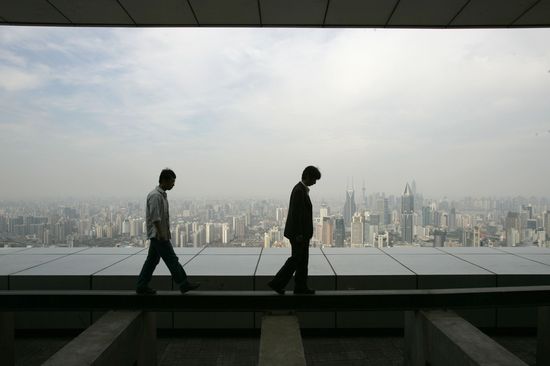
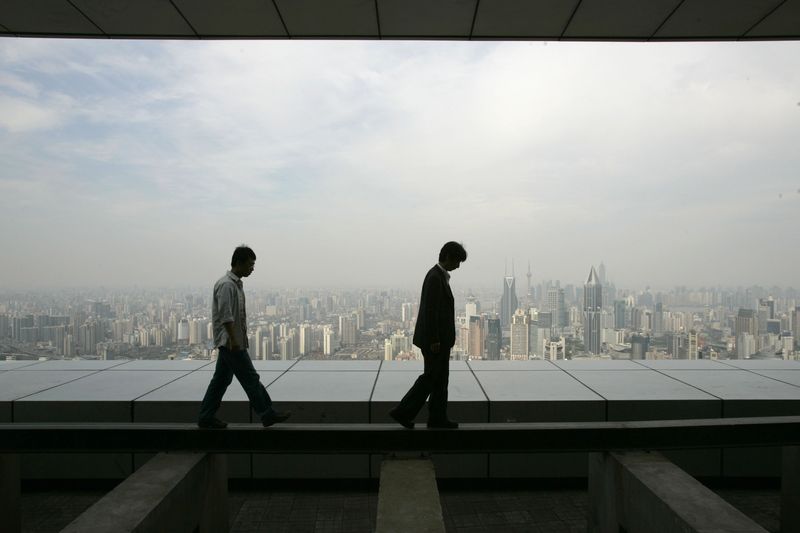
GT_SHANGHAI_111014

Joel Kotkin debunks the notion that the "golden age of Chinese supremacy" is inevitable:

Throughout modern history authoritarian and more centrally controlled countries have proved very good at playing "catch up" and impressing journalists. China’s Communist regime can order investment into everything from high-speed trains to green technology and massive dam construction. The results — like those previously seen in Nazi Germany and Soviet Russia — are often as physically and technologically impressive, although often cruel to both the environment and people stuck in the way. But once a country reaches a certain plateau of development, as Japan did in the 1990s, the nature of the competition changes; it becomes harder to target industries that are themselves in constant flux. Workers who have already achieved considerable affluence tend to be harder to bully or motivate.

(Photo: Men walk on the roof of a building facing skyscrapers in the skyline of the Lujiazui Financial Area in Shanghai, China. By China Photos/Getty Images.)

Was The Housing Bubble Also A Baby Bubble?

New research considers the connection between housing prices and the decision to have children. Ryan Avent takes the paper one step further:

Obviously, there's more to having children than perceptions of wealth. To the extent that housing wealth matters, however, the housing bust has likely contributed to a corresponding baby bust.

The Daily Wrap

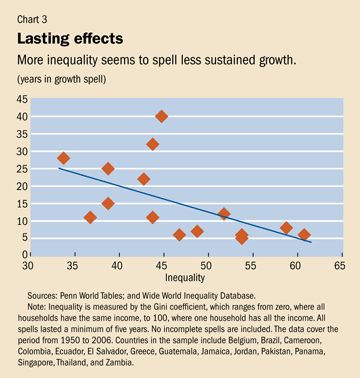
Inequality and growth
Today on the Dish, Andrew warned of the dire economic consequences of extreme inequality, and he reflected on the Occupy movement's mounting global resonance. OWS proliferated in the liberal West (dispatch from a reader-demonstrator in L.A. here), both OWS and the Tea Party have some explaining to do, and philosophers stood in solidarity with the former. The 99 percent have something of a PR problem, a Democratic PAC launched an OWS-inspired attack on an incumbent House Republican, and an NYPD officer struck a demonstrator brutally and out of the blue. 

Herman Cain claimed to be ignorant of the neoconservative movement, he didn't want to throw his advisers "under the bus," and he probably doesn't bring enough "pay" to play. Unfortunately for Cain, knowledge of foreign affairs is decidedly cumulative, and there's not much the blogosphere can do to legitimize Perry's "jobs plan." We read Romney's lips, wondered which way Jim DeMint would go, and our readers pushed back against Paul's "baby in a bucket" story. Perry's Christianist allies are still sounding their anti-Mormon alarms, Steve Clemons stood up for Huntsman's sensible foreign policy, and Andrew extolled the virtues of the British parliamentary system in our AAA video (don't miss the bonus analysis after the jump). 

The president preached sanity at the dedication of the MLK memorial, he deployed an intervention in Uganda, and we considered the legal questions surrounding the mini-war. The Supreme Leader would have "no problem" ending Iran's presidential system, Hamas is rapidly losing ground, and our withdrawal deadline in Iraq is still up in the air

The author Teju Cole tweeted "small fates," we recovered American exceptionalism from the dangers of bad theology, and TNC contemplated patriotism and gratitude. Readers voted on voting, a preventative approach to healthcare drives down long-term costs, and Felix Salmon made the case for economically efficient taxes. Free trade comes with a cost, widespread deleveraging is crippling demand, and optimism isn't always the best frame of mind. Hot stewardesses still fly outside the U.S., we brushed up on photosynthesis as changing leaves peaked, and hair crimes tested Amish core principles.

TWSS of the day here, hathos alert here, creepy ad watch here, MHB here, VFYW here, FOTD here, and charming presidential pick-up lines here

– M.A.

“These Are Not Radical Notions”

128340077

A reader writes:

I thought I'd write to you with our own experiences taking part in the Occupy LA protests. I'm in my early 40s, at a well-paying job as a web developer for a large hospital in Los Angeles. My wife and I have no children. We're very fortunate – we actually have a steady income and good health insurance. Yet, we live in a house that we share with her cousin because we couldn't afford our own place. The house is deep underwater, and we're drowning in debt (and shame on us for not reading the fine print when some of the credit card issuers arbitrarily raised our interest rates to 30% on cards that had never had a late payment EVER). We're barely making it check-to-check, but somehow we are still making all of our payments. It would be so much easier to walk away from it all, but we have a sense of responsibility to these debts that we voluntarily took on.

What we're demanding – what people in the Occupy movement are demanding – is the same responsibility from these large institutions, and the so-called 1%. It's really that simple.

When the financial industry came to the brink of collapse because of the reckless behavior of these "too big to fail" corporations, we saw an amazing ability for our government to come together to bail them out. In return, they've repaid the favor by working night and day to lift the already watered-down provisions of the Dodd-Frank reforms so they can continue with their same insanity, and to basically act like spoiled, entitled brats towards those of us who saved their butts in the first place.

Contrast this with any legislation in Congress that might actually help out rank-and-file Americans, and suddenly everything becomes gridlocked and impossible to achieve. From out here, it appears that when you have a lobby on your side, government works, and if you don't, well tough luck.

We march for three simple things: tighter regulation of the financial industry (a return to Glass-Steagall would be a big step), a demand for shared sacrifice amongst *100%* of this country, and to wake up those in Congress who have been listening only to the lobbyists and the media chattering classes, and losing sight of the fact that this country is a DEMOCRACY, of the people, by the people, and for the people.

These are not radical notions, and they're not even strictly left-wing (personal responsibility seems like a classic conservative belief to me). This is the no-longer silent majority in this country, across the spectrum, who have finally had enough.

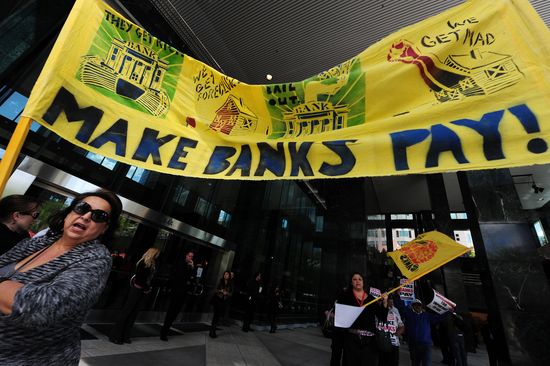
(Photo: Protestors march through downtown Los Angeles' financial district on October 6 during an anti-Wall Street demonstration. At least 10 protestors werre arrested after they entered a Bank of America branch and refused to leave. The arrests came at the end of a march of about 500 protestors from labor unions, Occupy LA, and other groups that marched passed banks and other financial institutions. By Robyn Beck/AFP/Getty Images)

Is Hamas Collapsing?

Looks like it:

Besieged by Israel and the West, which regards it as a terrorist group, and cut off from the Palestinian majority in the West Bank, Hamas has little to offer beyond its jihadist credentials — and the promise of clean government. So it's hardly surprising that the party has been rapidly losing ground in its stronghold. Recent surveys by leading pollsters conclude that if elections were held in Gaza today, Hamas, an acronym in Arabic for the Islamic Resistance Movement, would not be returned to power. A June poll by the Palestinian Center for Policy and Survey Research found that Hamas would get just 28% of the vote, a steep decline from the 44% plurality it won in 2006. Especially alarming for the Islamists is a precipitous drop in support for the party among Gaza's youth: two-thirds of the population is under 25.

Creepy Ad Watch

ChicagoChildren

Copyranter recoils:

No one should have to witness the sexual abuse? Alright, next time stepdaddy will bring a blindfold. Jesus what are people thinking?!? Also, re: putting a bear in a child abuse ad—ahem.

Update from a Chicago reader:

While I can't necessarily get behind the exact word choice on this ad, the Chicago Children's Advocacy Center ad campaign (including such other slogans as, "most victims of 'sexual molestation' aren't even old enough to spell 'sexual molestation'") are specifically designed to be "creepy ads" in order to make a point.  The kids that the CCAC deals come from deeply fucked-up situations and then get thrust into a justice system that treats them as case instead of a child, thus reducing their internal sense of humanity even further.  This is an organization that cuts through a Gordian knot of red tape in order to get criminals prosecuted and get the victims a support structure with which they can shed the role of victimhood.  CCAC's website claims that they deal with 2,500 victims each year, and I don't think it's at all unreasonable to assume that that's probably only a fraction of the kids being abused just in the Chicago area.

Pulling Out Of Iraq, For Real?

Over the weekend, the AP reported that the "US is abandoning plans to keep U.S. troops in Iraq past a year-end withdrawal deadline." Joel Wing says this is nonsense and that American troops will remain into 2012:

The fact that Iraq’s military is almost completely incapable of defending the country from foreign threats is the driving force behind their desire to keep some trainers past 2011. Current Iraqi plans, don’t have the security forces ready for that task until 2020, and even that might be too optimistic. In a region with yearly shelling and air strikes by Turkey and Iran, insurgents infiltrating from Syria, and Iran providing lethal support to Special Groups, a strong and competent military are a necessity to deter these countries from continuing their interference in a weak Iraq.