The Grim Tweeter

Screen shot 2011-10-14 at 3.10.56 PM

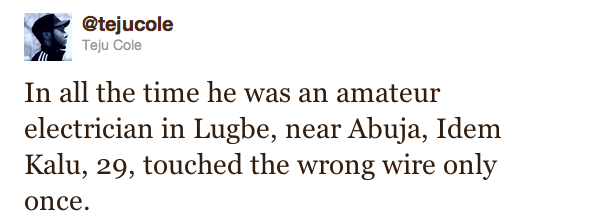
The author Teju Cole, who grew up in Nigeria, uses Twitter to eulogize random citizens, which he calls small fates:

Each small fate is complete in itself. It needs neither elaboration nor sequel. The small fates, I feel, bring news of a Nigerian modernity, full of conflict, tragedies, and narrow escapes. Similar to the French papers’ fait divers, they work in part because whatever that strange thing was, it didn’t happen to us. They are the destiny that befell some other poor soul, which we experience from a grateful distance.

How Matt Pearce reconciles his own guilt in enjoying the project:

It’s like the contradiction of liking animals but eating meat. At some point, eating a hamburger means that you’ve either chosen to ignore what’s happened to the cow or you’ve considered it logically and coldly approved it. To find pleasure in reading about any real suffering is either to ignore reality or to — perhaps even worse — rationally justify doing so. … Cole’s giving them their 140 characters of fame, and unless he finds some hidden way to take the suffering out of this world, I wouldn’t have him stop.

Where Is Occupy Wall Street Strongest?

The West:

On a per-capita basis, the West drew about two-and-a-half times more protesters than the Northeast, four times more than the Midwest, and five times more than the South. … I suspect that more than anything … [this regional split] it reflects the politics of the protesters. Specifically, they tend to be more liberal than they are Democratic partisans. Take liberalism, subtract the Democratic Party, and the remainder might look something like Occupy Wall Street.

Should You Vote?

Voting

According to Jason Brennan, the answer for most people is no:

We would never say to everyone, "Who cares if you know anything about surgery or medicine? The important thing is that you make your cut." Yet for some reason, we do say, "It doesn’t matter if you know much about politics. The important thing is to vote." In both cases, incompetent decision-making can hurt innocent people.

Commonsense morality tells us to treat the two cases differently. Commonsense morality is wrong.

Do you agree with Brennan? Of course you can email andrew@thedailybeast.com for any lengthy responses, but you can also answer the quick "yes/no/don't care" questions in the above survey and submit questions of your own.

A President Must Understand Foreign Affairs

Herman Cain claims that he would rely on unnamed experts for foreign policy advice. Dan Drezner finds this insufficient:

[W]ithout some knowledge about foreign policy, the best intelligence briefings and foreign policy advisors in the world won't be able to help Herman Cain. An awful lot of international relations knowledge is cumulative; without a decent base there's no point in trying to be briefed on the arcane stuff. That would be like trying to learn calculus without knowing any algebra.

An earlier look at Cain's foreign policy ignorance here, as well as here and here.

Is The LRA Mini-War Legal?

David Dayen says no. Scott Lemieux counters:

I take no position on whether the Obama administration’s actions are prudent or likely to be effective. But in terms of constitutional restrictions on executive power, the actions against the LRA are completely unobjectionable. Unlike Libya, this was done right, with the ex ante authorization of Congress.

Face Of The Day

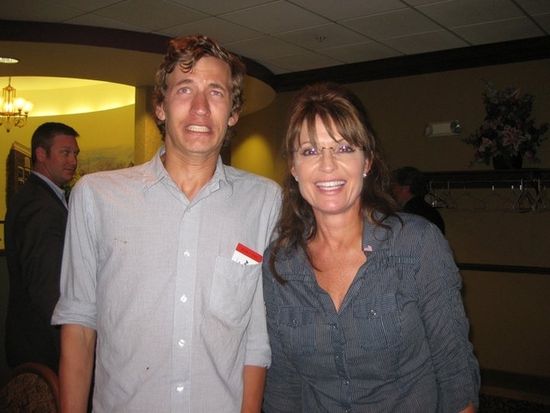
Sarah-palin-photobomb-15093-1318817522-3

Brian Adams adds, "Honestly he looks like he's keeping it together better than most."

Update from a reader:

My dear friend took the photo of today's "Face of the Day." I thought I'd try and get his photo credit on the Dish. His name is Michael DuPré. We're both delighted you picked it up.

Confirmed by Michael:

Yep, I took the photo of Sarah Palin and my friend.  The photo was taken in Pella, Iowa on the night of the premier of her film, The Undefeated.  To get this shot, my friend and I stayed at Monarchs, a local restaurant and bar, until Palin and her entourage left around 3am. 

The photo totally made my day.

Reimagining American Exceptionalism

Reacting to the "bad theology" of the GOP field, Mark Mitchell brings the notion back to earth: 

There is a world of difference between the person who with a brash swagger asserts that America is the greatest nation on earth and the patriot who lovingly cares for his particular place while uttering a prayer of thanksgiving for the manifold blessings he and his children enjoy. One fails to admit responsibility or to tread lightly and therefore invariably behaves poorly while remaining blind to the fact. The other recognizes that gratitude is inseparable from responsibility, for a gift rightly received must be tended with intelligence and care. Perhaps it’s time to seek out (or carve out) another strand in our American tradition, a strand that acknowledges the many good things we have inherited and soberly embrace the responsibility to steward these things well. A more modest republic would, in light of our history, be an exceptional accomplishment.

A-fucking-men. There is also a correlation, I'd wager, between declarations of exceptionalism and evidence of national decline.

Occupy Philosophy!

A group of philosophers has created a blog to "stand in solidarity with the Occupation Movement in the US and around the globe." Sample argument:

[H]earing stories of those with lots of school debt but with very limited job opportunities may at first compel some to think that something is wrong with the workings of our economic and political system. But according to some, the burden of proof is placed back on those sharing their stories. Historical considerations creep back up—How did you get into so much debt? What have you done in terms of trying to get a job? Etc. If the stories could be fleshed out in such a way that it becomes clear to the skeptic that historical principles have been violated, then the burden has been shifted into a sphere of how one’s injustice is to be rectified and compensated for.

There's an analogue for writers.