Steve Clemons is baffled by the WaPo's flimsy criticism of Huntsman's Afghanistan policy:
Jon Huntsman has offered a strategically coherent view on why American force deployments to Afghanistan undermine rather than enhance American interests. He sees American power being trapped and tied down by the deployment — and that higher tier problems, like Iran, are emboldened rather than constrained by the perception of an overstretched American military. Huntsman also thinks it is irrational for the United States to spend upwards of $120 billion per year in a country with a $14 billion GDP. What is the Washington Post's rational for labeling this logic "misguided"? The Post offers no explanation at all as to why Afghanistan is strategically more significant to the US than other vital American challenges — or why Afghanistan should stand as the "Moby Dick" of the US foreign policy portfolio.
"I think of my parents born into a socially engineered poverty, and I think of their children enjoying the fruits (social mobility) garnered by the nonviolent, democratic assault on that social engineering. And then I consider that for centuries, over the entire world, if your parents were peasants, you were a peasant, as were your children. I think it is proper to be proud of that change. I would not argue for a pride that insists America has worked out all of its problems, and evidences that work by exporting its institutions via tank and bomber. I would argue for a studied pride, a gratitude, that understands all that was sacrificed, that we could have easily tilted the other way, that the experiment is still, even now, fragile, and remains in constant need of the lost 19th century concept of improvement," – Ta-Nehisi Coates.
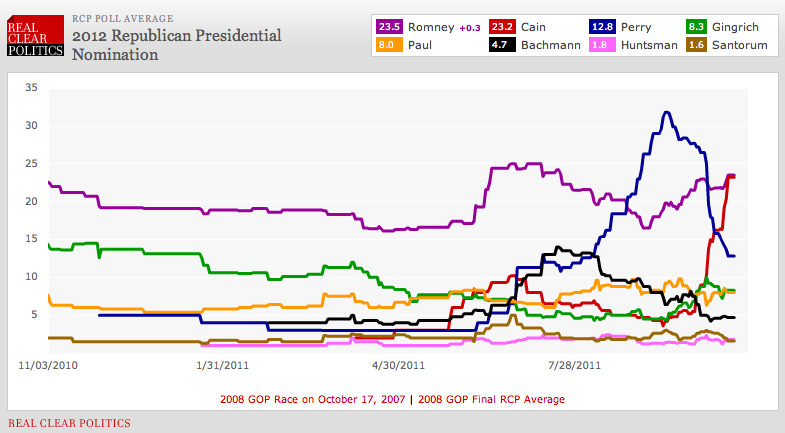
Rick Perry raised $17 million last quarter. Mitt Romney raised $14 million. Cain only raised a little under $3 million:
[M]oney-wise, [Cain is] still at the back. His take this quarter was roughly the same as the last, which either means his newfound name recognition didn't have time to kick in or that his supporters aren't reallysettled enough to want to open their checkbooks for him. But at least Cain can call on his pizza millions, right? Well, with a net worth of somewhere south of $6.6 million — which is plenty rich by most standards, but not by presidential campaign ones — he doesn't really have the Romney option of bankrolling himself.
Ed Kilgore compares the strengths of Cain's and Perry's campaigns:
What makes these numbers [showing Cain ahead in the polls and Perry behind] hard to interpret is the importance in Iowa of the money and organization needed to get supporters to endure a long, cold, winter evening of caucusing. Perry's got money and organization to burn; Herman Cain has neither at the moment, but as the current favorite of Tea Party supporters in Iowa and elsewhere, he does have enthusiasm, which was enough to propel Mike Huckabee past Mitt Romney in Iowa during the last cycle. The positioning of the field in Iowa will be crucially affected by whether or not Romney takes the bait and decides to go for broke there, aiming for the kind of early knockout blow John Kerry achieved among Democrats in 2004.
(Poll of polls, showing Cain tied with Romney, from Real Clear Politics.)
Can Ron Paul do another one of those self-righteous videos and go into detail about a woman who chooses not to have health insurance and enters a hospital with a complicated pregnancy? I'm just curious how all of that would work in Ron Paul Land.
Another expands on that point:
You're right in that this is a Christianist pitch, since Ron Paul's concern for human life apparently ends at birth. From Gawker last month:
Kent Snyder — Paul's former campaign chairman — died of complications from pneumonia. Like the man in Blitzer's example, the 49-year-old Snyder … was relatively young and seemingly healthy* when the illness struck. He was also uninsured. When he died on June 26, 2008, two weeks after Paul withdrew his first bid for the presidency, his hospital costs amounted to $400,000. The bill was handed to Snyder's surviving mother who was incapable of paying.
I'm sure everyone recalls the September 12th debate where the audience applauded letting a 30-year-old man die due to lack of health insurance. What they might not remember was Paul's initial response to the question: "That's what freedom is all about: taking your own risks. This whole idea that you have to take care of everybody—" So following Paul's own logic: everyone is free to make their own choices and live with their own consequences, unless you're a pregnant woman.
Another:
You wrote, "Because it's based on personal experience and because he's so laissez faire about so much else, this ad really resonates with sincerity, whether you agree with it or not." I would be interested to know what being pro-life has to do with being "Christianist" or what it has to do with laissez faire economic or social positions. Of course, they correlate highly as voter preferences go, but why are they necessarily ideological bedfellows? I ask because I don't think they are. Quite the contrary, I think they run directly counter to one another. If one really considers abortion to be the taking of life, if it is really the moral equivalent of, say, murdering the elderly or disabled, then Ron Paul's position that abortion should be decided on a state-by-state basis is morally indefensible. If government should not be empowered to protect a right so basic and fundamental as the right to life, then what do we have it for?
If abortion is the taking of life, then what is needed is not a small, restrained government fearful of trampling liberty, but rather an active, assertive one to forcibly prevent such injustices from occurring. Perhaps to someone as socially liberal as you, Andrew, the Ron Paul ad resonates with "sincerity." You must think it very appealing to pro-life voters. But, for what it's worth, I am a pro-life voter. I found the ad outrageous, and I would not vote for Ron Paul under any circumstances.
The Supreme Leader is threatening to eliminate the Presidency:
In a speech, Ayatollah Khamenei made passing mention of the presidential system, which was his own route to power. "Presently, the country's ruling political system is a presidential one in which the president is directly elected by the people, making this a good and effective method," he said. "However, if one day, probably in the distant future, it is deemed that the parliamentary system is more appropriate for the election of officials with executive power, there would be no problem in altering the current structure."
Meanwhile, more details emerge on who in the regime was involved in the Saudi assassination plot.
You’ve got to ask though: if a candidate’s entire jobs plan depends on taking a single industry’s policy wish list, tearing off the cover sheet, and putting his own name on the work, without even bothering to net out the costs and benefits for the whole US economy – how serious is that candidate?
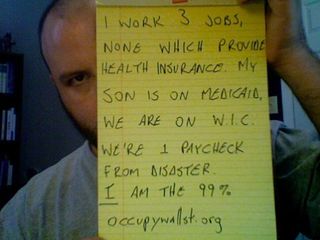
After this weekend, it is impossible to deny that something is going on out there – something that spans different cultures, countries and polities. From the "Indignants" of Madrid to the pierced peons of Times Square to the thousands in Berlin and Frankfurt and London: this is a chord being struck. The question, to my mind, is: which chord exactly?
The demos remind me a little of ACT-UP in its heyday, when AIDS activists got into the faces of the powerful and the masses and demanded they not be forgotten or ignored. There was the same ghastly p.c. crap, in which all that matters is the conversation and pure democracy and not specific leadership, which is swiftly problematized as patriarchal. But ACT-UP had an obvious set of goals: speed up HIV research, force drug companies to lower prices, give the FDA a kick up the ass, lobby for ADAP, etc. What does the Occupy movement actually want?
I see the signs urging us to "smash capitalism" and remain unmoved. Capitalism has – even over the last decade – brought more people out of poverty than ever before in history. I see personal hatred aimed at people working in the financial services industry, which again leaves me unmoved and not a little nauseated.
But what I do see is – finally – a powerful cultural protest against the corruption of capitalism in the last decade, the crony-ridden political system that even now is trying to stall or gut Dodd-Frank, and against the staggering inequalities that now exist in this country and threaten to change its core democratic nature. And this is a good thing. It's a good thing because it provides essential balance to the Tea Party's case against government as a whole. Only one entity can restore some equity to the system and it's government. Disempowering government at a time when the current system is consigning millions to decades of unemployment while rewarding a fraction of that with simply unimaginable rewards … that's a recipe for social unrest.
In other words, this street movement is emerging to demand some accountability from the bankers who helped destroy this economy, from the politicians who used our money to save them, from the GOP even now balking at basic regulations on Wall Street to help prevent another crash, and from Obama whose conciliatory style so many now regard as betrayal.
Some of this is self-serving. I don't believe the debt binge – private and public – was conducted without the eager participation of large numbers of Americans, trying to get something for nothing. I don't think you can leave government off the hook either, given its disastrous role in Freddie and Fannie. I think blaming Obama for all of it is absurd, when he is trying very hard in a deeply constrained Washington to enact core reforms. But reminding Wall Street and multinational corporations that they inhabit a polity, not a planet, is a good thing. Their fate is connected with ours, and until we return to a government that can balance its books, and to a banking system that seeks merely to make good loans, we are all in trouble.
My instinct is not to worry about those inequalities that reflect different talent or luck. Equally, though, when inequalities persist that are structural, that are rigged by one economic sector dominating others, and when the global trends point to even greater polarization, I think we should worry. This inequality will not hold over another decade of mass unemployment. Globalization is beginning to find millions of middle class victims in the West. This, in some respects, is the middle class's 1968.
The question hanging in the air will be the president's response to the movement. So far, he's been as vague as the movement itself. But if Obama can reframe his political future as harnessing this street power to hold the powerful accountable, if he can leverage it into passage of the American Jobs Act, and if he can cite this inequality as a reason for major tax reform with entitlement cuts and revenue increases, then Romney suddenly looks like a defensive plutocrat.
It's a question of movement and mood. The anger was first directed at Obama from the right (and largely redirected away from Bush and Cheney). Now it is being directed at those who were rescued after staggering recklessness. Each mood creates a different climate. And this one, I'd wager, benefits the populist left.
 last decade – brought more people out of poverty than ever before in history. I see personal hatred aimed at people working in the financial services industry, which again leaves me unmoved and not a little nauseated.
 The Dish