The Benefits Of Pessimism

Researchers tested newly married couples' reactions to stress. An optimistic perspective increased mental health for low-stress situations, but the more stressful the situation, the less optimism helped. The moral:

By all means, be optimistic and when life gives you lemons, make lemonade. But when the sh*t hits the fan, keep a cool head. It’s doing you no good to imagine rose petals are hitting your face.

The Economics Of Hot Stewardesses, Ctd

Emirates-airline

A reader writes:

I've always wondered about this too. I overheard the answer on a Southwest Airlines flight last year. A man across the aisle from me loudly and obnoxiously asked the guy next to him what happened to all the hot flight attendants from the '70s, and a passing flight attendant answered: "We're right here, buddy."

Sounds like McArdle nailed it: ageism laws and union rules.

Another quips, "Some of those gorgeous young women are still on the planes: one of them, a tall blonde named Karen, was the captain on my Airbus flight from Dulles to Denver yesterday." Another suggests that attractiveness is still a major factor for stewardesses on non-American airlines:

Do you ever fly Air France?  Young, hot cabin attendants of both sexes, clearly chosen at least in part for physical attractiveness, are alive and well there. I should imagine on some of the other national carriers, particularly the Asian ones, too, but I have no experience.

A reader with lots of experience:

I think many of your readers are missing a big point in this stewardess discussion. Who could afford to fly in the Kennedy Era? Rich people and international businessmen right? I am lucky enough to fit both those categories, and from my viewpoint, flying is as good as it must have been in the "good old days." Off the top of my head:

– Sitting in the private cabin of a 1st-class Emirates seat, watching Bullet on a 24-inch screen, while a cast of international beauties kept refilling my champagne flute.

– Another time in Emirates Business, discussing with a Nordic bombshell whether the rock lobster or spring bok was a better choice. (I went with the spring bok.)

– Sacrificing thirty minutes of sleep in British Airways Business from JFK to Heathrow because the pretty stewardess convinced me to try the blue cheese and port.

– Heck, it's not even as bad on US airlines as people say. During my last trip back from Tokyo on Continental, the ruggedly handsome gay flight attendant spent several minutes explaining the different wine options to go with my osso busco. He looks were wasted on me, but the service was impeccable.

The people complaining about poor airline service and cranky middle-aged stewardesses are right. Flying for most people (dare I say the 99%?) is terrible. But, back in the day, they wouldn't have been flying. Domestic trips would have been on Greyhound or trains and they could have never afforded to fly overseas. In my younger and poorer days, it was a thrill to be able to fly to Bangkok and Prague, even if the seats and service were shitty. Because I can remember when flying was only for the rich.

The above image, from Emirates airlines, was featured in a blog post entitled "Top 10 Most Attractive Airline Cabin Crews". Not one of the ten airlines in the survey was US-based. Virgin Atlantic, unsurprisingly, was #1 by a long shot.
Upstream Medicine

A new healthcare model:

CareMore, through its unique approach to caring for the elderly, is routinely achieving patient outcomes that other providers can only dream about: a hospitalization rate 24 percent below average; hospital stays 38 percent shorter; an amputation rate among diabetics 60 percent lower than average. Perhaps most remarkable of all, these improved outcomes have come without increased total cost. Though they may seem expensive, CareMore’s “upstream” interventions—the wireless scales, the free rides to medical appointments, etc.—save money in the long run by preventing vastly more costly “downstream” outcomes such as hospitalizations and surgeries. As a result, CareMore’s overall member costs are actually 18 percent below the industry average.

The Problem With Saving Too Much, Too Fast

Saving

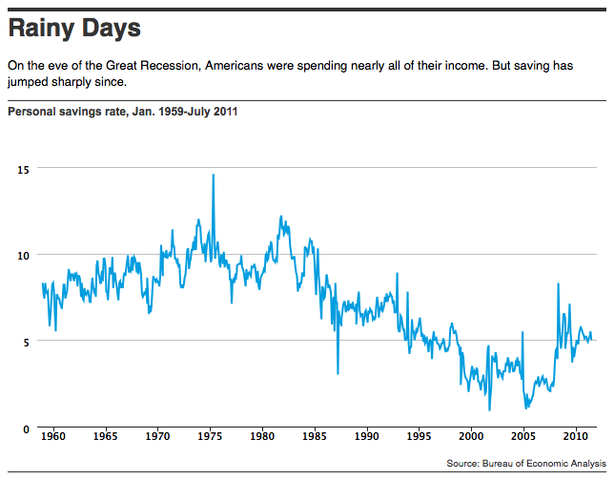
About 8 million Americans stopped using credit cards in 2010 and the average credit-card balance has fallen 10 percent this year. While deleveraging seems like good news, it could be hurting the economy:

This occurs when economic actors on all sides–consumers, business, government–all retire their debts at once. Unless their incomes are rising, they can pay off debt only by cutting what they spend. This, in turn, reduces the demand for goods and services, which drives prices down, further trimming businesses' revenue and thus their ability to pay employees, who in consequence spend less.

Overweight And Undereducated

Felix Salmon pinpoints an underlying dilemma:

[T]wo of the biggest and most daunting long-term problems facing the US economy are (1) the fact that Americans aren’t as well educated as their counterparts elsewhere in the world; and (2) the fast-growing obesity epidemic. Both of these problems are caused, in large part, by America’s very high levels of child poverty.

Acknowledging that taxing bad behaviors is verboten in the US, Salmon wonders if there's a conservative alternative to improving education and nutrition. Taylor Marvin bolsters the argument for change. Yglesias looks at Denmark's new tax on fatty foods:

On the one hand, most people probably won’t change their behavior much in response to a tax, which means it’ll raise plenty of revenue. On the other hand, if people do change their behavior, the social consequences will be beneficial. The Nordic countries have become the world leaders in combining high levels of public services with strong economic growth precisely by being pretty relentless at seeking out economically efficient ways to raise tax revenue.

Are The Neocons The Real Conservatives? Ctd

In the latest twist in the debate, Sehri Berman hits back at Corey Robin. Money quote:

Robin’s flawed definition of conservatism flatters and consoles the Left rather than forcing it to confront its true dilemma. If conservatism is always about the submission and subjugation of lower orders, then any popular support for such movements must—by definition—be misguided, misinformed, or the result of trickery. One need not, therefore, fully engage the rage, disenfranchisement, and disillusionment felt by the many who hold conservative and right-wing ideas. But if one instead accepts that such rage, disenfranchisement, and disillusionment are real, then the question becomes: why in the late twentieth and early twenty-first century has it found its home so often on the right rather than the left? This is a question that The Reactionary Mind leads directly to; it is not one that Robin—or the Left more generally—can or should avoid.

The Technology Of The Arab Spring

Clay Shirky attacks news Luddites:

[P]eople complain about the phrase ‘Guns don’t kill people, people kill people’ precisely because that formulation makes it hard to talk about technology. People kill people, but they do a lot more of it when given handguns, just as people testify to atrocities by the state, but they do it better when they have phones with cameras in them, and better still when TV networks broadcast those images using satellites instead of terrestrial antennae.

The Divine In Science Fiction

Margaret Atwood's theory about the sublimation of religious feeling:

I think that the religious strand is probably part of human hard-wiring … . Suppose that the religious thing is kind of a given and you can’t act it out using your old figures and images, because time has moved on and people no longer quite believe, and if you announce that you have seen a bunch of angels sitting in a tree, you’re likely to be locked up in a bin, so instead you put them on planet X, where they’re like to feel quite at home.

Optimistic Pessimism

Yes, it's come to that. Money quote:

In considering the path of future output, the question is: what's demand likely to do? My sense is that it's likely to rise slowly, at or just below real potential growth plus an inflation rate around 2%, which is probably all the Fed will tolerate. But we have no guarantees about that, and we certainly can't take much comfort in the low level of sales in housing and durable goods. They'll grow as quickly as the Fed allows. Should the Fed make an error of some sort, they'll fall with demand and the broader economy.

We should keep the Depression foremost in our minds. When systematic policy error results in low demand, it's as likely that the error will be sustained or compounded as it is to be rectified. In such cases, every bottom is ephemeral, and there is no darkness that can't grow darker still.