What’s The Real Unemployment Rate?

6216681724_bb53459226_b

Nouriel Roubini does the math:

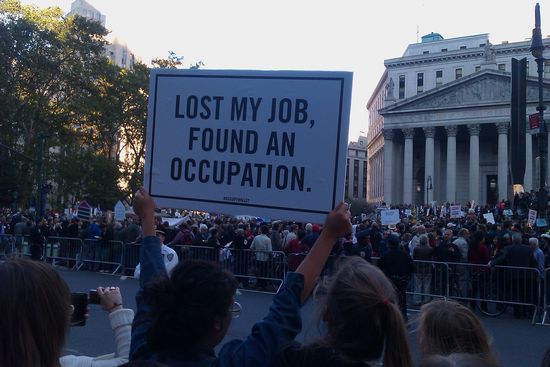
[T]he "official" unemployment rate is 9.1 percent — but the one that includes discouraged workers who have left the labor force or partially unemployment has gone from 16.2 percent to 16.5 percent. And if you add to it the millions of people that you have in jail in the U.S. — which is four times the amount of any civilized country as a share of population — than unemployment is probably closer to 20 percent. And that's just among the average population. For minorities, the youth, or unskilled people that don't have a high school degree, the number is closer to 30 percent. 

(Photo by Flickr user Blu Laces)
“Each Time You Don’t Share, A Relationship Loses Its Wings.”

Evgeny Morozov beats up on Jeff Jarvis's new book, Public Parts: How Sharing in the Digital Age Improves the Way We Work and Live:

Whenever he needs to explain something positive, his instinct is always to credit the Internet: it is the one factor responsible for more publicness, more democracy, more freedom. And every time he turns to darker and more difficult subjects—like discrimination, or shame—he announces that they have nothing to do with the Internet and are simply the product of outdated social mores or ineffective politics. In Jarvis’s universe, all the good things are technologically determined and all the bad things are socially determined. 

Jarvis's short response here.

When Did The Rich Get So Rich?

One_Percent_Income

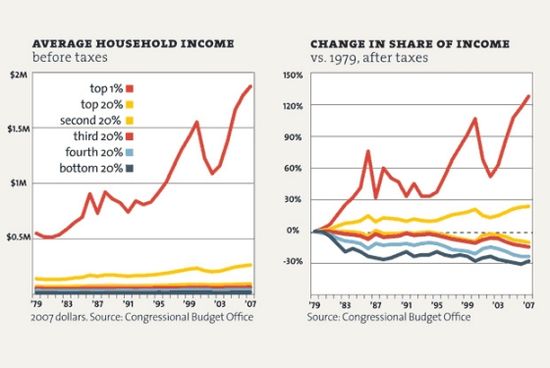
Jeffrey Winters traces America's wealth distribution over time:

The decade from 1970–80 was the turning point in the Great American Inversion. … By 1990, real incomes for the top 1 percent exceeded the 1920 level threefold and continued to rise thereafter, while those of the majority did not budge. Reversing the pattern of previous decades, the richer you were, the faster gains accrued. It did not matter if Democrats or Republicans were in charge of the White House or Congress. By 2007, the top 1 percent of households had almost five times the real income they had in 1920; the top 0.1 percent had around six times, and the top 0.01 percent were awash in nearly ten times the real income they had enjoyed nine decades earlier. 

Chart via Chait. 

When Do We Help, And Why?

A new study offers an alternative take on the bystander effect. Also known as Genovese Syndrome, it was named for Catherine Susan Genovese who was stabbed to death in 1964 despite the fact that some people supposedly saw and heard her being attacked:

In situations where there’s a clear threat—when someone is trying to extinguish a raging car fire, rather than merely struggling to change a flat tire—the bystander effect actually diminishes. “It’s counterintuitive,” says [Brown psychology professor Joachim Krueger] . “As the costs of a behavior become higher, you should be less likely to help.” Why that’s not so lies deep in our lizard brains. We know danger when we see it, and when we do, it induces higher levels of arousal and, therefore, more propensity to help.

Another Reason To Care About Climate Change

It could throw off biological clocks in the animal kingdom:

The biggest worry in this sphere is annual rhythms in mating, birth, migration and hybernation which have evolved to associate any given day length with the climatic conditions that usually accompany it at that latitude. Day length is a kind of short-hand that many species use to determine how best to time their annual activities, and once the month of March no longer means an average temperature of 12 degrees or whatever, the disconnect can be very stressful on a species. There are also animals that depend on synchronizing their annual rhythms with those of their food source. If their timing is thrown off, they starve.

Exorcism On The Rise

Daniel Burke reports there are more Catholic exorcists in the United States now than at any other time in modern history:

Pope John Paul II, who is rumored to have performed several exorcisms, frequently warned Catholics that Satan is very real and very dangerous. In a similar vein, Pope Benedict XVI praised a group of Italian exorcists in 2005, encouraging them to pursue their “important ministry.” In the latter half of John Paul’s papacy, the number of official exorcists in the United States ballooned from 1 to 19, according to sociologist Michael Cuneo. The number has grown to about 30 under Benedict.

Gay And Mormon

A primer on life in Utah:

For [Mormons], evidence of the world’s corruption is all around us, in those magazine covers, in R-rated movies, in men having sex with men. But in the celestial kingdom all will be restored.

So, for example, if your child has Down’s syndrome in this life, then in the celestial kingdom her body will be made whole. If your child is gay, as long as he never acts on his homosexuality and remains a church member in good standing, in the celestial kingdom he will marry a woman and populate the world with spirit children. When you are 20, eternity has a fairly strong pull on you, especially if all your family will be hanging out in the celestial kingdom forever. The promise of a whole body is compelling when you are taught that the body you have is impure.