Turning A Blind Eye

Jonah Lehrer wonders why we ignore prisoner abuse:

Part of the answer is rooted in a human bias. It turns out that we all have an intuitive belief in justice – people get what they deserve. This instinct makes all sorts of social contracts possible, but it comes with a perverse side effect, causing us to ignore stories of suffering that directly contradict that assumption. Because we believe in justice, we ignore stories of injustice. 

Is Laughter Yoga A Joke?

Despite initial cynicism, Laura Turner Garrison comes to take it mostly seriously:

When looking through the [Laughter Yoga] YouTube channel, what’s most surprising to me is the worldwide reach of this phenomenon. Granted, laughter might be the only thing universal about humor, but how different cultures engage in laughter varies wildly. As I have written about in the past, certain cultures do not like feeling as though they are being laughed at, nor do they want to risk looking foolish in public. For others, laughing aloud and openly is considered rude. So to see these Laughter Clubs from around the world doing the same exercises and letting go of all inhibition isn’t just surprising — it’s kind of amazing.

Marcelo Gleiser looks at research on laughter's health benefits:

There have been several studies trying to measure the medical benefits of laughter. If depression and sadness can hamper your immune system, wouldn't laughter improve it? It sounds reasonable to me, although studies have been, on the whole, inconclusive and mutually contradictory. Maybe it has to do with the fairly small size of the studies, or how they are done, usually with people watching comedies like Laurel & Hardy or Abbott & Costello.

Malkin Award Nominee

"Some of you … God hates you. Some of you, God is sick of you. God is frustrated with you. God is wearied by you. God has suffered long enough with you. He doesn’t think you’re cute. He doesn’t think it’s funny. He doesn’t think your excuse is 'meritous.' He doesn’t care if you compare yourself to someone worse than you, He hates them too. God hates, right now, personally, objectively hates some of you," - Pastor Mark Driscoll.

(Hat tip: Vorjack)

Can Altruism Be Addictive?

Yes:

Almost any mental state can be, we’ve learned. The human brain is spectacularly good at being self-tuned to release chemicals, on demand, that give the individual various kinds of highs.

The biggest come from activities and thoughts that most call wholesome, like love, skill, music, and such. But coming up close behind is self-righteousness! When you see someone who is indignant all the time—whether it’s your crazy neighbor or that face in the mirror—look for the flush responses and repetition rates of an addict, coming back again and again for that self-doped “hit.”

A Poem For Sunday

Wands_43

"Personal" by Tony Hoagland:

Don’t take it personal, they said;
but I did, I took it all quite personal—

the breeze and the river and the color of the fields;
the price of grapefruit and stamps,

the wet hair of women in the rain—
And I cursed what hurt me

and I praised what gave me joy,
the most simple-minded of possible responses.

The government reminded me of my father,
with its deafness and its laws,

and the weather reminded me of my mom,
with her tropical squalls.

Enjoy it while you can, they said of Happiness
Think first, they said of Talk

Get over it, they said
at the School of Broken Hearts

but I couldn’t and I didn’t and I don’t
believe in the clean break;

I believe in the compound fracture
served with a sauce of dirty regret…

The poem continues.

(Photo: Oulunjärvi Afternoon by Arno Rafael Minkkinen via Colossal)

The Transcendent In Everyday

Mark Vernon contemplates it using Abraham Maslow's notion of D-cognition and B-cognition:

D-cognition – D for deficiency – is the kind of knowledge required in the daily business of striving and surviving, which is largely a process of finding what we lack. B-cognition – B for being – is the felt or intuited sense of participating in the world at a deeper level than the humdrum. It's a different kind of knowing that can be linked to a sense of the transcendent. 

Maslow has an example, from when he was once participating in a graduation ceremony. Apparently, he tended to think of such occasions as 'silly rituals'. However, on this day he suddenly perceived a tremendous procession, beginning with the great figures at the origins of his discipline and reaching into the future with the generations not yet born. It was not a hallucination. Rather, the ritual conveyed a vivid and I would say transcendent representation of the deep meaning of university life.

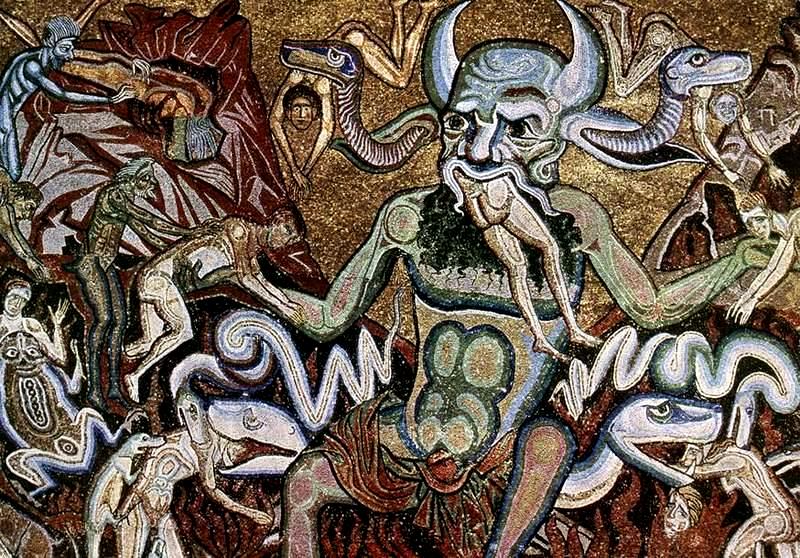
What Ever Happened To Hell?

Coppo_di_Marcovaldo_Hell

J. Peter Nixon reflects on the Church's shift away from a terrifying, "high stakes" notion of hell: 

[O]nly 60 percent of Catholics believe in hell. While comparable to mainline Protestants (56 percent), that’s far below the 82 percent recorded by evangelical Protestant churches. 

A voice in favor of the trend:

As for the younger generation of Catholics, Annie Selak is not convinced that a renewed emphasis on hell is what they need. “There is so much pressure on these kids to live up to the expectations of their parents, administrators, older siblings, high school teachers, and principals. The pressure is astounding! I think the move away from the fear of disappointing God and ending up in hell with one bad decision allows them to have a healthier relationship with their faith.”

(Painting: Coppo di Marcovaldo, Hell (ca 1225 – 1274, Mosaic, Baptistry, Florence)

Room For Spiritual Atheists And Thinking Believers?

Last week Alan Lightman argued for atheists to be more open to the religious. Daniel Dennett challenges his tolerance:

Lightman argues for a broader definition of faith, but he doesn’t explain what the boundaries of a properly expansive view of faith might be, and what sorts of nonsense it might tolerate. Faith healing instead of medical care? The Rapture? The efficacy of animal sacrifice? Or, what about convictions less relevant to important decision-making in life: the virgin birth and transubstantiation of the host? As a scientist he would declare any secular claims along those lines to be outright hoaxes. Is it mere politeness that prevents him from telling Francis Collins that if he, as a Roman Catholic, believes these doctrines, he is — in a word — deluded? How far does Lightman’s tolerance extend?

Lightman's riposte:

I oppose any belief that contradicts experimental evidence as determined by the methods of science. … For example, I would not embrace faith that mental concentration can affect the outcome of a coin flip, because experiments show that the distribution of heads and tails comes out in a random pattern regardless of the wishes of bystanders. On the other hand, I would consider as legitimate faith the belief that some intelligent being created the universe or that our lives have a meaning, because those beliefs have not been disproved by science.

Lawyers In Good Faith

Jeremy Kessler examines the new movement towards “religious lawyering”:

 Religious lawyers … are not missionaries; they do not seek to propagate religious observance through their legal work. Rather, they hope to bring the moral sensitivity they cherish in their faith traditions to the complex human relationships that structure their professional lives. In the words of one of the movement’s eloquent defenders, the law professor Robert Vischer, “The concrete differences religious lawyering will make will tend to involve relational differences—i.e., seeing the client not simply as a source of predetermined legal instructions, but as a fellow human faced with circumstances brimming with moral significance.”