Putting A Pencil Together

Dani Rodrik challenges Milton Friedman's riff on free markets from "Free to Choose," seen above. Most of the world's pencils today are produced in China, "an economy that is a peculiar mix of private entrepreneurship and state direction":

[T]he present-day pencil story would be incomplete without citing China’s state-owned firms, which made the initial investments in technology and labor training; lax forest management policies, which kept wood artificially cheap; generous export subsidies; and government intervention in currency markets, which gives Chinese producers a significant cost advantage. China’s government has subsidized, protected, and goaded its firms to ensure rapid industrialization, thereby altering the global division of labor in its favor. … Given China’s economic success, it is hard to deny the contribution made by the government’s industrialization policies.
How To Navigate The Sea Of Knowledge

For its 50th anniversary, Adam Gopnik recalls the moral of Norton Juster's "The Phantom Tollbooth":

Juster was writing a comic hymn to the value of the liberal arts at a moment of their renaissance, buoyed as they were by the G.I. Bill and new cadres of students. … In "The Phantom Tollbooth," the real moral sin is knowing too much about one thing: the Mathemagician who obsesses over quantities; the unabridged Azaz who lives off his own words. Against those who worried that the liberal arts could not help us "win the future," Juster argued for the love of knowledge, and against narrow specialization. "The Phantom Tollbooth" was for learning, against usefulness. 

The A.V. Club interviewed Juster not too long ago:

The Doldrums was a place I inhabited a great deal. I was a very introverted kid. In fact, I was quite intimidating to my parents, who never knew what I was thinking about or what mood I was in or how I was going to react to anything. In contrast, my brother, who was about 4.5 years older than me, he died a few years ago, was the family’s great hope. He was a really good-looking kid, he was the golden boy, and I was that strange kid. Consequently, one of the great advantages was, they left me alone. I inhabited a world which I invented, and in many ways, it was a fortress.

Writing On The Wall

109405402

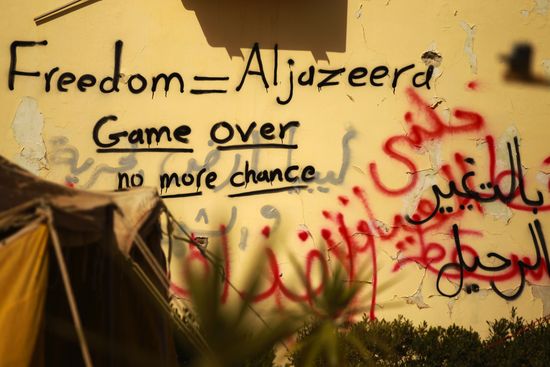
Blake Gopnik contemplates graffiti in the Middle East:

"Free doom — Get out Hamad," reads one spray-painted text from Bahrain. During the rebellion in Libya, "Freedom=Aljazeera" written on a wall makes the value of a free press perfectly clear; on another wall, the simple tracing of an AK-47 is enough to invoke an entire ethos of rebellion.  … In all these cases, graffiti is being used as a true means of communication rather than as purely aesthetic exchange. These 21st-century scrawls leapfrog back to a prehistory of graffiti, when wall writing was mostly about voicing forbidden thoughts in public.

(Photo: Graffiti praising Al-Jazeera news channel is seen on a wall in the dissident-held Libyan city of Tobruk on February 24, 2011. By Patrick Baz/AFP/Getty Images)

A Creative Kickstart

Tom Stafford uses Brian Eno's Oblique Strategies, a card deck of "worthwhile dilemmas," to solve problems:

[The] cards say things such as "Remove elements in decreasing order of importance", "Honour thy error as a hidden intention” or simply "Water". … Collecting information like this in cards recognises that the creative process needs an element of randomness, that making thoughts physical makes it easier for us to play games of invention with ourselves, and that too much organisation can sometimes restrict what we know – the information might be all there in a textbook, but the ends are all tied off, stopping our current state of mind latching onto what is needed. Invention comes naturally from inside ourselves, but sometimes we need a spark to set it off.

The View From Your Window Contest

Vfyw-contest_10-15

You have until noon on Tuesday to guess it. City and/or state first, then country. Please put the location in the subject heading, along with any description within the email. If no one guesses the exact location, proximity counts.  Be sure to email entries to VFYWcontest@gmail.com. Winner gets a free The View From Your Window book. Have at it.

Do Gays Exist Everywhere?

Not really, as evidenced by the hypersexual Aka people of central Africa:

The tribespeople, like Ahmadinejad, claimed there was no homosexuality of any kind in their culture. "The Aka, in particular, had a difficult time understanding the concept and mechanics of same-sex relationships," [anthropologists Barry and Bonnie Hewlett] write. "No word existed and it was necessary to repeatedly describe the sexual act … we thought that maybe they were shy or embarrassed, but this would have been uncharacteristic of the Aka that we had known for so long."

Apparently, the Aka aren’t alone in their homo-naivete. In 1976, another team of anthropologists sifted through the Standard Cross-Cultural Sample data for attitudes toward homosexuality and found that people in five of 42 cultures listed had no concept of same-sex desire or behaviors. It’s not that these cultures penalized or disapproved of homosexuality. Rather, they didn't even know what it was.

As Jesse Bering quips, "[T]here really are societies in which homosexuality does not exist; Iran’s just not one of them."

Greece: A Failed EU State

129204561

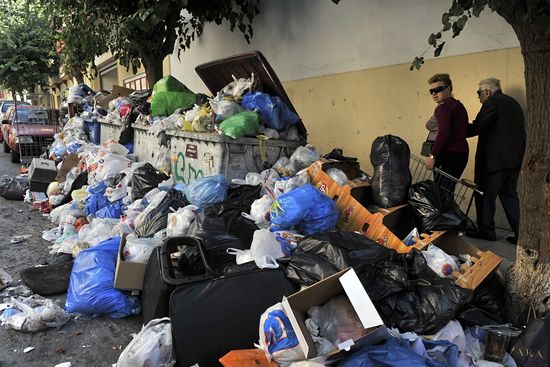
Takis S. Pappas thinks nothing less than full-scale nation-building in Greece can solve Europe's crisis:

Rebuilding a state is not easy. It will surely take a long time, and require huge initiative on a massive scale and at great cost; it will also involve a huge transfer of sovereignty from Athens to Brussels, which, however, depending on how it is done, need not necessarily provoke resentment among the Greek people. But this is an inexorable task if the EU wants to avoid a looming breakdown, not just of the euro, as many currently seem to fear, but of something much more important – the European project itself, which, for all its many deficiencies and enormous cost, has nevertheless defined Europe’s postwar stability and growth. 

(Photo: People pass by piles of garbage on October 14, 2011 in Athens, on the eleventh day of a protest by garbage collectors. Greece's two main unions said they would hold a two-day general strike next week against new austerity cuts by the government to address an unravelling debt crisis that has shaken the eurozone. The leading GSEE union that represents private sector staff said the strike would be held on October 19 and 20, revising earlier plans for a one-day action. By Louisa Gouliamaki/AFP/Getty Images)

One Man’s Trash Is Another’s Job

Charles Kenny unloads on the tendency of the West to send leftover goods to developing nations:

World Vision, for example, spends 58 cents per shirt on shipping, warehousing, and distributing them, according to data reported by the blog Aid Watch – well within the range of what a secondhand shirt costs in a developing country. Bringing in shirts from outside also hurts the local economy: Garth Frazer of the University of Toronto estimates that increased used-clothing imports accounted for about half of the decline in apparel industry employment in Africa between 1981 and 2000. Want to really help a Zambian? Give him a shirt made in Zambia.

The Lazy Man’s Blog

And yet kind of ingenious:

Surveys have shown that 95% of blogs are abandoned within 120 days and 60-80% of them abandoned within the first month. … Postary reduces the Blog Lifecycle down to step four: if you are inspired to say something, then just post it and share it with the world. It's our philosophy that sometimes we may only have one thing to say and one time we want to say it.

The full Blog Lifecycle after the jump:

1) Euphoric moment of inspiration
2) Pseudo-maniacal and self-indulgent perusing of domains
3) Careful consideration of theme and design
4) The inaugural post – "Hello world!"
5) The 2-4 post honeymoon phase
6) Waning and changing interests
7) Feelings of desperation and apathy from low engagement
8) Inevitable abandonment :(