Making Men Write About “Women’s Issues”

After reading the Atlantic's most recent cover story on marriage, Yglesias proposes mixing up the sorts of articles male and female journalists tend to write: 

[E]ven though these sex/marriage/babies topics that women writers tend to get assigned are generally less “prestigious” than the old “let’s interview powerful people and write down what they think” kind of stories, family life is actually really important. And roughly the half of the people having sex, getting married, and having babies are men. Their perspective is important too! I think part of taking women more seriously has to be assigning more women to write about things like the Iranian nuclear program and Mitt Romney’s quest for the presidency. But the other part has to be taking “women’s issues” seriously enough to assign male “star” writers to ponder parenting and family life. At the end of the day, your average American’s happiness and wellbeing is more impacted by his or her relationship with partners, children, and parents than by the trade deal with Panama.

Malkin Award Nominee

"The bishops established a website, Justice for Immigrants, which states its primary objectives “to educate,” “to create political will,” “to enact legislative and administrative reforms,” and “to organize Catholic networks,” all aimed at achieving the passage of the DREAM Act. … The bishops’ obsession with undocumented immigrants is selfish. It is a sign of their failure of evangelization. Indeed, the scores of undocumented immigrants come from countries with strong Catholic cultures. So, instead of rolling out a serious effort to convert Americans, the bishops want to replace them. They think this is a winning strategy, but it looks more like desperation, " – Nicholas G. Hahn III, Crisis Magazine. Michael Sean Winters responds here

How Can The GOP Reject 9-9-9?

The dilemma:

Liberals have been making jokes for the past year about the otherworldy "Can You Top This?" game being played by Republican presidential candidates, each one offering up a more buffoonish idea than the next in a vain attempt to prove that they're the purist conservative in the pack. Well, now Herman Cain has trumped them all: his 9-9-9 plan is too goofy even for the modern party to embrace, but it obeys conservative orthodoxy to a tee. So how do you convince all those people you've been selling conservative orthodoxy to that this, finally, is something that goes too far? Isn't that the kind of thing a liberal would say?

How Effective Are Negative Ads?

Enhanced-buzz-wide-24606-1318542121-42

Not very:

Take the "daisy ad." Perhaps the most infamous negative presidential ad of all time didn’t appear to move either Lyndon B. Johnson’s or Barry Goldwater’s poll numbers. And don’t be fooled by accounts suggesting that a negative ad had some subtle effect on a race — "changed the narrative" or another similarly squishy phrase. 

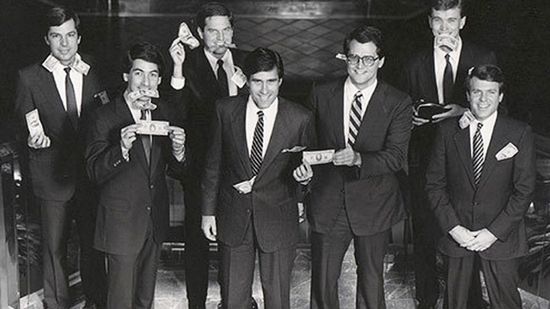
The above photo making the rounds has a good chance of appearing in a negative ad. Brian Abrams captions: "Mitt Romney, chillin' with his populist pals at Bain Capital back in the day."

The 47%: Those With Bush Tax Cuts And The Really Poor

That's the target of Erik Erickson's wrath:

[I]t is not that they are not paying their taxes. It is that the country’s tax structure lets them off the hook. Indeed, you can draw a straight line between the Bush tax cuts and the growing number of households exempted from income tax. … Additionally, the Bush tax cuts lowered income taxes in every bracket, making it easier for a household’s liability to get fully offset by deductions and credits. And on top of all that, the stimulus bill introduced a host of further tax cuts. That covers about half of the households that don’t pay any federal income taxes. The other half of households are just too poor to pay them. 

Pareene pulls his hair out:

The poorest Americans — people who make an average of $12,500 a year — pay, on average, 16 percent of their paltry income in taxes. That is less than every other demographic, but the point of a progressive tax system is that 16 percent of a poor person’s income is a hell of a lot more meaningful to that person than 30 percent of a millionaire’s. It’s a simple concept, and one that most Americans agree with. And that simplicity and popularity is why the conservative movement has spent 100 years attempting to muddy the debate with misinformation.

Or, as Steve Warmhoff told Benjy Sarlin:

If the Republicans are suggesting that it’s bad that some people are not paying federal income taxes, can they please clarify that they are in fact proposing a tax increase?

The Rise Of The Unmarried

Marriage_age

Kate Bolick ponders it:

[N]ow, by choice or by circumstance, more and more of us (women and men), across the economic spectrum, are spending more years of our adult lives unmarried than ever before. The numbers are striking: The Census Bureau has reported that in 2010, the proportion of married households in America dropped to a record low of 48 percent. Fifty percent of the adult population is single (compared with 33 percent in 1950)—and that portion is very likely to keep growing, given the variety of factors that contribute to it. The median age for getting married has been rising, and for those who are affluent and educated, that number climbs even higher. (Indeed, Stephanie Coontz told me that an educated white woman of 40 is more than twice as likely to marry in the next decade as a less educated woman of the same age.) 

Rod Dreher, no surprise, uses Bolick's article to argue for "traditional morality":

[Bolick] made a hash of her own marriage prospects because she believed in the emotivist, consumerist idea that maintaining autonomy and maximal choice was critical to the good life. It is inconceivable to many Americans today that true freedom comes through limiting your freedom by committing to a worthwhile discipline, which entails self-giving and self-denial. It is a paradox of life, one recognized by Christianity, that by giving up your life, you gain it — but only, of course, if you give it up for something worth the sacrifice.

 Amanda Marcotte finds Bolick's piece lacking for other reasons:

I remain skeptical of the idea that the surge in numbers of single women has anything to do with women's successes and/or men's failures. Bolick interviews one genuine expert in her piece, historian Stephanie Coontz, but neglects to mention Coontz's research showing that educated, successful women are more, not less, likely to be married and stay married. If you stop framing dating as some sort of competition between men and women and instead see it as a collaborative enterprise, another theory for the decline of marriage comes into view: Maybe marriage just isn't working for people anymore. Just because someone isn't married doesn't mean they're alone, after all. Maybe we don't need to come up with replacements for marriage, because it's possible that marriage is declining because people have already started to turn to replacements such as cohabitation, serial monogamy, and having a friend-family instead of a traditional nuclear family. 

Chart showing the average marrying ages for men and women over time from NPR.

Is Loading Up On Vitamins Bad Medicine?

It appears so:

A good definition of a superstition is "a belief or practice resulting from ignorance, fear of the unknown, trust in magic or chance, or a false conception of causation." As data accumulate, taking megadoses of vitamins looks more and more like a superstition. 

But a multivitamin a day? I add it to my morning cocktail, shaken with an aspirin and an allegra.

Beardage Update, Ctd

Tumblr_lsc87fb5cp1qjzyxso1_500

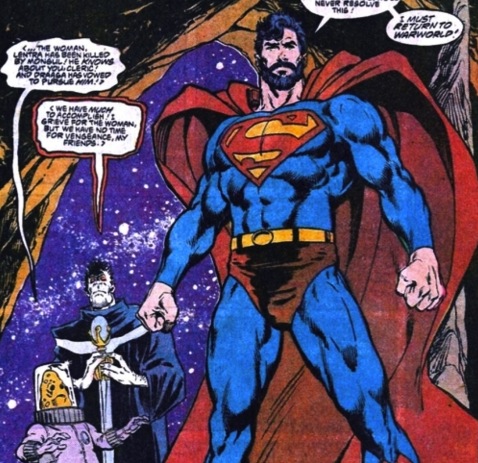
A reader enlightens our ignorance of the hirsute hero:

Superman's already had several beards in the past. Here's a roundup, which sadly fails to mention my favorite Superbeard – Alex Ross' retired version of Supes in the graphic novel Kingdom Come.

Another offers more links:

Superman has been beardy in the comics and on TV.  (Bonus pic of Conan O'Brien and Jarvis Cocker admiring each other's beards here.)