What Does Inequality Do To Society?

Richard Wilkinson charts how greater inequality influences almost every measure of a society's well being, from life expectancy to mental illness, violence to illiteracy. Nilofer Merchant applies the lesson to innovation:

Societies with a bigger gap between rich and poor are worse for everyone in them, including the well off. And America now has the widest gap in income inequality of every developed country measured. Inequality undermines the trust, solidarity, and mutuality. And yet these elements of trust, solidarity, mutuality are the core of a culture of innovation. … Business performance goes up when engagement and collaboration go up.

Yet Another Reason To Fear Global Warming

A new study found on average, "an increase in deaths from natural disasters of 25,000 leads to an increase in the following year of approximately 33 percent in the number of deaths from terrorism." Azure Gilman preempts the "correlation isn't causation" rejoinder:

After a disaster, a government must redirect its resources to cleaning up and rebuilding.  This leaves them more vulnerable than they would otherwise be, and terrorists usually prefer “soft” targets. In the clean-up process, money and resources are often given to the least-vulnerable parts of the country in efforts to rebuild, which often greatly angers the most vulnerable. Natural disasters, then, reveal pre-existing fractures that are easily exploited by terrorists.

Whatever Happened To Hell? Ctd

A reader writes:

I've been following your discussion of hell with interest. Let me put in a plug for an alternative concept: annihilationism, aka "conditional immortality".

St Paul says, "the wages of sin is death / the free gift of God is eternal life in Christ Jesus." That text is a good starting point to explain the concept of conditional immortality. Consider what the text doesn't say: "the wages of sin is eternal torment". No, the wages of sin is death — the sinner ceases to live, according to St. Paul. On the other hand, life after death (eternal life) is described as a gift. It is not the innate condition of human beings, but something that God bestows, or withholds — hence, "conditional" immortality.

It helps if one realizes that the immortality of the soul is a Greek concept. The Bible was not written by Greeks, but by Jews. The Hebrew mind did not conceive of human beings as consisting of a mortal body coupled with an immortal soul (separate, and severable). To the Hebrew way of thinking, the body and the soul were inseparable, and both were subject to death. This is why Christ's resurrection is depicted as a bodily event (not merely the survival of His spirit: a concept that is amenable to us precisely because of the Greek influence on Western culture).

Returning to St. Paul: on its face, the text says that sinners will cease to exist (annihilation) whereas those who are in Christ will be given the gift of eternal life (conditional immortality). If there is any experience of "hell" after death, it would be temporary. Jesus says the condemned will suffer. One could interpret this as being a temporary experience of suffering: a period of suffering commensurate with the individual's sins. (Not an eternity of suffering, which would be disproportionate to the individual's sins and therefore manifestly unjust.)

Among evangelical leaders, John Stott (an iconic figure among evangelicals) and R.T. France (a highly-esteemed scholar) have expressed support for the annihilationist interpretation of the New Testament. Both Stott and France continued to regard the Bible as inerrant; they merely argued that the traditional interpretation of the texts was incorrect.

Prayer On TV

Alyssa Rosenberg praises two new shows, Homeland and Sleeper Cell, that do it well:

Faith in popular culture is so often reduced to signifying ridiculousness or righteousness that it ignores what faith means to people inwardly in favor of a focus on what other people assume faith signifies externally. Making at least a gesture towards it, and in two charged shows about terrorism and national security, asserting that faith is bigger than its worst outcomes, is important, and all too rare.

The Poetry Of Mass

Anthony Esolen criticizes the old translation of the Catholic Novus Ordo Mass into English, done some forty years ago by a team of men:

Jesus did not say, “The Kingdom of God has relatively inauspicious beginnings.” He said, “The Kingdom of God is like a mustard seed.” … In their work, the wonderful dictum of Thomas Aquinas, bonum diffusivum sui, “the good pours itself forth,” was inverted into malum diminuendum alterius, “evil seeks to diminish the other.” Among other things, that meant the petty withholding of words of praise, presumably because they were considered redundant. But is that the mark of love?

Animals Can Grieve

Barbara King compiles the evidence:

[F]rom a combination of observation, evolutionary logic, reading the peer-reviewed 6078878172_9b1a2ea2b2_z science literature, and talking to insightful animal people, I’m convinced that animals may feel deep grief when another animal dies. Not all species, to be sure; if spiders and snails are ever found to grieve, I’d be the first to express astonishment. But I do mean more than only the usual suspects, more than the apes, elephants and cetaceans. Right now, for example, I’m under way with a critical assessment of grief in domestic cats. I’ve concluded that yes, they do grieve. (Not every cat, and not every death; I mean to speak of capacities rather than inevitabilities.)
(Photo via Flickr user Bill Murray, who explains “Navy SEAL U.S. Navy Petty Officer 1st Class Jon T. Tumilson was among the 30 American troops killed August 6 when Taliban insurgents downed their Chinook helicopter with a rocket-propelled grenade. At his funeral in Iowa, his dog Hawkeye paid his last respects, walking up to the casket, lying down in front of it, and heaving a sigh.”)

Standing In Death’s Shadow

Tony Woodlief drives by the house where his daughter died:

I wondered what would happen if I knocked on the door and a younger me answered. Would I listen to these words, that it will be worse than you imagine, that it will be nothing like you imagine, that you can burn down your marriage and your friendships and set your very soul aflame in fury, and none of it will heal you, because while the rest of your life is tinder, that hole shot straight through the center of you can never be burned away? This is what I’ve learned: suffering doesn’t make you noble. Suffering is a burden and a wound and a gift, even, but what you do with it, well, that’s on you, no matter how you rage at the sky. This is what I’ve learned, and maybe I haven’t learned it too late.

A Poem For Sunday

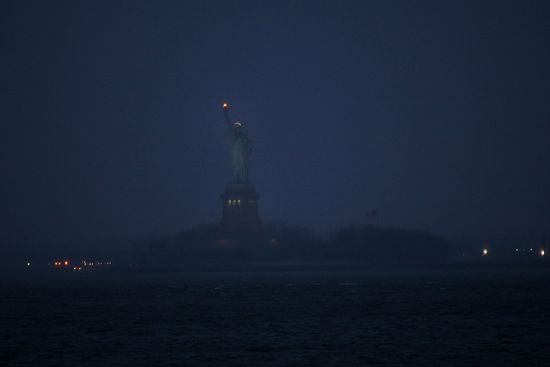
GT_STATUELIBERTY_111027

"The New Colossus" by Emma Lazarus:

Not like the brazen giant of Greek fame
With conquering limbs astride from land to land;
Here at our sea-washed, sunset gates shall stand
A mighty woman with a torch, whose flame
Is the imprisoned lightning, and her name
Mother of Exiles. From her beacon-hand
Glows world-wide welcome; her mild eyes command
The air-bridged harbor that twin cities frame.
“Keep, ancient lands, your storied pomp!” cries she
With silent lips. “Give me your tired, your poor,
Your huddled masses yearning to breathe free,
The wretched refuse of your teeming shore.
Send these, the homeless, tempest-tost to me,
I lift my lamp beside the golden door!”

David Bromwich parses Lazarus' message:

Like other late Romantics, she believed in republican freedom and the religion of the heart; they went together naturally and might be known to each other under the name of “sympathy.” … Americans, the poem says, must never forget what it is to be weak and comfortless. For me to know, through the workings of sympathy, that “heroic forms” have passed through a crisis like mine, can be a liberation in itself.

(Photo by Spencer Platt/Getty Images)

“A Seminal Work”

Screen shot 2011-10-28 at 10.25.42 PM

The images used to illustrate The Joy Of Sex (1972) had to be drawings in order to avoid obscenity charges. The couple featured in the book was one of the illustrators, Charles Raymond, and his German wife, Edeltraud:

The pictures delighted author Alex Comfort, partly because Charles and Edeltraud looked so natural and unposed, absorbed in their private sexual relationship. "The great thing about Charles and his wife was that they were completely authentic – you couldn't get more authentic," says [art director Peter Kindersley]. "It was a real happening – it wasn't a cooked-up thing – and Alex really liked that."

(Image: Screenshot from a BBC segment on The Joy Of Sex)