The Return Of Gilad Shalit, Ctd

129073342

Aaron David Miller insists that the prisoner swap "changes almost nothing in the broader Israeli-Palestinian conflict":

Had the deal included high-profile Palestinian prisoners such as Marwan Barghouti, a former Fatah leader with a national reputation, or Ahmad Saadat, head of the Popular Front for the Liberation of Palestine, it would have had much more significance. Letting Barghouti out would have been a direct challenge (and threat) to Abbas's leadership — a clear effort by Israel to divide the PLO that he heads. No, this deal takes care of business, period — business that Hamas and Israel needed to get done. And though it does make clear that these two parties can do deals together and may well presage a period of stability (neither side wants a war), it has no bearing on peace. 

Really? A deal with Hamas just as the PA is trying to get recognized at the UN? Just move along … nothing to see here. An Israeli reader has, as so often, a less rose-colored pair of spectacles on:

Having staunchly opposed the Shalit deal for two years, even saying publicly that there are prices a country ought not to pay, I have to wonder why Netanyahu finally negotiated. Is it because his popularity is dwindling following the J14 protests and a brutal doctors' strike (Netanyahu is also an absentee Health Minister, leaving most of the work to a hated deputy minister)? Or, as Ami Kaufman suggests, the prime minister does so in order to galvanize the country for a war with Iran, providing the public with Shalit, whose face is possibly more famous than even his own?

A prominent Israeli pundit with excellent sources in the military, Amnon Avramovich, wrote an oblique piece last week, hinting that the senior brass are under pressure from Netanyahu and Barak to confirm an attack on Iran. His piece was published on the eve of Yom Kippur, which for a generation of Israelis means the Yom Kippur War, and he called the officers to stand firm so as not to end like the officer corps of that war. Which, again, raises the specter of former Mossad chief Meir Dagan, whom Ariel Sharon described as an "expert in separating Arabs' heads from their bodies". Why did he publicly warn against an attack, and risk his entire reputation?

(Photo: Supporters show their emotion as Noam and Aviva Shalit, parents of captured Israeli soldier Gilad Schalit, leave a protest tent set up outside the Prime Minister's residence on October 12, 2011 in Jerusalem, Israel. An agreement has been made between Israel and Hamas for a prisoner exchange where IDF soldier Gilad Shalit is returned for the release of over 1000 Palestinian prisoners. By Uriel Sinai/Getty Images)

Christianism Watch

A sign that the Mormon issue isn't going away for Romney: the latest from the far right WorldNetDaily:

The daughter of a Mormon bishop who has abandoned her family's faith claims in a new book the election of Mitt Romney to the presidency would put the U.S. in danger due to what she calls the Republican's "outrageous," "horrific" and "mind-controlling" beliefs.

"While he attempts to portray Mormonism as just another Christian religion, Mitt Romney counts on his skills to shift our attention away from what he truly believes," says Tricia Erickson, author of "Can Mitt Romney Serve Two Masters? The Mormon Church Versus the Office of the Presidency of the United States of America." "If the American people knew what he truly believed, they would surely not place him in the highest office in the land."

The deployment of an ex-Mormon by evangelicals is something I hadn't anticipated – but should have. The McCarthyite angle is one I didn't quite see coming either:

The author, who herself was married in a Mormon temple at age 19 but now considers herself a non-denominational Christian, says there's a secret agenda  Mormon officials don't like to talk about publicly. "A complete takeover of the government," she said. "They have more people in the CIA, the FBI. They have an employment office for Mormons in D.C. to be able to infiltrate them into the government."

If this really is the flavor out there in the wingnut fever swamps, it's going to get much uglier.

How’s The Libyan Reconstruction Going?

128801443

Daniel Serwer says "pretty damn well":

In a trip to Libya this month, just weeks after Muammar Qaddafi’s fall, I found peace coming fast to Tripoli, despite continued resistance in several Libyan towns.  Ten days ago, families with children mobbed Martyrs’ square, where Qaddafi once held forth, to commemorate the hanging 80 years ago of Libya’s hero of resistance against the Italians, Omar Mukhtar. Elementary schools opened last week. The university will open next month. Water and electricity are flowing. Uniformed police are on the street. Trash collection is haphazard but functioning. This is the fastest post-war recovery I have witnessed: faster than Bosnia, Kosovo, Iraq or Afghanistan. Certainly faster than Somalia, Sierra Leone or Rwanda.

Efraim Chalamish zooms in on Libya's sovereign wealth fund.

(Photo: A Libyan woman is reflected on the display window of a store as she walks past while others shop inside at a souk in the old city of Tripoli on October 9, 2011. By Karim Sahib/AFP/Getty Images)

Should Women Be Paid For Egg Donations? Ctd

A reader responds in great detail:

I think there is no question that egg donors should be paid. It shouldn't be thought of as purchasing the woman's eggs but rather paying for her services. When men donate sperm, they go into a room with some dirty magazines and do something they do all the time for pleasure. Women who donate eggs, on the other hand, have to donate several weeks of their lives, endure daily injections, multiple blood tests and a surgical procedure.

Basically, the donor has to go through an IVF procedure. In any reputable program, before women are accepted as donors, they are thoroughly screened, not only physically, but psychologically, to make sure that this is the right thing for them to do. Potential donors who are doing it primarlily for the money, or who are not really comfortable with what they are doing are generally screened out.

Once a woman is accepted, the donor and recipient have to coordinate their menstrual cycles, so the donor generally has to go on birth control pills for some period of time. Depending on the protocol used, she then may have to have daily injections of a drug that puts her body into basically a menopausal state, with attendant side effects like hot flashes and headaches. Then she has to have daily injections of drugs to stimulate her ovaries to produce multiple eggs.

If she develops a lot of eggs, as one hopes with an egg donor, she may feel uncomfortable, crampy and bloated. During this stimulation phase, which can be about another 8-10 days, she also has to have frequent blood tests and ultrasounds. When the eggs are ready to be retrieved, she has to have another injection, and a surgical procedure to retrieve the eggs, and will have to miss a day at work. She will have to take antibiotics after the retrieval, and have follow-up doctor appointments. She is also asked to refrain from intercourse during at least the last part of the cycle.

(Here's a link to a guide for donors from the fertility clinic at St. Barnabas in New Jersey, considered one of the best in the country. Donors get paid $8,000 at St. Barnabas. Private agencies pay much more.)

This is no minor commitment. I think women who donate eggs mostly do it for altruistic reasons. I get choked up just thinking about what an incredibly generous thing it is to do, to give someone the means to create a family. It takes a special person to do something like that. While it is generous, and the women who do it generally have their hearts entirely in the right place, I think very few women would do it if they were not somehow compensated.

I do think there is a danger, however, that if potential donors are offered too much money, greed will be become the primary motivator. Some women will then overlook the potential risks and ignore their feelings about the myriad implications of donating genetic material to a total stranger. Having women do it for the money, who regret it later in life, would taint what should be a beautiful thing.

The GOP Field’s International Ignorance

Trudy Rubin is incensed at the GOP candidates, and Romney in particular, for talking nonsense on foreign affairs:

[A] lack of seriousness runs through every aspect of Romney's foreign-policy posture. On Afghanistan, he's backed off from an earlier pledge to bring troops home soon and now talks of a "full review" of our policy. Do we really have time for – or need – yet another full review? On the Middle East, he ignores failed peace talks but promises to focus aid and diplomatic efforts, even as Republicans slash the State Department budget. And on Iran, Romney talks tough – saying an Iran with nukes is "unacceptable" – but he doesn't say how he'd act differently than Obama. Perhaps that's merciful, because other Republicans (including the normally level-headed Huntsman) are talking of military strikes against Tehran.

Max Fisher rounds up 13 of the biggest foreign policy blunders from the presidential race, including Cain's "right of return" doozy seen above.

Our New Trade Agreements

David Rothkopf has mixed feelings about the passage of bilateral agreements with South Korea, Panama and Colombia:

The most important reaction to these trade deals is akin to my parents' reaction to my report card in that it looks past the accomplishment to the deflating underlying issue.  In this case, the issue is "now what?" What is the next chapter in U.S. trade policy going to look like?  A protracted period of inaction in terms of new deals with a major shift in focus (generally justified) to enforcement issues seems most likely. But with world markets representing vital potential growth for U.S. companies and workers and with material tariff and non-tariff barriers still in place, it's time for a new conversation and new ideas.

Larison is characteristically grumpy. Jacob Stokes examines what a President Romney might do with respect to trade policy.

Why We Love YouTube Videos

An economic explanation:

The harder it is to gain access to cultural elements, the higher the quality of those elements will be consumed. On the flip side, if it is easy to access culture, people will prefer to consume shorter lower quality pieces of culture. In the middle ages, people had to travel long distances to view concerts, which were performed by live musicians. Thus, the fixed costs of consumption were very high. If you bothered to pay a huge amount of money and time, you might as well view a long complex opera or symphony. On the flip side, when fixed costs are as low as a Google search, people prefer short YouTube videos of cats doing cute things.

Or monkeys.

The Geography Of Drug Prohibition

Reflecting on Ken Burns's Prohibition, Stephen Smith points out that federal laws hurt urbanites most:

As with alcohol in the 1920s, when Prohibition was foisted on cities by small towns, today’s anti-drug policies are most popular among white suburban and rural conservatives. Urban voters, who bear the brunt of the damage of America’s misguided drug policies, are more liberal and likely to favor reforms like marijuana legalization and needle exchanges, but just like their predecessors who opposed Prohibition, they are forced to acquiesce to the federal war on drugs. We can even see the same pattern in ultra-liberal Netherlands, where the national government wants to restrict the sale of cannabis to foreigners, against the wishes of Amsterdam (although Rotterdam has not been so tolerant).

More on Prohibition here and here

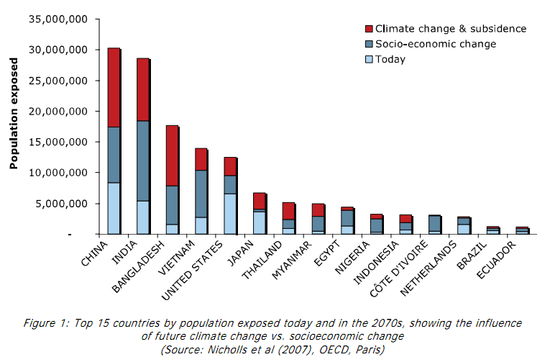
Which Cities Will Need Scuba Gear?

Sea_levels

A new OECD report (pdf) looks at the impact of rising sea levels on cities around the world. In short:

Things don’t look good for India. But the United States doesn’t get off easy, either. If you look at exposed assets rather than total population, then Miami, New York-Newark, New Orleans and Virginia Beach all climb higher on the list, with $7 trillion in assets vulnerable to severe coastal flooding by 2070.