Cain’s Economic Plan Is A Joke, Ctd

Joining Bartlett and others, Ezra Klein pans 9-9-9:

This plan wouldn’t work. Not as policy and, as I expect Cain will soon find out, not as politics. Moving to an 18 percent consumption tax is, among other things, very bad for older voters, who make up a substantial portion of the Tea Party base.

Jacking up taxes on the poor and the middle class even as you sharply reduce them on the rich and completely eliminate them on overseas income for corporations isn’t popular among anyone in the political system who isn’t specifically paid by the Club for Growth. The 9-9-9 plan is a great slogan. But the more seriously Cain gets taken, the more seriously the plan is going to get taken. And as that happens, it will soon become clear that it’s very poor policy.

Further evidence that the plan was poached from SimCity or a pizza menu.

The Daily Wrap

6a00d83451c45669e2015436190297970c-800wi

Today on the Dish, Herman Cain surged in the polls, his 9-9-9 campaign slogan fell flat, and readers weighed in on his interview with Moore Award nominee Lawrence O'Donnell. Romney is already looking past the primary as he somehow dodges the healthcare bullet, but endorsements aren't pouring in, Limbaugh is freely airing his suspicions, and Chait insists that Perry might rebound. If Romney is elected it's because his supporters are convinced he's a liar, and undoing Obamacare is much easier promised than done. D.R. Tucker suggested that Mitt and the Tea Party are engaged a zero-sum contest, the former probably isn't hiding a secret plan to save the economy, and the latter never followed through on its crony capitalism attack. Meanwhile, a testier Obama raked in $70 million, and we scouted his likely offense for 2012. In our video feature, Andrew previewed his next book, and we marked Lenny Bruce's birthday.

The European press puzzled over the Iranian "plot," Madison Schramm cautioned against freaking out, and we wondered what Iran was thinking here and here. Netanyahu made a significant trade, the Pentagon will be downsized no matter what, and military coups aren't exactly back in vogue. We caught up on Slovak domestic politics, Charles Stimson defended the Obama administration's decision to try Umar Farouk Abdulmutallab in federal court, and human rights groups lobbied Canada to arrest Bush for torture when he visits the country next week. 

Matt Taibbi outlined some solid demands for OWS, Nicole Gelinas clarified the movement's notion of "capitalism," and it was largely the incompetent private sector that plunged us into the financial crisis. The war on medical marijuana raged on, Americans are getting more skittish about religion in presidential politics, and a cultural sense of retribution seems to perpetuate capital punishment. We tested the new iPhone's virtual assistant feature, the performing arts entered a depression, and travelers aren't willing to pay more for better-looking flight attendants. We appreciated the scratchwork in classroom porn, women should be compensated for sharing their eggs, and Michele Yulo came to terms with her parents' separate lives by default. Raymond Tallis knocked neuroscience research that tries to explain too much, and Steve Jobs wasn't, in fact, perfect.

Email of the day here, headline of the day here, tweet of the day here, MHB here, VFYW here, and FOTD here.  

M.A.

What Was “Iran” Thinking Ctd

Afshon Ostovar explains the history and standard operating procedure of the Quds Force, the branch of the Revolutionary Guards allegedly responsible for the plot:

The Quds Force has relied on its strong relationships with allied proxy groups and trusted militant networks. Its success in these operations has depended on not only the reliability of its partners, but also to a large extent on overlapping political and ideological interests. It is not a coincidence that the Quds Force works almost exclusively with individuals and organizations that have had long-standing ties with Iran's senior leadership and Revolutionary Guards commanders. Given the Quds Force's modus operandi, it is odd that its commanders would entrust an unprecedentedly brazen attack against a foreign diplomat on U.S. soil to a former used-car salesman and Mexican drug-cartel hit men. 

Odd it is. Yet Obama seemed adamant about it today. Ackerman parses an argument from Michael Singh. This was a helpful nugget:

One needs to take into account an important change that the IRGC made in its military command-and-control structure in 2005.

According to these changes (authored by the IRGC's then-chief strategist, Gen. Mohammad Jafari, who is now the organization's commander), individual IRGC commands were given greater freedom to act without seeking authorization. This change in doctrine was reinforced in practice. For example, the IRGC naval commander who took 15 British sailors hostage in 2007, apparently on his own initiative, was not punished by the regime but rather awarded a medal. This emphasis on distributed command, combined with the IRGC's reliance on asymmetric warfare in the face of America's vastly superior military power, makes seemingly odd terrorist plots such as the one recently revealed far more plausible.

Perry Isn’t Over?

Perry_Plunge

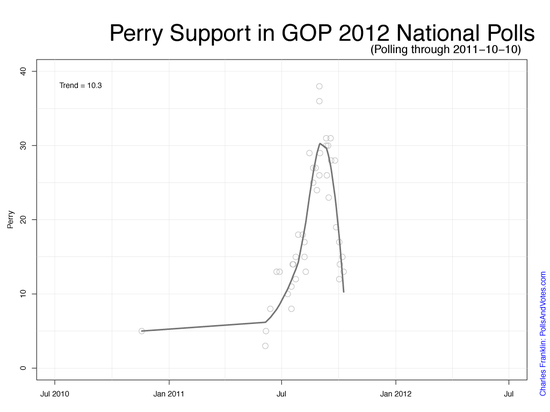
Chait differs from my view:

The proportion of Republicans who don't want to vote for Romney seems very large and undeterred by the lack of credible alternatives. Perry has a lot of money, and it's plausible that he can improve his debating performance (which has already risen from "addled" to "near-sentient"). If Republicans aren't flocking to Romney now, it's a sign they want to give every chance for somebody else to emerge.

Seth Masket agrees:

Yes, the Mormon thing is a problem for the Evangelicals in the Republican base, but my sense is that the bulk of them would be still find a way to turn out votes for a Mormon over whatever they think Obama is. Of greater concern is the fact that Romney is a really unreliable conservative. Sure, as long as he believes he needs the right's support to get into or stay in office, he'll advocate what they want, but can they trust him to stay faithful to the cause? I imagine that a President Romney would work quite well with a Democratic Congress. That thought has to terrify conservative activists.

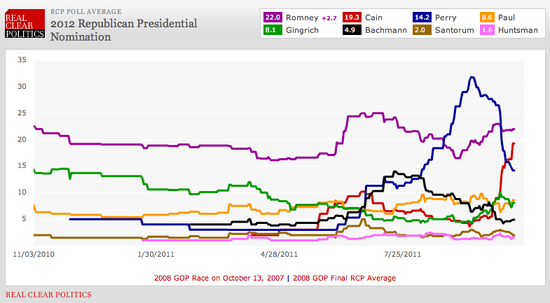
Arguments against President Romney as bipartisan here. Chart from Charles Franklin. I'm not sure any future nominee has such a rise and fall in the polls before rising again. McCain had a reverse "U". But I'm sure Dish readers will correct me if I'm wrong.

“Neurotrash”

That's what Raymond Tallis calls much of the research purporting to draw big conclusions from neuroscience:

Tallis informs 60 people gathered in a Kent lecture hall that his talk will demolish two "pillars of unwisdom." The first, "neuromania," is the notion that to understand people you must peer into the "intracranial darkness" of their skulls with brain-scanning technology. The second, "Darwinitis," is the idea that Charles Darwin's evolutionary theory can explain not just the origin of the human species—a claim Tallis enthusiastically accepts—but also the nature of human behavior and institutions. Those trends, as Tallis sees them, are like "intellectual illnesses" metastasizing from academic labs into popular culture. He sees the symptoms in neuro-economic thinkers who explain our susceptibility to subprime mortgages by describing how our brains evolved to favor short-term rewards. He sees them in philosophers who claim that our primate minds admire paintings of landscapes that would have supported hunting and gathering. He sees it in neurotheologians who preach that "God is a tingle in the 'God spot' in the brain."

Mark Anthony Signorelli concurs:

Over and over again, Tallis shows us that the portrait of human life presented by materialism – of things like romantic love, or economic deliberation – bears absolutely no resemblance to human life as it is really lived and experienced by every one of us. It is that experience – the realm of conscious desire, belief, and action – which Tallis insists is the realm of human reality; his book is essentially one long relentless assertion of common sense against a delusive but entrenched academic orthodoxy.

Face Of The Day

129154712

People watch the dancing during the wedding celebrations for King Jigme Khesar Namgyel Wangchuck, 31, and Queen Ashi Jetsun Pema, 21, on October 13, 2011 in Punakha, Bhutan. The Dzong is the same venue that hosted the King's historic coronation ceremony in 2008. The popular Oxford-educated king's ceremony will be followed by celebration in the capital and countryside. By Paula Bronstein/Getty Images.

Questioning Cain

An earlier reader took issue with this Moore Award, given to Lawrence O'Donnell for his interview of Herman Cain. Another reader follows up:

What was appalling about the Lawrence O'Donnell interview was not the substance of the questions, but the tone. If you want to ask Cain about his perspective on the Civil Rights Movement and why he did or did not do certain things, fine. But shouting at a African American about his failure to stand up while his fellow African Americans were "MURDERED" outside his window is not a question, it's an attack. And a pretty disgusting one. 

And that wasn't even the end of it.  O'Donnell went on to shout at Cain some more for not fighting in Vietnam … even though Cain served his country during the war by working for the Navy as mathematician (… apparently that doesn't count?). I don't think you can truly appreciate just how gross it all was unless you actually watch the tape. It honestly made me sick.

Another turns the tables:

I teach a course on the Vietnam War at the University of Wisconsin-Madison, where I am a graduate student.  In addition to my scholarly interest in the Vietnam War, I am a Marine Corps veteran of the Iraq War.  Two of my three colleagues on the teaching team for the Vietnam course are vets – one a Vietnam veteran, the other a Marine Corps veteran who served in the Eighties.

When I watched O'Donnell's interview with Cain, I was struck by a statement which seems to have become lost in wake of O'Donnell's breathtaking display of white privilege in hectoring Cain about the degree and nature of Cain's involvement with the Civil Rights Movement. O'Donnell raised a question about Cain's draft status during Vietnam, asking about Cain's deferment and why Cain chose not to volunteer for service in Vietnam.  Cain stated that he worked in a civilian capacity for the Navy, work for which his draft board gave him a deferment. Following his completion of an Masters in computer science in 1971, Cain left his job with the Navy, after which he maintains that he made himself available for the draft, which by then had shifted to a lottery system.

Unsatisfied with Cain's explanation, O'Donnell excoriated him, stating "I am offended on behalf of all the veterans of the Vietnam War who joined, Mr. Cain. The veterans who did not wait to be drafted, like John Kerry, who joined. They didn't sit there and wait to find out what their draft board was going to do. They had the courage to join, and to go, and to fight that war. What prevented you from joining? And what gives you the feeling, after having made that choice, you should be the Commander in Chief?"

Though I have no interest in Cain as a candidate for office, this sent my eyebrows rocketing. A quick check of Wikipedia (presumably reliable in at least this regard) shows O'Donnell's birthdate as 07 Nov 1951. According to the Selective Service System, O'Donnell's birthdate corresponds with a draft number of 72. The highest number called in the draft lottery the year O'Donnell became eligible was 125, meaning O'Donnell would have been obligated to report for classification for eligibility for military service. However, neither Wikipedia or O'Donnell's MSNBC bio indicate he served.

Thus, my question is: What was O'Donnell's classification, and where does he get off being offended on behalf of veterans if he himself never did a tour in Vietnam, let alone wore the uniform? I know I'm not the only veteran sensitive to civilians who never served wrapping themselves in the cloak and bandages of our service for personal political benefit.

The Death Penalty, Vengeance, And The South

Death_penalty

Peter Singer makes a salient point:

Retribution is often seen as a more important justification for the death penalty. It is quite common for family members of the victim to watch the execution of the person convicted of killing their relative, and afterwards to pronounce themselves satisfied that justice has been done – it happened again with the execution of Troy Davis. In the rest of the Western world, the desire to witness an execution is widely regarded as barbaric, and barely comprehensible. The idea that the families of murder victims cannot obtain “closure” until the murderer has been executed seems not to be a universal human truth, but a product of a particular culture – perhaps not even American culture as a whole, but rather the culture of the American South, where 80% of all executions take place.

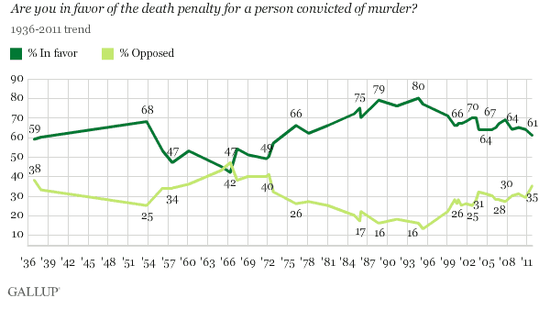
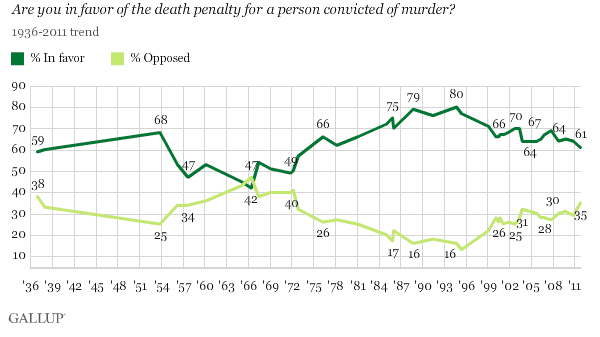
Chart from a new Gallup poll finding the "the lowest level of support [for the death penalty] since 1972, the year the Supreme Court voided all existing state death penalty laws in Furman v. Georgia."