Obama’s Big Money

$70 million is rather impressive, given the current stampede of the media herd. Ben Smith's remaining question:

Will the new outside money have a leveling effect? That is, Republican outside groups have been able to raise money partly because they presume their candidate will be outspent. Can a well-funded Obama campaign draw the same kind of support? 

Herman Cain, Frontrunner

Poll_Of_Polls

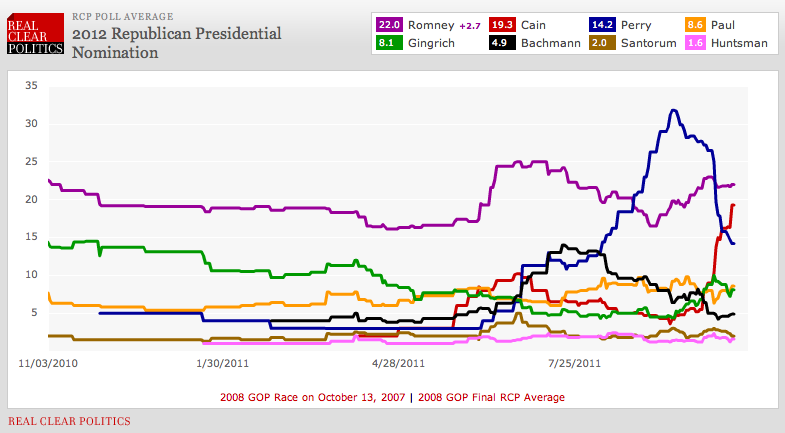
Cain now leads in two polls and he's within spitting distance of Romney in the poll of polls (above). James Joyner isn't ready to take Cain seriously:

No major party in modern American history has nominated someone whose resume doesn’t include previous stints as President, Vice President, US Senator, Governor, or general for the presidency. I don’t expect Cain to break that streak. But it’s probably a little early to consider this race in the bag for Romney quite yet.

Allahpundit takes stock:

Perry’s lost 22 points since the last poll — and not a single one went to Romney. That’s how reluctant base voters are to back him over some other conservative in the field. The good news for Romney is that he still has an electability argument against Perry. His favorables are 27/29 overall and he trails Obama by just two points head-to-head. Perry’s favorables are 19/36(!) and O leads him by an even dozen, 51/39, in a hypothetical match-up; Perry also trailed Obama by double digits in Rasmussen’s latest poll released this morning. (Cain’s favorables are 24/18 but, being mostly unknown, he trails Obama 49/38.) 

Two things: how hilarious is it that after the Obamacare summer, the Tea Party Revolution, the proposed abolition of Medicare as an entitlement, and the various Palin, Bachmann, Cain, Trump circuses … the GOP looks as if it's going to nominate … Mitt Romney, almost a definition of what the Tea Party claim to oppose, by default?

Second, what does it say about a party that its most competitive nominee is basically tied with the president, while unemployment remains over 9 percent? It says it's much weaker right now than it wants you to believe.
Reading Mitt’s Mind

Josh Barro gives Romney's economic plan an Incomplete: 

[N]ow more than ever we need bold Republican ideas about getting the economy moving again. Our best hope – and not an entirely implausible one – is that presumptive-nominee Romney has a secret plan for the economy. If he doesn't, we may be in for years' more stagnation.

Yglesias pooh-poohs the notion:

Even if Romney does, personally, have some kind of secret plans the various cross-pressures of party government make it likely that standard-issue GOP thinking as represented by the agenda of the House GOP caucus will be the main thrust of his agenda. That means permanent regressive tax cuts, short-term discretionary spending cuts, substantial relaxation of environmental regulation, and possibly a shoot-the-moon effort to repeal Medicare. Whatever the merits of this may be, none of it is really even calculated to tackle the short-term problems of housing debt, mass unemployment, and excess capacity. 

Frum earlier attempted to project moderation and "independent thinking" onto Romney. I have to say I think Matt is right on this. Here's what we know about Romney: he will pander to whomever he needs to at any given moment. If he wins the White House, moreover, he is going to be on an extremely tight and fragile leash vis-a-vis his own party base from the get-go and likely to have a terrible time getting anything vaguely centrist through the Congress (sorry, David). After the last few years, I doubt the Democrats would be rushing to embrace Mitt in any serious way, meaning his total dependence on the furthest right loonies in the House (if the GOP retains it) will define his legislative agenda. And Romney will have to earn huge amounts of political capital in office to get any chance to deviate an iota from the magisterium of the GOP.

Are Military Coups Making A Comeback?

Coups_annual_counts_successes

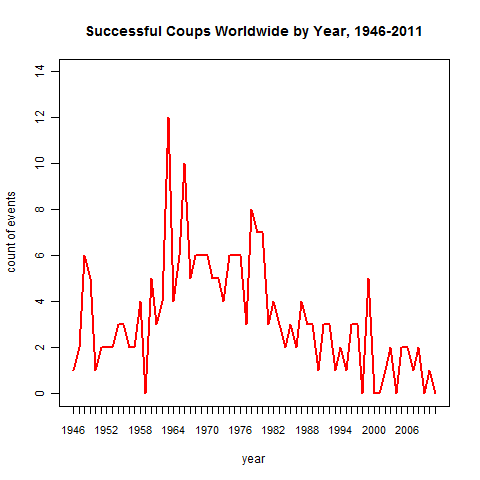
Joshua Kurlantzick says yes. Jay Ulfelder points out that this assertion is simply unsupported by the data. His advice for reporters:

[S]ure, some questions can’t be answered with numbers; the relevant data may not exist (yet), or the research question might involve aspects of process that are difficult to quantify. The rest of the time, however–and that’s going to be a lot of the time–it’s a good idea to look at available data before getting deeply invested in a particular answer.

Should Women Be Paid For Egg Donations?

A new report thinks so. The status quo:

In Britain, where direct payment for unfertilized eggs are prohibited, women are allowed to receive discounts on in vitro fertilization treatments in exchange for making some of their eggs available for treatment or research, a procedure referred to as "egg sharing." In the United States, egg donation rules vary by state, with some drawing distinctions between eggs used in research and in treatment. The U.S. National Academy of Sciences recently issued guidelines permitting only reimbursement to egg donors for expenses such as travel and lost wages.

Defense Cuts Are Coming

If history is any guide:

[T]he past build downs have seen defense resources decline an average of 30% in constant dollars over ten years.  Right now, the Budget Control Act would lead to a build down of about eight percent, so historically very low.  We will get to at least 17%, because that is what $1 trillion represents, as a ten year reduction from the Pentagon's appetite. If the 1990s is a precedent, we will go beyond that.  The difference between the 1985 baseline and what DoD actually got between 1985 and 1998 was a total of $ 1.6 trillion.