Bromance In Britain

Tracy Clark-Flory compares adolescent male bonding on both sides of the Pond:

"It is normal in the United Kingdom for young straight boys to sleep in the same bed, frequently, and to cuddle," says [Eric Anderson, an American sociologist], who has primarily focused his research on white males living above the poverty line. In a recent study, he found that 90 percent of heterosexual undergraduate men in the U.K. had at least once kissed a straight male friend on the lips. Things are not so fluid in the U.S. — he found 7 percent of heterosexual college guys had smooched a straight male pal — but his in-depth studies of American jocks and frat boys, those expected to be the most homophobic, have revealed them to be increasingly comfortable with same-sex physical and emotional intimacy, he says.

Not when I was growing up.

Moore Award Dissent

A reader writes:

I have to admit being horrified at how horrified people are at Lawrence's interview with Herman Cain.  He treated Mr. Cain far more politely than I or virtually any other African-American I know would have given the circumstances. And the circumstances are these.  My father attended the University of Texas roughly during the same time period.  UT was desegregated at the time, but he has no fond memories of the school, even though any troubles he experienced there were minor in comparison to others.  He would eventually go on to Rice University (where he teaches today) for his PhD as the first Black man ever to attend that institution.  His admission was delayed a year because White Alumni sued Rice to prevent his entry.  He also had to deal with a Professor in Applied Math who publicly vowed that any Black student who enrolled in his class would start at a "C" and head downward.

Still, as angry as he remains to this day over what relatively little happened to him during his stays at both Texas schools, he still found time to test restaurants, because he knew it was his about him and his future children. 

He was doing it for me.  He also met another student at the time who was also testing restaurants while attending Texas Southern University.  Her name was Claudette Smith. I know her today as Mom.

You may argue that Herman Cain had a right not to participate in the Civil Rights Movement, and that may be true.  But here's the problem: he's holding himself up as an example of, if not the very pinnacle of, the black community.  (Just ask him, he'll be glad to tell you).  He has gone so far as to suggest that Black People who do not support him (not give him a fair hearing, mind you, but out-and-out support him) have been brainwashed by the Democratic Party.

May I suggest that my Father and Mother were not brainwashed?  May I suggest that they saw with their own eyes who was supporting Civil Rights and who wasn't; and their allegiance forevermore was aligned with the Democratic party.

And for the record, yes, there were Southern Democrats who voted against the 1965 Civil Rights Act.  They long ago switched parties and joined Herman Cain's party, the Republicans.  I'm sure even Mr. Cain remembers Lyndon Johnson signing the Civil Rights Act, and saying he was delivering the South to the Republicans for the next 40 years.  He was wrong.  Try 60-70.

The horrific part of the interview which apparently did not catch your eye, was Lawrence's first asking Mr. Cain if he wanted to back off that "brainwashing" statement.  Mr. Cain did not.  With him questioning my intelligence as a African-American, I had a right to know where he stood in relation to the community he was questioning  I had a right to know what kind of African-American he was, and yes that is something I can judge given the questions Lawrence O'Donnell asked rather haltingly.  I had a right to know what he had given to the cause.  Because if he had stood with my parents, if he had marched with my parents, then African-Americans as a whole would have shrugged when he called us "brainwashed".  At least, we would have decided, he earned the right.

But he didn't.  He didn't march. He didn't sit-in.  He didn't test.  He didn't want to get involved, because frankly, it was probably more important to him to ingratiate himself to his white oppressors.  I'm sorry to come off sounding like a member of the Black Panther Party, but we see people like Mr. Cain all the time in the African-American community.  The ones who think they're better than the rest of us, smarter, and the only ones fit to lead, the only ones fit to be heard from.

Republicans For “Class Warfare”

Tim Noah is struck by the latest WaPo-Bloomberg poll which found that "68 percent of all voters and 54 percent of Republican and Republican-leaning voters favored raising taxes on incomes above $250,000 (i.e., the Obama plan) to tackle the deficit":

To whom, exactly, do Republican officeholders and candidates think they're pandering? The Tea Party? Evidence has begun to trickle in that even the Tea Party isn't as anti-tax as Republican party leaders. On Aug. 1 the New York Times ran a Page One story by Kate Zernike … that said "the power of the Tea Party as a singular force may be more phantom than reality." Zernike then went on to report: "When Tea Party supporters were asked if the debt-ceiling agreement should include only tax increases, only spending cuts, or a combination of both, the majority — 53 percent — said that it should include a combination. Forty-five percent preferred only spending cuts." 

Psilocybin At The End Of Life

3567431472_f8414a7ea1_o

Dr. Stephen Ross's research uses "psilocybin-assisted psychotherapy to treat end-of-life distress in people with cancer." The results:

In my fifteen years as a psychiatrist, I’ve seen some profound things. Here I’ve seen decreased death anxiety, decreased depression, greater integration back into daily life, improved family function, and increased spiritual states. Half of our patients had classic mystical experiences, and the other half probably had near-mystical experiences. … I think psilocybin is a safe treatment modality that can potentially be a paradigm change within psychiatry and very helpful to dying patients.

If only we can transcend the fear.

(Photo of Psilocybe Cubensis by Flickr user afgooey74)

Iranian Terrorists On US Soil – For Real? Ctd

Joe Klein sees the alleged Iranian plot as part of a bigger conflict:

The attempt to kill Adel al-Jubeir may have been a one-off by a rogue element of the Al-Quds Force, but it is also a clear sign of escalating tensions between Sunnis and Shi’ites in the region. Those tensions will only increase now. A Saudi response is not improbable. A collapse of the Assad government in Syria could precipitate a regional sectarian conflict between Sunnis and Shi’ites, which could become chaotic very quickly–involving Lebanon, Israel, Iraq, Jordan, to say nothing of the destruction of the Iranian and Saudi oil fields.

A New Reality, Ctd

A reader writes:

I generally agree with your assessment of the economy and the various Occupy protests happening right now, but I have to take exception to something you wrote:

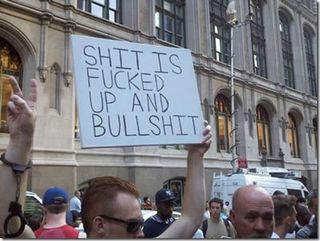
Shit is fucked up and bullshit all right. Except that this isn't a conspiracy. It's a function of choices we made as a democracy: to defeat Soviet and Chinese communism; to ramp up private and public debt in good times rather than tackle deeper problems in education and infrastructure; to enlarge the global economy; to foster innovation. We are, in this sense, a victim of our own success.

Who is the "we" you refer to? Many people who are adults today had no say in any of those choices and have not profited from them. I was born in 1985, too late to vote Occupy_wall_street bulls..._thumbagainst Reagan or Bush Senior. I was raised by a single mother who worked as a house cleaner and landscaper. She never used a credit card because she believed (and still believes) that it was irresponsible to spend money she didn't have. As a teenager and young adult I watched the insanity of the financial markets (the tech bubble, and later, the housing bubble) incredulously. How could anyone believe that it was a good idea to invest in companies that did nothing useful or build homes that no one actually wanted to live in?

As an adult, I've followed my mother's example, avoiding credit and trying to live within my means, but I now find myself with $1000 of medical debt (despite having health insurance) and no income. Meanwhile, I'm trying to decide whether I should take out a student loan to continue my education when my financial aid runs out. Will there be a decent job waiting for me if I pursue a degree, or will I just get stuck with more debt?

From where I'm standing, it looks to me like I'm a victim of other people's success. And I'm not alone. If you look at the protest crowds, you'll notice that many of the protesters are about my age. We've all come to the same realization: while our elders were mortgaging their future, they mortgaged our present. The economic injustice in this country is not just a result of collusion by the rich against the poor, it's also a result of collusion by the old against the young. That may not be a conspiracy, per se, but it still feels like a swindle.

I'm with you mostly. But you're not a victim of someone else's success. The economy is not a zero-sum game. You're a victim of collective decisions made by majorities in the last three decades, and especially the last catastrophic one. I too saved for retirement, never took on credit card debt, diligently paid off mortgages within my financial reach … and I landed in the top 5 percent. To do all that and end up in the bottom 20 percent and see reckless bankers destroy the economy and still give themselves massive bonuses … well, I sure understand the anger nonetheless. Niall Ferguson blames the boomers here. To have been the wealthiest generation ever … only now to bankrupt the rest of us through Medicare, while the young have so few jobs and often no health insurance: it does anger up the blood.

So my collective "we" is not meant literally. But it does mean that all of us who have participated in the polity for the past thirty years are not blameless. We lived beyond our means; and created bubbles we really should have known to avoid. We bought houses we couldn't afford, leveraged by financial instruments no one understood. And we expected it to go on for ever. Yeah, some financiers committed crimes of recklessness and greed. But our elected officials changed the rules to help them. And we voted for them.

The Conservative Case For Elizabeth Warren

Contra George Will, who accuses Warren of advocating "collectivism," William Galston makes the case

Warren is saying … that (to quote a thinker with whom Will has more than a passing acquaintance), "Society is indeed a contract … a partnership not only between those who are living, but between those who are living, those who are dead, and those who are to be born." Warren’s homely phrase, "pay forward," captures the moral bond that connects this generation with the next. If we don’t adequately provide for their future, we are breaking that bond. A decent political community has the right—indeed the obligation—to honor that bond—if necessary, by compelling individuals who refuse to look beyond their own immediate concerns to contribute their share to the common future.

Scott Galupo dusts off Will's own words from 1983 to reinforce the point. Will was once a Tory:

Biologically, we are directed toward culture; we are pointed beyond our individual existences, toward our species, in the form of our community and progeny. Politically, we should be led up from individualism.

Siding with Galston, Dreher adds:

As the Catholic writer Mark Shea points out, you don’t have to embrace the Occupy Wall Street crowd to grasp that they are onto something, that there’s something truly disordered about our society’s economic arrangements. Seriously, could Burke even get a hearing among American conservatives today? Or is he to be seen as some sort of proto-commie?

Can we not just be adults and recognize that society exists and that it empowers the individual and that the individual therefore owes something to the society at large – and our arguments are about the size and shape of that relationship through time in different circumstances. Or would that mean we couldn't yell at each other quite so much?

The Pioneer

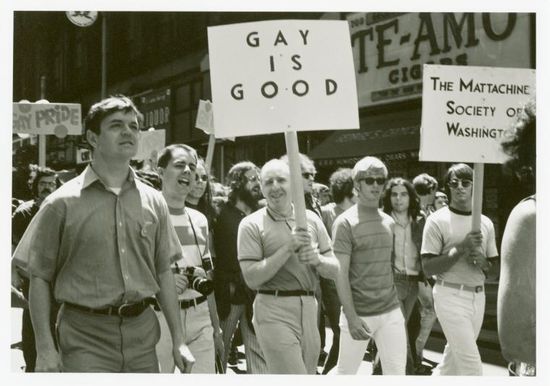
Frank-kameny-and-mattachine-society-of-washington-members-marching-1970

The great, perhaps greatest ever, campaigner for gay equality, Frank Kameny, died last night. MW has a good summary of his life's work. Wiki's profile is here. For all you atheist readers, a good summary of his strongly Hitch-avant-la-lettre position on religion is here. But picketing the White House in 1962 in a tie for homosexual equality tells you much that you need to know. That he never gave up, that he insistently engaged even his fiercest opponents for decades with unremitting conviction and self-worth, that he was firing off clarifying emails to his last days … this was a giant of a man. Without him, the movement to remove homosexuality as an impediment to security clearance in federal work would never have gotten off the ground. Ditto sodomy law repeal. Ditto the removal of homosexuality from the list of psychological disorders by the American Psychiatric Association board in 1973.

But what I treasure about Frank was his refusal to write anyone off. The most ferocious bigots he wrote polite but stern letters to. Here is an extract from one that was sent to the raging bigot, Joseph Farah, of WorldNetDaily. And they published it. Classic Kameny quote:

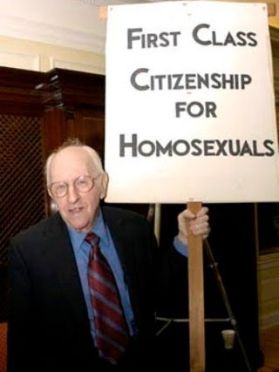
I am a long-time gay activist, considered by many to be one of the remaining Founding Fathers of the gay movement. I initiated gay activism and militancy in 1961 and Kameny, first class citizenship signcoined the slogan "Gay is Good" in 1968. It is!
I am a gay veteran of front-line combat in Europe in World War II. I did not fight that war to return to second-class citizenship or back-of-the-bus status (or off the bus altogether) for me and my fellow gays…

We gays know that our homosexuality is a divinely inspired gift and blessing, given to us by our true God to be enjoyed to its fullest, exultantly, exuberantly and joyously.

We seek not "special rights and privileges" as you term them, but precise equality of rights and privileges in what is our America, for us explicitly as gay Americans (not merely "American Americans" so to speak) fully – fully – as much as it is your America as non-gay Americans.

To repeat: For us, as gay Americans, this is our America, fully as much as it is yours, and you are not going to be allowed to steal it from us, try as you may – and you are certainly trying very hard.

And they are our White House and our president, fully as much as they are yours.

Any time one's nerve faltered, or when the price of being a bit in the drill of a civil rights movement seemed too high, Frank's enthusiastic embrace of the goodness of gayness always cheered me up. There was not the slightest trace of defensiveness about him or his arguments. He believed, as I do, that gayness is not a disorder but an objective wonder, a way of being human that has its own unique patterns and staggering achievements through the centuries of our civilization and others.

The tragedy is not that gays are discriminated against because of who we love. That is an absurdity. The tragedy is that the goodness of gayness is barely grasped by many gays, beaten down as they have been by social and cultural pressure, and only recently grasped by large numbers of straights.

Frank Kameny believed in the goodness of gayness with all his mind, heart and soul in 1957. And he lived a long life, and died a peaceful death at home. His thought and his life made "gay tragedy" finally an oxymoron. He was a gay triumph.

(Photos: a march by the Washington Mattachine Society in 1970, with Frank holding his trademarked sign, and Frank with a placard from 1962 I was honored to carry in the 2009 Equality March.)

Cain’s “Economist”

Is underwhelming:

That Cain doesn’t have a lot of specifics to back up the slogans shouldn’t be all that surprising. While he loves to mention the plan during his media appearances, he is far less willing to share any of the details behind the plan, such as the backup for his assertion that the plan is revenue neutral, or the even who has helped him come up with the plan. That’s not surprising, though, once you realize that the plan’s chief architect, Rich Lowrie, isn’t an economist at all and is in fact a Wells Fargo Branch employee working outside of Cleveland, Ohio whose highest educational degree is a apparently a B.S. in Accounting from Case Western Reserve University.