Not of the one you're thinking of, thankfully.
Month: October 2011
Ask Me Anything: The Best Doctor Who?
Is Jon Huntsman The Next Colin Powell?
Spencer Ackerman wonders:
That's his only game plan, right? To be the Republican Party's foreign policy beard? The guy centrists and liberals can cheer for against the crazies, oblivious to the fact that Huntsman is being manipulated by those crazies, and substantively marginalized within the administration? Not that I don't like Huntsman. I do. In fact, liberals who care about foreign policy — both of us! — probably should come to terms with the uncomfortable fact that his internationalist rhetoric is probably closer to our sweet spots than Obama's record is. But the game stays the game.
Larison found Huntsman's foreign policy address reasonable in general, but is taken aback by his apparent openness to a preventative war against Iran:
[I]t undermines the main argument for why Huntsman should be taken seriously as a candidate: his reputation for greater foreign policy experience and understanding. In a mostly hawkish field that ranges from the ridiculously alarmist (Santorum) to the irresponsibly alarmist (Romney), Huntsman is supposed to possess the sobriety and sanity that other “mainstream” candidates lack. His “I can’t live with a nuclear-armed Iran” line may be nothing more than lip service, but the fact that he is willing to indulge one of the most dangerous ideas in current foreign policy debate badly weakens the one thing that distinguishes him from the other candidates.
Naturally, Jennifer Rubin describes Huntsman's foreign policy as "Obamaism in a prom dress." (Yes, female columnists can use misogyny when it suits them.) It's also sanity compared with Romney's warmed-over Project For A New American Century, and Rubin's relentless pursuit of war.
Repeat After Me: Newt Is Dumb
Here's even Mark MacKinnon succumbing to the nonsense:
Newt Gingrich came off as the smartest guy in the room as usual.
No he didn't. He came off as a petulent, pompous, pseudo-intellectual prick. He is simply not that bright, and as out of his depth as his insecure pronouncements of self-described world-historical profundity suggest. He belongs on Dancing With The Stars, not a Republican debate, even of this poor caliber.
Or maybe it's best put another way: having constant stupid and half-baked ideas that you believe are world-altering is not a sign of intelligence. It's a sign of narcissism, wrapped in a constant, angry snarl.
Iranian Terrorists On US Soil – For Real? Ctd
Eli Lake has some details on the alleged plot:
Officials told The Daily Beast that President Obama first learned of the alleged plot in June, as undercover agents from the Drug Enforcement Agency were working on a sting against an Iranian American accused in court documents Tuesday of trying to pay Mexican gangsters to murder Ambassador Adel al-Jubeir…The plot, according to an indictment unsealed Tuesday, was approved at the top levels of Iran's elite Quds Force, an organization the United States has accused in the past of aiding the Taliban in Afghanistan and plotting lethal attacks on U.S. soldiers in Iraq. The Quds is an arm of Iran’s elite Revolutionary Guard tasked with carrying out the Islamic regime’s agenda outside the country.
Ken Pollack worries that this attack marks a sea change toward aggressiveness in Iranian foreign policy. Daniel Serwer thinks the right response is ratcheting up international pressure on the nuclear program and calling Ahmadi's "bluff" on negotiations:
How do American diplomats make nice with Ahmedinejad while announcing to the world that Iran’s security forces have been plotting murder, even mass atrocity if one version of the alleged plot had taken place, inside the United States? But it is precisely at a moment like this–when Iran is going to find itself weakened and isolated–that the international pressure might be sufficient to force progress on the nuclear issue, with the added potential benefit of further fragmenting a regime whose president and “supreme leader” are already on the outs. Maybe taking up the offer privately, cautiously and conditionally would work too.
Robert Haddick focuses on the implications for our ability to deter Iranian attacks.
The War On Medical Marijuana
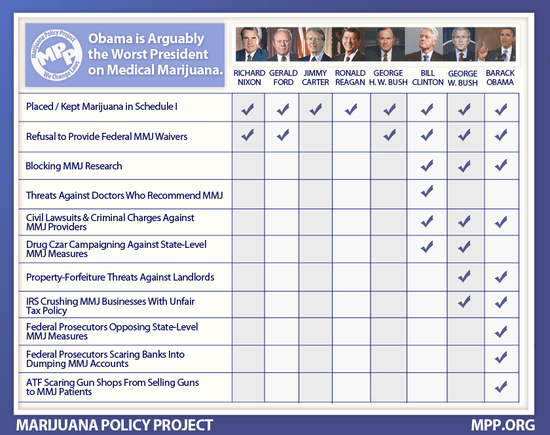
Obama ramps it up:
[E]nough with the pretenses. The Justice Department's current position is that the tolerance promised by the president applies only to patients, which makes Obama's policy indistinguishable from his predecessor's, which in turn did not represent any restraint at all, since the federal government generally does not bother with cases involving small amounts of drugs, regardless of who is using them or for what purpose.
The California raids were particularly retrograde, even though the system there obviously needs a revamp. I wonder how much politics is behind this and how much is simple institutional lobbying. But if Obama wants to truly depress his younger base, he can keep this up. You think they'll be voting for an administration that treats marijuana on the same level as crystal meth?
And why, one wonders, aren't the Republicans lambasting the Obama administration for violating the Tenth Amendment they're so fond of? Because, as with marriage, federalism only exists among most Republicans (except Paul and Johnson, peace be upon them), in so far as it never encounters a policy Christianists dislike.
Iranian Terrorists On US Soil – For Real?
AG Holder alleges Iranian special operatives planned to bomb Saudi and Israeli targets in Washington, DC. Steve Clemons demands a response:
This is a serious situation — and this kind of assassination is the sort that could lead to an unexpected cascade of events that could draw the US and other powers into a consequential conflagration in the Middle East. If Iran was indeed willing to attack a Saudi Ambassador and close confidante of the Saudi King on US soil and countenance the death of 100-150 Americans, then the US has reached a point where it must take action.
Josh Rogin thinks we will be seeing one. Michael Rubin, bizarrely, blames Obama “projecting weakness” for the plot, though he also has a substantive take on who in the Iranian government might have been responsible for it. An Iranian reader close to the Green Movement is skeptical about the whole thing:
As you know this is a huge story with long term implications for US-Iran relations and possibly a turning point that could put the two countries on a collision course. But can it be true? There are lots of credible voices tonight raising red flags about jumping on the bandwagon. If, as the US government claims, they were trying to attack a restaurant where the Saudi ambassador frequented and had actually succeeded in killing him and possibly a few other Americans, that would have been considered an act of war by Iran. Now, I can’t think of one “sane” Iran expert who can look you straight in the eye and say the Iranians (or any of its elements) really want a war with US!
In other words: what would the Iranian government gain from hitting the Saudi Ambo in DC? Nothing other than providing the excuse to AIPAC and neocons to push for a military attack! If Iran wants to hit its rival in the region, there are plenty of targets there, so why on earth would they do it on US soil? And why would they get some amateur 56-year-old Iranian who has been living in small town Texas for 30 years (with an American wife) to contact a Mexican Cartel on his own!!? Just sounds fishy.
It does a little. But this could be a rogue element in the Quds force. Or some function of Iranian factional politics. I would note, however, that leading nuclear scientists in Iran have also been assassinated in their cars by foreign agents, almost certainly the CIA or Mossad. But targeting a Saudi in Washington, a third country? Surreal.
Bloomberg Debate Reax II
At one point during the debate, candidates were allowed to question each other. Armed with the golden gift of new White House records showing intimate meetings between Romneycare architect Jonathan Gruber and the Obama administration, Perry mumbled a jovial question at Romney for a few seconds — after which Romney steamrolled him with his usual spin for the next several minutes. Perry disappeared somewhere under the table after that. Or maybe he was playing Words with Friends on his iPhone. Or looking at his watch George H.W. Bush-style.
While the debate will probably not be critically damaging to Mr. Perry, his odds of upending Mr. Romney have continued to lengthen. Meanwhile, the more solid Mr. Cain’s support becomes, the harder it may be for Mr. Perry to recover his standing in the polls.
I thought it was a bit premature to say Perry was mortally wounded, even if, as the Times’ David Leonhardt informed us in a tweet shortly after the debate finished, Intrade, an online political futures market, “now gives Assad a larger chance of being ousted this year (15%) than Perry of being the R nominee (13%).” For all his errors of omission, Perry hadn’t made any obvious gaffes. By his standards, this was a big improvement.
[Perry] went back and forth between garbling his answers and simply disappearing for large stretches. He showed up for a debate on the economy with nothing to say on the economy other than that his economic plan wasn’t ready yet, and apparently he decided to avoid his difficulty in delivering prepared zingers by not bothering to even try any. Just incredible.
Once again, Romney defended his Massachusetts health care plan by citing its reliance on private insurance, and the way it was designed to cover the uninsured without changing health care for the already-insured. This is exactly what Obama did, too. But, of course, by describing his plan in reasonable terms, Romney realizes that Republicans will conclude it must be different to the hated Obamacare, which is based on socialism and death panels. Romney's contempt for his electorate continues to endear me to him.
In not getting bruised and by demonstrating his superior campaign skills, Romney came out the big winner. Perry didn’t help himself a bit, and now risks slipping behind Bachmann and others.
Rick Perry continues to amaze. I mean, after his last disastrous outing, he must have known that Job 1 was looking like he was ready for prime time. Instead, he looked completely unprepared, as if he was surprised that people were still asking him actual questions instead of just nominating him on the spot.
Herman Cain is going to be around for a while, and people should start taking him seriously. If he’s not president, he could be vice president. Or bet the under and just start calling him Mr. Secretary.
[Cain's] performance was solid, if unremarkable. He stuck to his talking points — anyone who criticizes his plan doesn’t understand that he wants to chuck the whole tax code first! — and met new attacks from his rivals with cheerful aplomb. At this point, any boost in Cain’s name recognition will be a boon to his relatively obscure campaign. And the constant 9-9-9 chatter, even if some of it was negative, probably helped Cain’s chances of sustaining his unlikely rise.
Romney is quickly demonstrating that he’s ready for the challenge of the campaign and that everyone else has a lot of catching up to do.
The Density Cure
Encouraging development fixes numerous problems:
The politician's incentive is to hide costs—to cave to the neighborhood's demands for less development and then try to mandate affordable housing through still more new rules. I'd argue to politicians that this is all making their city less efficient and their lives more difficult. New growth will ultimately make other problems easier to solve, by supporting the local economy and increasing the tax base. That creates less demand for interventions to "focus on jobs" or dig up tax revenues through new gimmicks. And it creates more room to satisfy local demands for amenities like well-cared for parks and infrastructure. A city that can find ways to accommodate new residents with new development will have an easier time addressing other typical civic problems.
The Sectarian Autumn
Hussein Ibish sees a resurgence of infighting in the Middle East:
I now think it’s impossible to deny that the single most important factor shaping the Arab regional dynamic is a sectarian divide, not between Sunnis and Shia, but between Sunnis and everybody else. On the sidelines are also significant divisions between Arabs and ethnic minorities such as Kurds or Berbers, but it is the sectarian split that is the real dividing line these days. This new sectarian consciousness has greatly assisted the rise of Turkey as a regional power, strongly aligned with Arab Sunnis, at least for the moment.
Steven Cook zooms in on the "Maspero Pogrom" against Coptic Christians in Egypt.
 The Dish