"President Obama has spoken sympathetically of the Occupy Wall Street Movement. Nancy Pelosi has endorsed it. So have others. Let me therefore offer some counsel to my Democratic friends: A party that embraces a movement like this is asking for, and will soon find, trouble. This is not a movement to which you want to link yourself. As John F. Kennedy once warned, 'those who foolishly sought power by riding on the back of the tiger ended up inside,'" – Pete Wehner. And the Tea Party is what, a puppy?
Month: October 2011
Libya’s Lesson
Eric Martin urges us to carefully evaluate whether an Responsibility to Protect (R2P) intervention will escalate into regime change:
[T]he lesson is that we should look at every proposed R2P missions with that potential escalation front and center. At the outset, we must determine whether there is a strong likelihood that we could protect the civilian population in question by a military action that falls short of regime change. If not, it is essential that we fully appreciate exactly how serious this proposed military involvement is, and what it could entail in terms of ongoing responsibilities.
In Libya, we were given, what?, two days to think this through. Matt Fay is infuriated that NATO is refusing to tally the civilian casualties caused by the intervention.
Cain’s Dereliction Of Duty
Herman Cain boasted that he knows little and cares little about foreign policy. Larison puts Cain's statement in context:
What I find interesting about this statement is that it puts a lower priority on one of the main things for which the President is actually constitutionally responsible (formulating and executing foreign policy) than it does on something that he can at best indirectly affect through preferences on fiscal policy and regulation (“creating” jobs).
Yglesias is tired of Cain's shtick:
The president of Uzbekistan is Islam Karimov. Maybe Cain doesn’t know. Fine. It’s a trivia question. But say, I dunno, something about American foreign policy in Central Asia. Try to demonstrate some command of the issues. But Cain is transparently running for talk radio host or something. If it wouldn’t make a good subject for a 10-minute drive time segment, he doesn’t want to talk about it.
The Conscientious Scientist
Maria Konnikova provides background on the star of Sunday's MHB:
Richard P. Feynman was the physicist who could, it seems, also be anything else he chose to be: a musician (who played the frigideira in a Brazilian samba group and even performed during Carnaval), a composer (who co-wrote and performed music to an award-winning modern ballet), an artist (who, as Ofey, had a one-man show), a specialist on Mayan hieroglyphics (who lectured on the codexes of the ancients and could spot a fake before the experts themselves)—and most of all, always, a profound thinker, who wondered not only about the world around him but about the him the world was around. Who not only wondered why, but then immediately, why he wondered why, and then, why he wondered that. How did his mind work? How did it get to wherever it traveled, and could he find a way to trace it?
Just in case your own self-esteem wasn't a little wobbly already. A reader echoes Feynman's wonderment:
In Judeo-Christian religions the belief is that God provides some form of stopping point, where the questions end. When I was a five-year old, I learned that you could ask the question “Why” to the answer to any query that you posed your parents. After several layers of “Why,” my mother would answer, “Because God said so,” implying the end of the conversation.
But ultimately, my father gave the wisest answer: “I don’t know but go look it up.” If I couldn’t find the answer in a book (this is long before Google), he responded: “Then you’ll have to find the answer yourself. And that answer will create more questions. And you will have to be happy in that search.”
How Bibi Pulled Israel To The Right
Daniel Levy summarizes the prime minister's Fox News-ification of Israeli institutions:
Netanyahu has come a significant way in shaking up [Israeli] culture in the intervening years. He helped found what has now become Israel's leading think tank, the Shalem Center, which provides both personnel and policies for right-wing Israeli governments and is funded by Bibi's key American supporters (Sheldon Adelson and Ron Lauder). Israel now has a free daily newspaper, Israel Hayom, the widest circulation broadsheet in the country, also funded by Adelson and unswervingly committed to the prime minister's line. Netanyahu has named overtly political place holders to head up the news broadcasts on Israeli state TV and radio. The Israeli right now has an academic, think-tank, and campaigning infrastructure modeled on its U.S. neoconservative counterparts (with which there is close cooperation) and just as influential. But it's not due solely to force of Bibi's charisma. This political and institutional change is built on solid demographic foundations.
Plagiarism vs Sampling
Beyoncé has been accused of liberally sampling from Rosas danst Rosas, a work by Anne Teresa de Keersmaeker, a major contemporary choreographer. It's not the first time she's been accused of borrowing moves. Echoing Blake Gopnik, Alva Noë defends the practice:
Sampling is nothing new, not in art, and not in life. Every time you use a word or phrase you are, wittingly or not, making a pastiche out of the linguistic gestures of those who came before you. Evolution, whether in biology, or in technology and culture, is never anything other than a redeployment of old means in new circumstances. We use the old to make the new and the new is always old.
Willa Paskin points out the obvious:
"Countdown" alludes to many things other than De Keersmaeker's work (most notably Funny Face), but maybe it's time Bey cooled it with the homages to folks who are not that famous — or at least paid them and/or asked for their permission before sampling their work. Who would say no to Beyoncé? And then instead of "stealing," she could just be remixing.
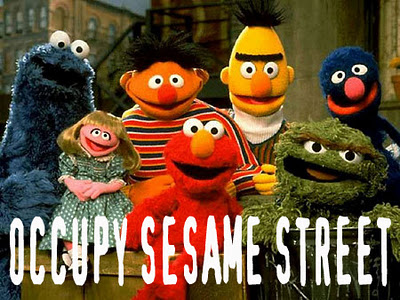
“Oscar has started a trashcan drum circle”
Playing By The Rules
Freddie deBoer, who supports the Wall Street protests, is troubled by the movement's direction:
I keep seeing photos of people holding signs, or watching interviews with people, or reading blog posts or on Facebook, that express some measure of this: the problem is that young college graduates have lots of student loan debt and can't get jobs, and so now they're taking to the streets. And to me, if that is the message here, heaven help us. …
Consider what the idea here is: that this protest becomes something worth considering when and only when it becomes about those who are most visible. Only when the young and college educated begin to express grievance, and only when that grievance concerns their material wealth and opportunity, do the protests begin to take off. It is extremely disturbing to me how quickly a movement opposing our system of prestige and wealth becomes a movement about those who thought they were entitled to succeed in that system. Complaining that a college education hasn't moved you into the material comfort and social strata you wanted isn't an argument against this system; it's a complaint about the outcome of the system that tacitly asserts the value of that system. When someone says "I have a law degree and I work as a barista," the necessary assumption of that statement is that their law degree entitles them to a certain material and social privilege. That privilege is precisely what animates the system they say they are protesting.
He follows up here.
Mental Health Break
(Hat tip: 3QD)
The GOP Establishment’s Candidate
Dan Amira and Jennifer Rubin expect Christie's endorsement of Romney to help Romney's image. Ramesh Ponnuru explains how the establishment manages to keep winning nominations – even as the Republican base swings rightward:
[T]he Republican establishment almost always wins presidential-nomination contests, and conservative insurgents almost never do. Since 1984, nobody substantially to the right of the party establishment has won the nomination. Make a mental list of the last four Republican nominees – George H.W. Bush, Bob Dole, George W. Bush and John McCain – and the notion of a Romney victory in the primaries becomes less surprising. Establishment-oriented candidates keep winning for two reasons. The first is that the party establishment has moved to the right, too, co-opting conservatives who might otherwise have overthrown it. … The second reason the establishment wins is that its opponents never unify behind another candidate.
 The Dish