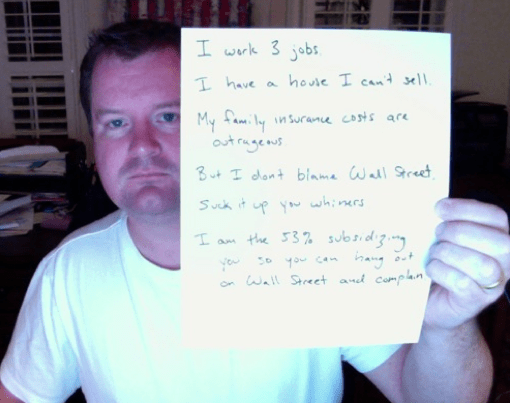
– Erick Erickson. His "three jobs" claim is pretty weak. Yglesias notes another 53 percenter. It's a fascinating insight. The key notion is that: "I will succeed or fail because of me and me ALONE." But the dude says his house has lost 40 percent of its value. He did that all by himself? Then this:
I don't blame Wall Street because it doesn't matter what Wall Street or anyone else does.
I admire the attitude and share it. But empirically, he's out of his mind. This global depression was triggered by fancy-ass financial products that were unintelligible even to those who sold them. The huge amount of public money spent to bail the bankers out came from the 53 percenters. Wall Street has nonetheless slowed down Dodd-Frank to a crawl and are festooning themselves with millions of dollars in bonuses, while poverty soars. It does matter what Wall Street does. It has transformed our world, including that of conservatives. Maybe we should do nothing about it. But that it doesn't matter? Please.
John Avlon sees tonight's debate as crucial. So does Steve Kornacki:
Perry’s candidacy seems to be at a pivot point: Will he bounce back, assuage all of the concerns he’s raised among conservative leaders and activists and reassert himself as the right’s chief alternative to Romney? Or will things go from bad to worse, with Perry permanently marginalized as just one of several Romney alternatives? The week we are now starting, which will feature the first debate since his Orlando debacle and a major Perry speech on the economy, may be crucial in determining which direction he goes.
Going forward, Perry's principal challenge is to stay viable so that more elites don't defect to Romney. He is well-funded and has a favorable primary calendar. Regardless of his standing in national polls, he has a decent chance to mount a comeback against Romney because support in multi-candidate primaries is so fluid. When there are relatively minor ideological differences between candidates, it's possible to make rapid gains as voters shift to their second or third choices for strategic or stylistic reasons. If Perry can adapt to the rigors of a national-level campaign, his odds of consolidating enough of the anti-Romney vote to win the nomination are significantly better than the current Intrade estimate of 18.9%.
It turns out the two laws are more tightly connected than previously thought:
Newly obtained White House records provide fresh details on how senior Obama administration officials used Mitt Romney’s landmark health-care law in Massachusetts as a model for the new federal law, including recruiting some of Romney’s own health care advisers and experts to help craft the act now derided by Republicans as “Obamacare.” The records, gleaned from White House visitor logs reviewed by NBC News, show that senior White House officials had a dozen meetings in 2009 with three health-care advisers and experts who helped shape the health care reform law signed by Romney in 2006, when the Republican presidential candidate was governor of Massachusetts. One of those meetings, on July 20, 2009, was in the Oval Office and presided over by President Barack Obama, the records show.
It was merely embarrassing for Romney when the president and West Wing officials would say they were inspired by the former governor’s health care law, but the realization that Romney’s own policy team was brought in to help point Obama and his aides in the right direction is more problematic for the GOP presidential candidate. It makes it that much more difficult for Romney to distance himself from the health care law the right hates with the heat of a thousand suns, and arguably strengthens the case that Romney has part-ownership over the national reform law. In effect, Mitt Romney is the godfather of what Republicans call “ObamaCare.” It was Romney’s policy that created the blueprint for Obama’s policy, and it was Romney’s team that served as advisers to Obama’s team.
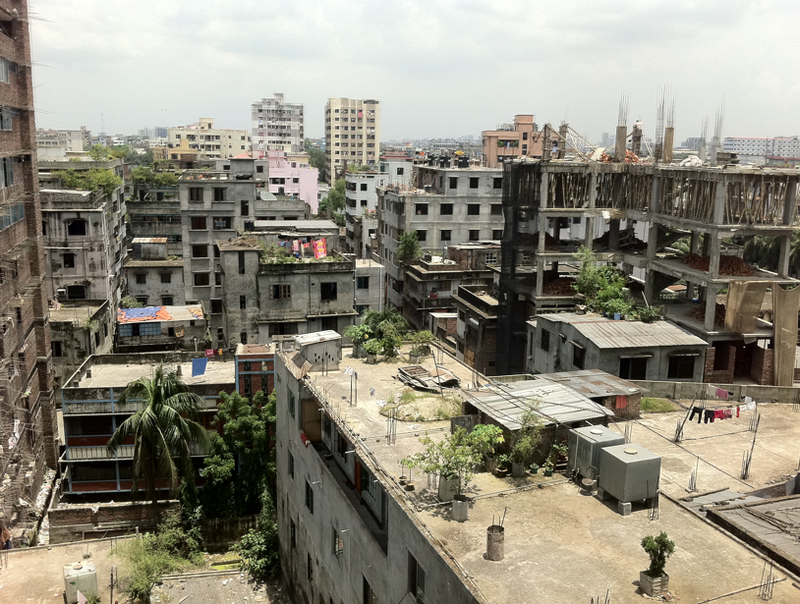
I'm useless at this sort of thing, so I usually just sit it out and wonder how other folks can be so smart. This one is almost impossible – no cars, no landmarks to speak of and no background mountains. So, for the sake of tropicality and as a tribute to the washing on the lines, let's say Libya. Tripoli?
Another writes:
This screams urban Africa to me. The palm trees suggest tropical and likely near a coastline. Would say Eastern coast, as there are more big/crowded cities there. Maputo or Dar maybe, but my first glance said Maputo.
Another:
I love the hut, the clothes on the line, and landscaping on the roof of the building in the foreground that was obviously intended to be at least one story higher than it now is. The rooftop cisterns are primitive, but effective. It could be Central or South America but more likely Africa. The first thing that came into my head after a 30-second look, for no discernible reason, was Kinshasa, Democratic Republic of Congo. I have been in the construction business for more than 30 years but am still amazed at what can be accomplished with limited means as long as will, ingenuity, and manpower are available. The ingenious method of pouring concrete in a multi-story building shown in the following video reminded me of the buildings in the contest photo:
One more thing. I realize this hasn't exactly been a slow news week, but I'm surprised there hasn't been more of a resolution of the controversy over the result of last week's contest, #70. I know it was addressed, but it was not resolved, nor was their an indication that it would be. Has the submitter of the photo been contacted for verification? This part of their note caught my eye: "A friend used to live in this apartment, … so when visiting home (I'm an expat Scot living in Belgium) we used to abuse his hospitality quite a bit. He's since moved out and is on a 7-month meander through Latin America…" The submitter refers to #11 as an apartment, but it has been a bed and breakfast since at least 2005.
The submitter of last week's photo responds to the row:
I think your protesting correspondents may well be right. They seem to have paid more attention than I did when physically there! I have no immediate way to confirm with my friend, who has probably reached Guatemala by now, but the reader you quoted seems very persuasive. Deep apologies for the confusion!
An honest mistake. Back to this contest:
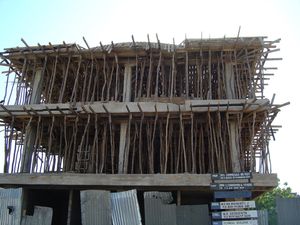
Well, not quite so easy this week as the past weeks. The palms and general decaying post-colonial appearance puts us somewhere in the tropics. The size of the buildings indicate it's a city of some size, too. I considered South America for a bit, but it somehow had an African vibe, and the "scaffolding" on the right nicely matches some Google Image hits I came across labelled "Tanzanian scaffolding" (see here). We've recently had contests for Mozambique, Angola and South Africa, so I ruled those out. I couldn't find any cities in West Africa that had the requisite size or vague general appearance, so those got ruled out too. Go north from Tanzania and it starts getting "redder" and dustier too. And, to top it off, the buildings in the photo bear the most resemblance out of anything I've seen to one shot I found on Google Images of buildings under construction in the Kariakou neighborhood of Dar es Salaam, which of course I can't find again but was something like this.
So, much more of a guess than the last two weeks, and the lack of Street View has really hindered my progress. But, not a bad stab I think! Fingers crossed.
Another:
I suck at Google Maps, but the building on the right without the walls looks hauntingly familiar to the view from my room in the Hotel Victoria Regia on Ricardo Palma in Iquitos, Peru last summer. (I was there for an ayahuasca retreat, but that's another story). The angle seems off from my memory, and since there aren't that many hotels in the Amazon I will guess the 5th floor of the Hotel Sandalo, 616 Prospero, Iquitos, Peru.
Another reader shared his ayahuasca story here. Another writes:
It reminds me of Nicaragua's capital, Managua. While walking its streets on a backpacking trip through Central America in the early '90s, I was amazed that people inhabited multi-story unfinished buildings that developers abandoned following the 1972 earthquake. I wouldn't be surprised if those very buildings are being used the same way two decades later.
Another:
This is a view of Cairo, Egypt. Homeowners there often don't complete the construction of upper floors of buildings, as doing so prevents the reclassification of the project from "work in process" to "completed project." Since the building is not yet completed, it is not reassessed at the new higher value for property tax purposes. The city is full of otherwise completed and occupied buildings – except for the upper floors. You can see that the building in the foreground is occupied but still has concrete rebar extending up from the roof of the building. In fact, it appears that some of the support columns are being used as planters!
Another:
I'm crap at this game; the only one I ever guessed correctly was the Boston green line, which about 500 others got right as well. Sometimes I just get a gut feeling, though, and those guesses are sometimes in the correct hemisphere. This photo reminds me of the year I spent in Beirut ten years ago. The frenetic, ramshackle building, the ubiquitous rooftop gardens (especially the plants growing out of giant olive oil tins) and the palm trees. I'm hoping I don't get so far off that you show this as the first, booby guess, but hey, sometimes you just go with your gut.
Another:
I'm guessing it's from The Future.
Another:
Famgusta, Cyprus? It's a seafront city that was abandoned in a matter of hours during the 1974 war, and since then an uninhabited space within the UN buffer zone of Cyprus has gone to ruins. The distant flag appears to be of the self-declared Turkish Republic of Northern Cyprus. A confounding element is apparently fresh laundry on the roof top. Squatters? If I'm right, this scene is the site of heart-breaking stories. Hopefully Famgusta will be rebuilt as part of an bizonal, bicommunal federation reuniting Cyprus.
Another:
Some poor outlying district in Bangkok, Thailand. The clues are the building style and condition, vegetation, the weather-beaten red/white/blue (Thai national colors) building decorations on the left, and especially the derelict "ghost building" on the right. These are all over the place, a result of being abandoned by the developers following the Asian financial crises in the late '90s. The low-rise, gray-sided, pink-roofed building on the right horizon is a very common style of new construction. I have no idea where specifically this is, but I can easily picture the motorway between the airport and downtown being off in the distance.
Another:
I just want to clear up any misconceptions; this is not Detroit, Michigan. (We do not have palm trees.)
Another:
This looks soooo much like home (well what home used to be; I am one of those many aliens in US). My guess is Mumbai, India. There are too many little roads (galis) and buildings crammed into small spaces to make an exact guess.
Another:
With only the light, which reminds me of Florida, and the vegetation to go on, my first thought was Mumbai, but the city in the background seemed too small be in India. I briefly considered Sao Paulo, Brazil, but images of that city did not match at all. I finally looked up "slums" and "south east asia" and found the vegetation and buildings looked very similiar in the photos of Dhaka, Bangladesh. Still a neophyte with Google Earth, I think the photo is taken from the east part of the city/suburbs. Perhaps the Rajarbagh area.
Dhaka it is. A panorama from a reader (click to enlarge):
From someone who lived there:
I've never entered the contest and I can't give any coordinates, but this took my breath away. Two years ago, my then 15-year-old son and I lived in a 5th floor walk-up for 10 months when I had a Fulbright to teach at BRAC University, Dhaka, Bangladesh. He went by rickshaw and bicycle to an international school and grew up so much more than the 6 inches he added in height. Not having regular electricity, water or gas is a shock to people coming from the U.S. We watched as the building across the street rose, floor by floor with the bamboo poles that you can see criscrossing in the building in the upper-right hand corner. The plants in the buckets are probably small mango trees. I hung a lot of wash on those lines on the roof.
Another:
Easy! I knew Dhaka as quickly as I would recognize a picture of my wife (who grew up there). I suppose it *may* be another city in the same part of the world (Calcutta?) but every building there looks straight out of Dhaka. I grew up in the US, but I've had the good fortune to travel to Rangpur many times (the VFYW book contains a picture of mine from there). Whenever we go to Rangpur, we always fly in and out of Dhaka and spend a few days with my wife's family. My first thought was to say Mirpur, but my wife's gut instinct was Mogh Bazar. So let's say: Mogh Bazar Rd, Dhaka, Bangladesh.
Of course I hope I win, but just seeing the picture made my day. It's been too long since I've been back to Bangladesh.
Another:
Looks like Dhaka to me, it's also the only picture I've ever seen of Dhaka that isn't teeming with people! I'd say somewhere in the Dhamondhi or Baridara areas. The address? That's going to be very hard, since the numbers are usually stuff like "Road 7, House 24".
The winner this week not only sent the most specific entry, but he is the only Dhaka respondent to have gotten a difficult window in the past, and in fact had a couple very close defeats within the past month. So the victory is especially well-deserved. He writes:
I had not realized how unique slum architecture is. After looking at slums in Indonesia, the Philippines, Malaysia, Hanoi, Saigon, Brazil, Jordan, and probably some others, I quickly settled on Dhaka, Bangladesh as the location. The terrain, the colors, the method of building construction, the general feeling, all matched Dhaka. Within half an hour, I had concentrated my search there.
But the way I knew for certain that it's Dhaka is because I found two more photos taken from the same building. The first one, by Larry Louie, was taken from either the same window or right below. (It was . The second one, by Nikki Linsell on Flickr, is from the same building, but higher up.
So, two photos from the same building means it's a pretty popular building, and since we're up a few floors, it's probably a hotel. Since Westerners are staying there, it's probably part of a Western hotel chain. Slogging through the hotels in Google Earth, I missed the right one a few times before finally matching up the photo with the Best Western La Vinci. Trip Advisor has a photo taken from a floor or two below, and a few rooms to the right taken from Best Western La Vincim.
So, the photo was taken from the Best Western La Vinci Hotel, 54 Kawran Bazar, Dhaka City 1215, Bangladesh. It's really hard to guess which floor, since the base of the nearby buildings isn't clearly visible in the photos. From Nikki Linsell's Flickr photo, I think the first row of solid windows in the building next door is on the seventh floor. Assuming rough parity, the photo was taken one floor above that – on the eighth floor.
This was by far the hardest one yet!
Specifics from the guy who took the photo:
View from La Vinci Hotel, 12th floor, facing east. Next to the Kawran Bazar (one of the commercial districts and the largest wholesale open market in Dhaka – produce arrives by midnight for the next day via truck stacked 10 feet high with little children on top hanging on for the ride, and likely a day's work). The incomplete construction is optically what divides Dhaka from just slightly more developed Indian cities and certainly the major cities to the east and south in to SE Asia.
Great clip, demonstrating the utter foreign policy illiteracy of a major GOP candidate for president. And, as you can imagine, "insignificant little country" is going over very well in Tashkent, just as the Obama team are desperately attempting to wring a deal from Karimov for logistics support to the war effort in Afghanistan as the current arrangements in Pakistan dissolve into grains of sand in their hands.
Beautiful autumnal weather here in Central Asia, by the way, though today was a tad hot.
Modern democracies generate a choice between one party offering more public services and higher taxes and another offering fewer services and lower taxes. Under the pressure of the current crisis – intoxicated by anti-Obama feelings and incited by talk radio and Fox – Republicans have staked out an extreme position on the role of government. They are expressing opinions they have never acted on in office and won’t act on if returned to office.
They’re talking to relieve their feelings, always a big mistake. I remain convinced that the Tea Party moment is a passing infatuation, a rhetorical over-indulgence, that will fade as soon as Republicans re-encounter the responsibilities of governing – just as the Democrats’ over-heated MoveOn.org type rhetoric about the war on terror was quietly retired by President Obama in favor of continuing most of the anti-terrorism policies of the Bush years. In a more normal kind of contest between the party of less (not zero) government and the party of more and bigger government, I’m with the party of less government.
Yes, at one level this is Cartman-bait. On another level it's surely true. It's dawning on people that this recession really is different. It's a classic post-financial crisis recession – slow, uneven, uncertain. But it's also a recession lacking any new industry to power new growth and accompanied by a technological revolution that is making human beings less relevant to labor than ever before. Think factory automation; or the jobs lost in, say, the music or journalism industries. The only growth sectors are those where you need people near other people to perform key tasks, like healthcare. And on top of all this, this is the first recession that the US has exited, or tried to exit, with two billion new people integrated into the global economy, from India, China, Brazil and elsewhere. Information technology also makes distance less problematic – and so outsourcing continues apace, in white collar jobs up and up the food chain.
Shit is fucked up and bullshit all right. Except that this isn't a conspiracy. It's a function of choices we made as a democracy: to defeat Soviet and Chinese communism; to ramp up private and public debt in good times rather than tackle deeper problems in education and infrastructure; to enlarge the global economy; to foster innovation. We are, in this sense, a victim of our own success.
So what now? The GOP response is to cut spending drastically and cut taxes and regulations even more drastically. The trouble with this approach is that this is not 1983. Three decades of low tax rates have not produced record-breaking growth (au contraire, alas) and have made the US close to bankrupt under any normal measurement. Only by printing money, and relying on being the investment of last global resort, are we able to stay afloat. I don't, however, believe we can simply wish the debt away as we concentrate on jobs. The two, to my mind, are connected. Confidence swooned after the failure of the Obama-Boehner Grand Bargain; and long-term constraints on Medicare spending are essential – above and beyond the cost controls in the ACA – if we are to regain any sense of optimism about our future. This healthcare drain is a huge burden on private business and a major disincentive to hire new employees – which is why it's odd, if predictable that the GOP never mentions it. They have to believe in totally private medicine as the best option, despite its rank failure to be anywhere close to as efficient as socialist schemes elsewhere. This is the kind of dogma conservatism has to abandon in favor of empirical analysis.
The president should not, in my view, abandon his Jobs Act – but neither should he tout it as some sort of solution. It isn't – and neither was the last stimulus. They are negative acts designed to prevent a spiraling economy from plunging into a self-sustaining abyss. And Obama is not going to get re-elected on damage limitation.
He should, instead, back a big, serious program of infrastructure spending, of the kind laid out in "The Way Forward," presaged by Joe Nocera today. Bottom line:
A sustained infrastructure program, lasting from five to seven years, to create jobs and demand. “Labor costs will never be lower,” says Hockett. “Equipment costs will never be lower. The cost of capital will never be lower. Why wait?” Their plan calls for $1.2 trillion in spending — not all by the government, but all overseen by government — that would add 5.2 million jobs each year of the program. Alpert says that current ideas, like tax cuts, meant to stimulate the economy indirectly, just won’t work for a problem as big the one we are facing. Indeed, so far, they haven’t.
Their second solution involves restructuring the mortgage debt that is crushing so many Americans. It is a complex proposal that involves, for some homeowners, a bridge loan, for others, a reduction in mortgage principal, and, for others still, a plan that allows them to rent the homes they live in with the prospect of buying them back one day.
I'm not expert enough to judge the details here. But this notion of thinking big does seem to me to be good political and economic advice. We don't want to look like Japan in a few years' time. Americans, moreover, won't tolerate it. And a serious infrastructure program was something Romney backed in 2008. A second stimulus that focused entirely on this kind of infrastructure upgrade – roads, high speed rail, broadband, high schools – could capture the imagination and also tackle the actual deep-seated problems that can be engaged, as opposed to monthly jobless figures which once can merely fiddle with for years.
Am I now an apostate from conservative economics? In some respects, many on the right would say so. But my core belief is that this is not 1979. We do not have sky-high taxes and rocketing inflation. We have lower revenues than at any time since the 1940s and a constant risk of deflation. The rest of the world is not coming to our aid – and Europe could be facing its darkest days since the 1940s. Protectionism is no solution. And the bond markets are signaling that they'd be fine with more spending in the US.
This time, in other words, it's different. And in my view, the core task of the conservative mind is to be open to the present moment, clear-eyed in trying to understand it, and flexible on solutions. Government must play a role in this. In my judgment, Obama can easily say that he tried to advance bipartisan solutions to the debt problem but failed because of Republican intransigence on revenues. He can then say he has no choice but to advance proposals on his own, to be carried out after the next election if politics prevents it beforehand. It would be a turn to the left – but in order to save the capitalist system, and its credibility with most Americans.
For this is the deeper danger. If we continue as we are, fighting over a shrinking pie, and if those who have made vast fortunes over the past three decades refuse to contribute their share to solving it, and if ordinary Americans believe that these people have bought the Congress, then we're talking serious social unrest. Occupy Wall Street is a puppet show compared with what could be coming. Americans aren't Japanese. They do not take decline and depression stoically – and if such decline is seen as one that exempts the global moneyed elite, watch out. Leveraging that instinct for radical reform – I'd favor both a big infrastructure package with full-scale tax reform to raise revenues and reduce rates – will be critical to America's endurance as the world's richest and most innovative nation.
Can Obama pivot in this way convincingly? That's his challenge. Can we rally behind him if he does? That's ours.
Cain is right to make economic issues his priority. Voters, after all, generally don't care about international issues nearly as much as they care about their next paycheck, and that will be especially true in 2012. But that doesn't mean voters will be okay with putting a foreign-policy ignoramus in charge of our armed forces and international relationships. Ultimately, to win the White House, people have to be able to envision you as their president, and Cain's unserious, disinterested [sic] approach to the world beyond our borders isn't very presidential. If he maintains his position near the top of the polls and begins to invite more scrutiny, his inexperience, which makes him so attractive to some people now, could become an Achilles heel.
Cain's policy ignorance could hurt him at tonight's debate. Stay tuned.
“To expect one person, man or woman, to make you happy for the rest of your life is a ticket to divorce,” – Iris Krasnow, professor at American University, author of “The Secret Lives Of Wives”.
Bruce Bartlett studies the pizza tycoon's "9-9-9" economic plan. Bottom line:
At a minimum, the Cain plan is a distributional monstrosity. The poor would pay more while the rich would have their taxes cut, with no guarantee that economic growth will increase and good reason to believe that the budget deficit will increase. Even allowing for the poorly thought through promises routinely made on the campaign trail, Mr. Cain’s tax plan stands out as exceptionally ill conceived.

 indicate it's a city of some size, too. I considered South America for a bit, but it somehow had an African vibe, and the "scaffolding" on the right nicely matches some Google Image hits I came across labelled "Tanzanian scaffolding" (see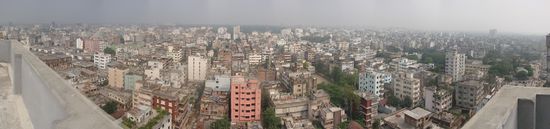
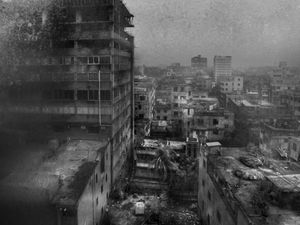 Dhaka, Bangladesh as the location. The terrain, the colors, the method of building construction, the general feeling, all matched Dhaka. Within half an hour, I had concentrated my search there.
 . The second one, by Nikki Linsell
 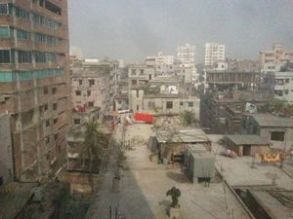 Western La Vinci Hotel, 54 Kawran Bazar, Dhaka City 1215, Bangladesh. It's really hard to guess which floor, since the base of the nearby buildings isn't clearly visible in the photos. From Nikki Linsell's Flickr photo, I think the first row of solid windows in the building next door is on the seventh floor. Assuming rough parity, the photo was taken one floor above that – on the eighth floor.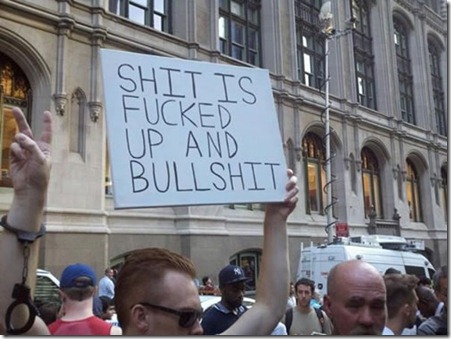
 The Dish