The NYPD's overreach was a gift to the Occupiers:

The NYPD's overreach was a gift to the Occupiers:
Steve Jobs advocated the pursuit of dream jobs. Will Wilkinson and Robin Hanson thought that advice was unrealistic. Timothy B Lee defends Jobs:
"Don’t settle" is bad advice for a 35-year-old who is still waiting tables while he waits for his big break in screenwriting. But it’s an important message for a 22-year-old Stanford grad to hear, because if he’s the obsessive type, he’s far more likely to regret taking a well-compensated job he finds slightly tedious than spending a few years in relative poverty while he pursues a career he’ll love.
A reader chimes in:
I was initially surprised by the criticism of Steve Job’s suggestion that you should do what you love. And these criticisms have been on my mind all week long – maybe in part because they remind me so much of my parent's counsel. For my parents, the best kind of work was the work you were "called to" by something outside yourself. This something might be God or it might be the needs of the world or the people around you, but it was clearly something bigger and more important than you. And there was a sense of satisfaction that came with the submission of one’s self to this duty or calling.
So I realized that Jobs is articulating something of a generational shift. For him to suggest that our true vocation could be found by understanding ourselves and our deep inward desires seems both revolutionary and to the previous generation’s way of thinking – selfish! But if we trust in the way we were made and believe that our making was not accidental, might it not be of great benefit, not only to ourselves but to the world we live in, to take the time to know ourselves and our loves and find a way to bring that love into the world through our work?
We learn faster when told we made a good effort rather than praised for being smart:
The problem with praising kids for their innate intelligence — the "smart" compliment — is that it misrepresents the psychological reality of education. It encourages kids to avoid the most useful kind of learning activities, which is when we learn from our mistakes. Because unless we experience the unpleasant symptoms of being wrong — that surge of Pe activity a few hundred milliseconds after the error, directing our attention to the very thing we’d like to ignore — the mind will never revise its models. We’ll keep on making the same mistakes, forsaking self-improvement for the sake of self-confidence. Samuel Beckett had the right attitude: "Ever tried. Ever failed. No matter. Try Again. Fail again. Fail better."

Jeff Deeney, an addict-turned-social worker, returns for a visit:
The living room carpet was littered with used condoms, a sign that women had been tricking here for drug money. Upstairs, the toilet was overflowing with shit that had run all over the floor because the water got shut off, but they kept using it anyway. The place looked like it had been tossed; drawers were flung open and clothes had been thrown everywhere. I suspected robbery but it turned out later the DEA had recently raided the place. There were spoons still crusted with dried coke and blackened glass stems everywhere.
Needless to say, the scene didn’t tempt me to pick one up and hit it for old time’s sake. I don’t share these details in the spirit of moral judgment—it’s just the reality of what a crackhouse looks like in the clear light of day after the party’s over and everyone’s run from the Feds. Years ago, I would have had no qualms getting high here myself.
(Photo by Karen Apricot)
A reader writes:
Your dissenter, along with many media commentators, forget that Jobs' most significant contributions were not in the last five years but over 30 years ago when he realised that computers were not just for businesses, universities and engineers, but could, and should, be like an appliance in the home – something for everyone. And unlike other technology visionaries who theorised this idea Jobs went and made it happen, pushing the Apple II and the Mac with its revolutionary features like a Graphical User Interface and a Mouse. Sadly this achievement has been eclipsed by the "inventor of the iPhone and iPad" tag because home computers have become so ubiquitous that a world without them has become unimaginable.
Another defender:
Your dissent is absolutely correct that Jobs was a master marketer; the fact that the term "Reality Distortion Field" was coined back in the eighties is testament to this. But there is too much else to Jobs' legacy to simply dismiss him as the guy who brought us slick pitches and minimalist designs. Your dissenter completely overlooks Jobs' fundamental roles at places like NeXT and Pixar – roles which, in both cases, could not have been fulfilled by someone as simple as a master pitchman. (Fun fact: Tim Berners-Lee, the father of the World Wide Web, used a NeXT computer to build the first web browser and web server; how slick marketing and shiny consumer devices alone made that happen is an exercise left to the reader.) Your dissenter also makes no mention of OS X, an operating system firmly rooted in Jobs' work at NeXT. Without Jobs, OS X would simply not exist today.
Your dissenter also furthers the canard that Apple products are fundamentally more expensive than their non-Apple counterparts. The key difference between Apple and the Dells, HPs, and Toshibas of the world is that Apple simply never entered the bargain-level race. You can spec out pretty much any Apple product and land in the same price range as comparably configured non-Apple PCs, and while Apple's entry-level $599 computer isn't cheap, it's a stretch to call it prohibitively expensive for an average first-world family. What's more, Apple is decidedly more price-competitive in the tablet space than any other manufacturer out there, by dint of having aggressively gobbled up the supply chain back when the rest of the tech world was pooh-poohing the idea of an "oversized iPod Touch".
Jobs is a pariah in many tech circles. To call his relationship with developers over the decades "rocky" would be an insult to rocks. Jobs had a long history of treating developers as secondary fixtures in the Apple ecosystem; to Jobs, it was far less important to make the development community happy than it was to make the end user happy. Jobs was a control freak, and created a "walled garden" around his iOS devices, locking developers out of areas that are generally considered free territory on other platforms. This alone was enough to put him on the blacklists of free software advocates, despite Apple's many substantial contributions to open source projects. There are sizable swaths of geekdom that actively disdain graphic and interface design efforts as pointless and counterproductive; after all, why waste time on making something pretty when you could spend that time making it work better?
Because Jobs was such a successful marketer, and because he was so focused on style and design, there's a strong tendency for geeks to undercut the man's formidable geek credentials. There's also considerable (and very fair) disgruntlement that Jobs is a household name largely because he made pretty, popular devices, but great minds like Hamming, Djikstra, Knuth, Cerf, and Turing draw more blank stares than anything.
Jobs is not a titan of computer science, and was no great friend to many in the computing world's more technical spheres. That said, he's not the empty turtleneck geeks often make him out to be, either. He had considerable technical insight and skill, and managed to join it successfully with his knack for wrapping complex systems in easy-to-use devices and pitching them to the world at large. That's a rare and valuable talent.
One more:
The analogy to Armani clothes holds only if there was an alternative. When the iPhone and iPad launched, there was nothing like it out there. That's why he is often spoken of as changing the world. Because he did. He put it all together in a way no one else could.
What other company has the level of customer support satisfaction that Apple has? (Hint: nobody – it is the envy of all companies.) You can break down that $300 iPod touch and find out the part costs are only $125 and some will scream highway robbery. This ignores development, marketing and support costs. For most, you don't have to hold waiting for a CSR from India if you have a problem; you can take it to your local Apple store and get it fixed right there.
Yes, Jobs made these devices cool and that's the appeal for some. For others it is the sheer simplicity and knowing it will just work. Do they charge a premium for having something that just works and if it doesn't you can get fixed very very easily? Maybe, but that's a trade off most customers are willing to make.

Today on the Dish, Andrew remained sympathetic to Occupy Wall Street and bullish about Obama at a time of extreme inequality, he began to dismantle Romney’s oblivious foreign policy address, and he reflected on the miracle of married life. Tony Blair defended Obama against the absurdity of the liberal critique, David French brought evangelical voters back to earth, and Jackson Diehl revised the history of the Iraq War once more. We compiled reports from the fighting in Egypt, a computer virus infected the cockpits of American drones, and IED blasts target the genitalia of soldiers.
Perry unleashed a sweeping attack on Obamneycare, Lawrence O’Donnell assailed Herman Cain over civil rights and Vietnam, and Jennifer Rubin was somehow surprised by right-wing bigotry towards Mormons, among other groups. John Gray pushed back against Steven Pinker’s thesis on pacifism, Kevin Drum refused to heed Peter Thiel’s warning that American innovation is halting, and Felix Salmon ushered in an era of high unemployment. We mapped same-sex households in America, and Noah Millman brainstormed solutions to our healthcare spending crisis.
The standard-setting American kilogram is better protected than the president, HPV now exceeds tobacco as a common cause of oral cancer, a new film celebrates citymaking, and “the storm and stress” of adolescence is rockier than the much-maligned midlife crisis. We visualized dinner and flavor patterns, readers mulled over Steve Jobs’ unique role in American job-creation (and destruction), and one reader has had enough of all the Jobs eulogizing. We uncovered the history of “Keep Calm And Carry On,” hitchhiking could combat our transportation and environment woes, and a Pennsylvania town has been going up in flames since 1962. Both painters and bankers benefit from conspicuous consumption, psychological bribery drives the economy of influence, and regulations stifle crowdfunding.
Cool ad watch here, poseur alert here, VFYW here, MHB here, and FOTD here.
– M.A.
(Photo of a sign at Occupy Wall Street via The Hairpin.)

A devastating combat reality:
The upward blast of an IED often rips off lower limbs as high as the hip, as well as the genitals. … In some cases the perineum, the seam at the bottom of the torso, is ripped open and the intestines and other organs spill out, a Navy combat corpsman told me. One out of five Americans whom the Army medically evacuated from Afghanistan last October suffered such wounds, which the military calls genitourinary, or "GU," wounds. … According to the Army task force report on severe IED wounds, a number [of troops] have developed "do not resuscitate" pacts in case they suffer traumatic genital amputation.
The Army has begun to ship tens of thousands of pairs of "armored overgarments — in effect, diapers — to try to protect soldiers’ genitals from blasts."
(Photo: U.S. Marine Cpl Ryan Yeaton (L) and LCpl. Benjamin Harshman with India Battery, 3rd Battalion, 12th Marine Regiment comfort each other after escorting the remains Marine LCpl. Francisco Jackson to an aircraft to begin the ride home on October 19, 2010 in Kajaki, Afghanistan. Yeaton and Harshman were with Jackson when he was killed by an improvised explosive device while on patrol earlier in the day. By Scott Olson/Getty Images)
Yglesias reviews Lawrence Lessig's new book, Republic, Lost:
Socially and psychologically, human beings do favors for people who have done favors for them. Lobbyists, bund-lers, and campaign contributors don’t need to bribe anyone to exert influence. They just need to give. By the same token (although what is at stake is often hardly a token), it would be illegal and gauche, not to mention unnecessary, for members of Congress to bargain votes explicitly for post-congressional rewards such as trade-association presidencies. Without anyone necessarily being bribed, Lessig argues, a dangerous and unseemly economy of influence has arisen in Washington that renders legislators dependent on lobbyists and all too independent from their constituents or the national interest.
A proposal:
Imagine a Kickstarter 2.0 where, for a sum of around $250, you get part-ownership in a company instead of a thank you note and t-shirt. There are already a small handful of companies lining up to facilitate crowdfunding, some flying under the radar of regulations and others chomping at the bit and pushing for change.
So what's holding this up? Regulations:
[T]here are a number of sites in the US where you can "give" money to a creative project in return for a prize or keepsake or two. There are places where you can lend money peer to peer. But you cannot purchase equity, as you can in the UK, because the SEC demands [such] a high fee for authorising the documentation to sell equity to the general public.
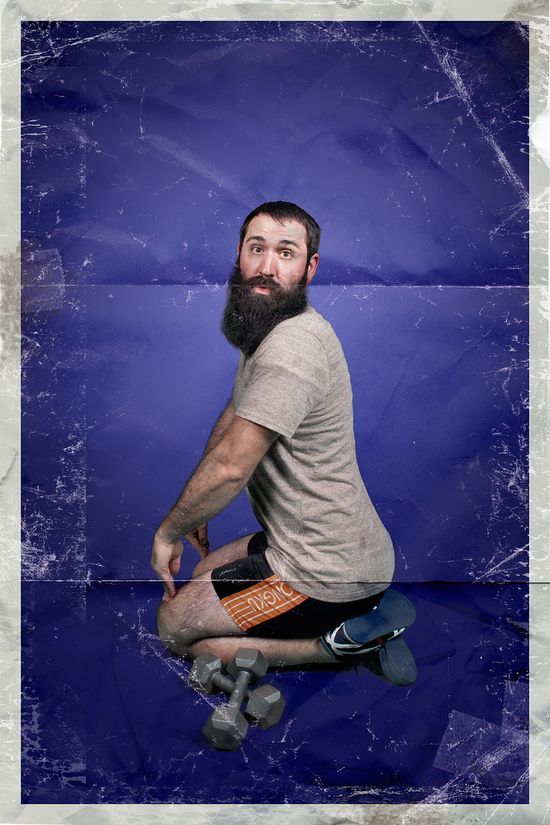
Caperton parses the project "Men-ups," a take on the classic pin-up:
We’ve seen how Batman just isn’t quite the same in bustier and cocked hip. And now photographer Rion Sabean shows us that a gender-bent approach to the classic pin-up girl loses something in translation.
Money quote from an interview with Sabean:
The one with the beard has become a fan favorite it seems.
 The Dish