You can say that again.
Month: October 2011
We Why Love Flawed Characters
Because we relate to them:
Human beings have rough edges. Authors who write exclusively about ethical, admirable, likeable characters are not writing about real people. … Good stories require mistakes. If you want to read about unimpeachable characters, order the annual report from Oxfam. If you want to read about difficult, complicated, maddening characters who remind you of people you know – who remind you, if you’re honest, of yourself – read Shakespeare. Read Dostoevsky, Tolstoy, and Flaubert. Read Wilde, Updike, Roth, Yates, Wolfe, Woodward, McEwan, Hornby, Hollinghurst and Shriver.
The View From Your Window
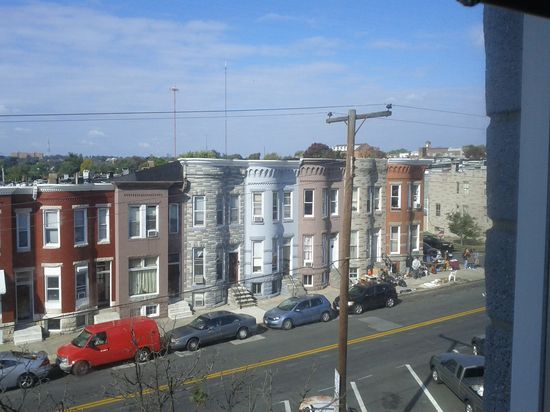
Baltimore, Maryland, 11.09 am
Can Smartphones Safeguard Democracy?
A new study by Michael Callen and James Long points in that direction. They used low-end digital cameras in Afghanistan’s 2010 parliamentary elections:
At polling stations where locally reported vote counts were digitally photographed, reports of electoral fraud were as much as 60 percent lower, and the vote counts of politically connected candidates—the ones most likely to have rigged elections—were reduced by about one-quarter.
Callen and Long found similar results in a study they conducted in Uganda's national election last year.
Face Of The Day
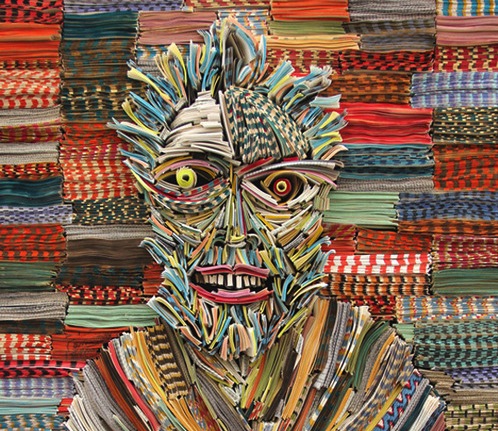
"Paper Elegies" by Nick Georgiou.
Ahab Lives
Nathaniel Philbrick ponders the lasting lessons of Moby Dick:
In every age, there will be a threat to the principle of "divine equality," and his name is Ahab. In Melville’s view, it doesn’t take much to become a demagogue as long as you learn a few simple tricks. Dictators such as Hitler, Saddam Hussein, and Muammar Qaddafi are not geniuses; they are paranoid despots and expert manipulators of men. If you want to understand how these and other megalomaniacs pull it off, read the last third of Moby-Dick and watch as Ahab tightens his stranglehold on the Pequod's crew in his increasingly horrifying quest for the White Whale.
But Melville also provides a description of the ideal leader.
In the midst of a disorienting crisis, what is needed more than anything else, he suggests, is a calm, steadying dose of clarity, the kind of omniscient, all-seeing perspective symbolized by an eagle on the wing: "And there is a Catskill eagle in some souls that can alike dive down into the blackest gorges, and soar out of them again and become invisible in the sunny spaces." This is the anti-Ahab, who instead of anger and pain relies on equanimity and judgment, who does his best to remain above the fray and who even in the darkest of possible moments resists the "woe that is madness."
The View From Your Window Contest

You have until noon on Tuesday to guess it. City and/or state first, then country. Please put the location in the subject heading, along with any description within the email. If no one guesses the exact location, proximity counts. Be sure to email entries to VFYWcontest@gmail.com. Winner gets a free The View From Your Window book. Have at it.
Why We Gesticulate
Our mouth and hands are closely linked in the brain:
[I]t actually takes work not to gesture when we’re having a tough time getting our point across. When researchers have prevented people from gesturing while trying to think of words—inferno, say, or criminal negligence—they are less likely to successfully retrieve them. There are cultural differences in the size and frequency of our gestures (falling, more often than not, along stereotypical lines—want to hazard a guess about whether the Italians or the Japanese gesture more boisterously?—but we all gesture. The blind even gesture to the blind. As both artifact and facilitator, gestures may prove to be as much a part of speaking as speech itself.
A Burmese Spring?
Morton Abramowitz and Thomas Pickering keep tabs on the military junta's surprising liberalization:
When we visited in May, talk of reform was in the air but few concrete measures had been taken. The new government has now released dissidents, met with pro-democracy leader Aung San Suu Kyi, known as ASSK, at the highest levels, created a National Human Rights Commission, somewhat eased media censorship, welcomed back overseas exiles and more publicly emphasized dialogue with ethnic-minority groups focused on a national reconciliation. Following some uncharacteristically open debate, President Sein suspended a controversial, Chinese-backed mega-dam project that would dislocate thousands of villagers, harm the environment, and contribute to ethnic conflict. Equally important for accelerating change, the new government recognizes its serious economic troubles and is reaching out to the IMF and other international financial institutions to help reorient its economy.
Russ Wellen flags an assessment (pdf) of the Burmese opposition by Roland Watson:
[S]trategy for the Burma pro-democracy movement is relatively simple, albeit complex to implement. The movement has two arms, non-violent protestors and ethnic rebels. But, rather than opposing each other, they can instead complement and work together, creating what chaos theory calls a feedback loop where the pressure inside Burma on the regime becomes so great that it breaks. If the people start protesting, and the ethnic groups launch offensive operations wherever and whenever possible, the regime will not be able to handle it. What worked in Libya will work in Burma, too.
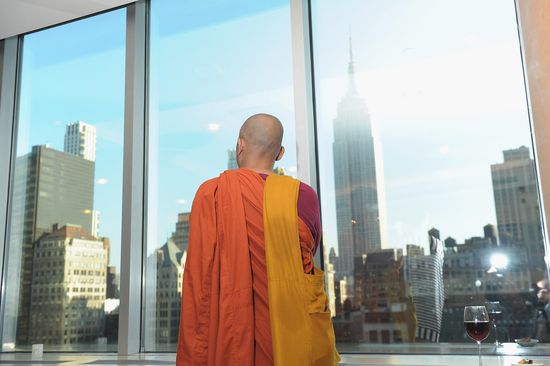
(Photo: A Burmese Monk looks at the Manhattan skyline during the HBO Documentary screening of 'Burma Soldier' at HBO Theater on May 12, 2011 in New York City. By Michael Loccisano/Getty Images for HBO.)
What Is Turkey Doing In Syria?
Turkey appears [NYT] to be providing support and shelter for the Free Syrian Army, an anti-Assad military organization. Daniel Serwer freaks out:
None of this is good.
Violence–however justified on moral grounds–is going to make it harder for the protesters to win over minorities in Syria and opens the real possibility of ethnic and sectarian warfare that will spill over Syria’s borders into Iraq, Iran, Turkey and Lebanon. That could become a truly serious mess that all concerned would regret. It is time to ask the Turks to keep the Free Syrian Army inside Turkey and to stop playing with fire. If they want to do something, some stiff restrictions on Turkish business with Syria would help.
Michael Totten shrugs.
 The Dish
