The Weight Of The World

The kilogram by which all kilograms are measured, located in France, has been losing weight. Americans have their own version:

The official US kilogram—the physical prototype against which all weights in the United States are calibrated—cannot be touched by human hands except in rare circumstances. Sealed beneath a bell jar and locked behind three heavy doors in a laboratory 60 feet under the headquarters of the National Institute of Standards and Technology 20 miles outside Washington, DC, the shiny metal cylinder is, in many ways, better protected than the president. … As a metric unit, the kilogram is “equal to the mass of the international prototype,” according to the official definition. In other words, as metrologists like to point out, it has the remarkable property of never gaining or losing mass. By definition, any physical change to it alters the mass of everything in the cosmos.
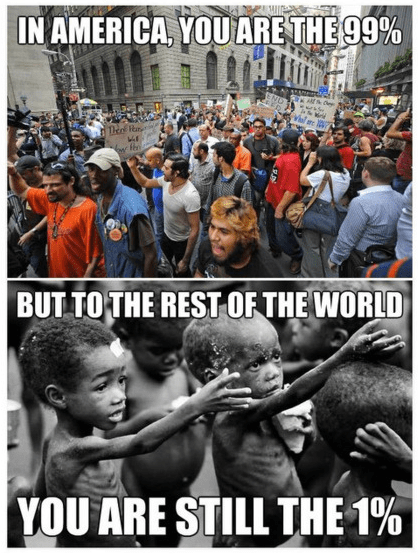
Will The Real 99% Stand Up?

Screen shot 2011-10-06 at 4.23.02 PM
Taylor Marvin checks the math of the above image, which has been making the rounds:

Is this true? Is the income of the bottom 99% of US citizens in the top 1% of world income? Short answer: maybe. From the World Bank, World Development Indicators dataset, in 2009 per capita US income was $45,989, compared to a world average of $8,599. Plugging this into the Global Rich List income comparison tool tell us that the average American falls into the top 1.43% of humanity, suggesting that the 99 Percent graphic’s claim is just off. However, there are a lot of problems with this comparison. For example, the average US income provided by the World Bank is given in GDP per capita. This is problematic for a few reasons. First, it includes the income of the top 1%, which we’re not interested in and in the US is high enough to significantly skew this figure. Similarly, GDP per capita is an averaged measure — while this is often the best income measure economists can get, it doesn’t account for inequality.

The Miracle Device

Tim Carmody, whose son is autistic, explains why the iPod and iPad have been called “a near-miracle device” for children and adults with autism. On disabilities and technology more generally:

I bought my first iPhone when I broke my arm, because it let me use a computer with one hand. And on Tuesday, when I saw Apple’s demo video for Siri, its new voice-command AI assistant — which ends with a blind woman using Siri to send and receive text messages — knowing that blindness has been the disability least well-served by the touchscreen revolution — I wept. I’m weeping again now. These frail and fragile bodies don’t always work the way we want them to. Steve Jobs understood that. Steve Jobs succumbed to that. But he also left us things that make that easier, that let us touch people we might not otherwise.

In Praise Of Darkness

Tim Blanning reviews Evening's Empire: A History of the Night in Early Modern Europe by Craig Koslofsky:

Christian disapproval of the night is as old as the New Testament. Unsurprisingly, St Paul’s epistles equate darkness with evil, as does John’s Gospel – “I am the light of the world: he that followeth me shall not walk in darkness”. However, there was another albeit less obtrusive theological tradition advocating a path leading to God that was not brilliantly lit. Especially influential was Pseudo-Dionysius the Areopagite, the fifth-century Syrian thinker, who proclaimed: “I pray we could come to this darkness so far above light!”. … It was always those who preferred personal introspection to institutional dogma who found the dark side congenial.


The Good Word

In honor of the 400th anniversary of the King James Bible, Glen Scrivener is blogging many of its most famous phrases. He notes how many came from William Tyndale, who was later "condemned as a heretic, degraded from the priesthood, strangled and then his body burnt":

Computer analysis has revealed that more than three quarters of the King James Version can be traced directly to Tyndale (83% of the NT and 76% of the OT). … The King James Version is sometimes called ‘the greatest book written by committee.’ And I suppose there is something to celebrate about that. Yet, for the most part, those 47 scholars, working in peace and prosperity, could not improve on the work of a young evangelical who gave his liberty and his life for the gospel.

Exiting The Herd

In a harangue against our addiction to technology, Louis René Beres argues in favor of taking a break:

Nothing important, in science or industry or art or music or literature or medicine or philosophy, can ever take place without some loneliness. To be able to exist apart from the mass – to be tolerably separated from what Freud called the “primal horde,” or what Nietzsche termed the “herd,” or Kierkegaard the “crowd” – is actually indispensable to exceptional intellectual development, and determinative creative evolution. … To achieve any sense of true spirituality in life, we must first be willing to endure at least some aloneness.

NFL Beer Commercials Ruin Sundays

Andrew Sharp savages the conception of masculinity being pushed in-between downs:

It’s really, really hard to screw up boobs, unless you ask us to identify with a bunch of mouthbreathing douchebags staring at them. Masculinity’s not an illusion, but when it’s distorted like that, it feels like one. Likewise, when the NFL juxtaposes its macho culture by selling itself as the manliest man’s game in the history of men, all the rhetoric undermines the subtle moments in the game where football really is the coolest sport on earth. Where manhood’s real, and actually pretty badass. Where it becomes a chess match between brilliant men who’ve given their lives to the game, with the best athletes on earth, all battling like hell. Where opponents leave the field with either mutual respect or visceral loathing, either of which bonds them for life.

Digital Detritus

Clive Thompson sifts through it:

Right now, of course, our digital lives are so bloated they’re basically imponderable. Many of us generate massive amounts of personal data every day—phonecam pictures, text messages, status updates, and so on. By default, all of us are becoming lifeloggers. But we almost never go back and look at this stuff, because it’s too hard to parse.

The Neurology Of Evil?

5412298986_d9c1d28a92_b

Ron Rosenbaum ponders attempts to find a biological explanation for evil in the brain. In short:

 [Many neuroscientists] argue that the time has come to replace such metaphysical terms with physical explanations—malfunctions or malformations in the brain.

Will Wilkinson resists this understanding of evil:

About evil specifically, it seems obvious that people with perfectly normal brains do evil all the time. The interesting empirical question about evil is not whether or not there is any. Anyone who doubts it just confused. For the life of me I can't see what anything about the brain has to do with the evil of chattel slavery, the brutality of colonial occupation and dispossession, the Holocaust, the Cultural Revolution, etc., etc. Rosenbaum gets it right when he says "Evil does not necessarily inhere in some wiring diagram within the brain. Evil may inhere in bad ideas, particularly when they're dressed up as scientific (as Hitler did with his 'scientific racism')." The interesting empirical question is how it is that people who are not in the least lacking in empathy or disposed to psychopathy can, in the right circumstances, find themselves quite ready and willing to torture, kill, and humiliate other human beings — to do evil.

(Image by Flickr user Alex Robertson)