Happiness Is A Place?

Maria Popova reviews Eric Weiner's The Geography of Bliss: One Grump’s Search for the Happiest Places in the World:

Our tendency to conflate geography and happiness seems to be more deeply embedded in our thinking and even our language than we realize. We speak about “looking for” happiness and “finding” joy as though these were specific locations on an actual map. Until the 18th century, people even believed the Garden of Eden, the biblical notion of paradise, was a real place, so they depicted in on maps — located, as Weiner notes the irony, at the intersection of the Tigris and Euphrates rivers where modern-day Iraq lies. At the same time, the entire self-help industry is built — and billed — on the premise that happiness is inside us and we simply need to dig it out. But, Weiner argues, both of these notions are wrong — the line between “out there” and “in here” is much finer than we’ve been led to believe and, as he puts it, where we are is vital to who we are.
A Poem For Sunday

Exodus

"An Essay on Man: Epistle I" by Alexander Pope:

       Cease then, nor order imperfection name:
Our proper bliss depends on what we blame.
Know thy own point: This kind, this due degree
Of blindness, weakness, Heav'n bestows on thee.
Submit.—In this, or any other sphere,
Secure to be as blest as thou canst bear:
Safe in the hand of one disposing pow'r,
Or in the natal, or the mortal hour.
All nature is but art, unknown to thee;
All chance, direction, which thou canst not see;
All discord, harmony, not understood;
All partial evil, universal good:
And, spite of pride, in erring reason's spite,
One truth is clear, Whatever is, is right.

The full poem can be read here.

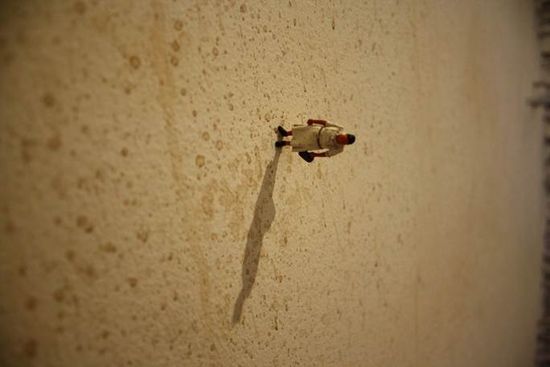
(Image: Procession (Exodus) by Clinton De Menezes)

Where Science Can’t Go

Alan Lightman explores the limits of the scientific method:

We cannot clearly show why the ending of a particular novel haunts us. We cannot prove under what conditions we would sacrifice our own life in order to save the life of our child. We cannot prove whether it is right or wrong to steal in order to feed our family, or even agree on a definition of “right” and “wrong.” We cannot prove the meaning of our life, or whether life has any meaning at all. For these questions, we can gather evidence and debate, but, in the end, we cannot arrive at any system of analysis akin to the way in which a physicist decides how many seconds it will take a one-foot-long pendulum to make a complete swing. These are questions for the arts and the humanities. These are also questions aligned with some of the intangible concerns of traditional religion.

When A Kid Comes Out

A mother nods approvingly as her six-year old son lusts after Blaine, the gay hearthrob on Glee. And then she rages against those who have dismissed her son's feelings:

While I fully acknowledge this may not be the end-all-and-be-all to my son's sexual orientation, I object to the idea that being gay is only about sexual acts. Our emotions and feelings, our attractions and compulsions, all contribute, not just our body parts. If my son had a crush on the star of iCarly, I doubt people would be saying he was too young to have those sexual feelings towards a girl. I think they would think it was an innocent schoolboy crush, which is exactly what it is.

Plus, for every comment I've read saying my son is too young, I have received multiple messages from adults saying "I knew when I was little, too." It got me thinking and after awhile I started to feel like I knew this big secret that shouldn't be a secret at all: Every gay adult used to be a gay kid.

A Counterfeit Buzz

China's forgery market has reached the vineyards:

Wine consumption has grown by 16 percent in past three years, making China the ninth-largest wine-drinking country in the world in 2010 … The price of a bottle of Château Lafite Rothschild, considered one of the finest Bordeaux in the world, increased 574 percent, according to Lucas Botebol, who writes about the Chinese wine market on his site Zhongguo-wine.com. And wine merchants believe more than 70 percent of all Lafite bottles sold in China are fake, according to the magazine China International Business.

The Visual Charge Of A Beard

Screen shot 2011-10-05 at 9.50.00 AM

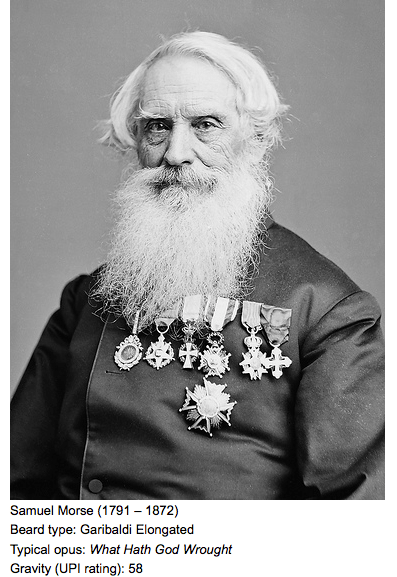
Gilbert Alter-Gilbert uncovered the English book Poets Ranked by Beard Weight, "a privately printed leaflet offered by subscription to the informed man of fashion" by Upton Uxbridge Underwood on the eve of Great War:

[O]ur self-appointed arbiter of all things fuzzy and frizzy applies a grading system structured as a sliding scale he has unassumingly named the Underwood Pogonometric Index. This admirable instrument of scientific classification gauges the presence and projection of a "galvanic imponderable" Underwood calls poetic gravity — an intangible property which results from the aesthetic "charge" of the beard itself rather than from any intrinsic ability or merit attaching to the wearer in question or to his literary productions.

(Image: Samuel F. B. Morse, winner of the highest ratings.)

Cruising

Cruising

Nozlee Samadzadeh interviews photographer Chad States about his series:

The wonderful thing about cruising parks is that there is generally a great cross-section of subcultures. Sex is the great unifier. All these different types of men who normally wouldn’t interact much in another situation come to the park with the same desire to physically connect. I do occasionally talk with some of the guys in the woods, but the conversations are kept brief as talking isn’t usually condoned. You don’t come to a cruising park to have full-blown conversations, though that does occasionally happen. Most interactions are kept to just making eye contact. Words are spoken only when needed.

Why Gatsby Endures

Lee Siegel connects Gatsby to today's politics:

Outsiders like Gatsby are quintessential figures of American democracy, a system designed to welcome outsiders by elevating individual will over group affiliation. They can redeem, but they can also unsettle. Gatsby had to escape his humble origins in order to conquer society, yet in remaking his life he generated an aura of mysterious menace. Everyone attended his parties. Hardly anyone came to his funeral.

And here we are, in a time of unsettling flux, in which one enigmatic outsider after another vies for political leadership. Sarah Palin, Donald Trump, Michele Bachmann, the scores of obscure Tea Partiers suddenly thrust into Congress. Then there is the epitome of outsiderness himself, Barack Obama. No one had the audacity to ask Gatsby for his birth certificate as proof of who he really was. But until Obama produced his, he was mythologised as wildly as Gatsby had been: as socialist, communist, revolutionary, conspirator, traitor.