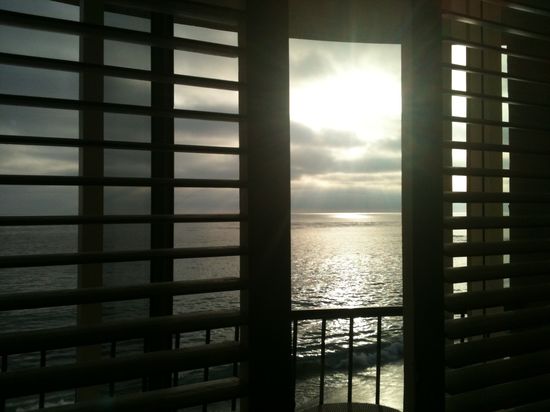
Laguna Beach, California, 5.54 pm
Laguna Beach, California, 5.54 pm
Artist and writer/director Miranda July confesses her former infatuation with shoplifting. On the moment she decided to quit:
[F]or a long time I thought my biggest heist was fooling everyone into believing that I was an upstanding citizen, a sweet girl. Then, just a few years ago, I realized that everyone feels secretly fraudulent. It’s the feeling of being an adult.
Musician Patti Smith's tale of stealing a volume of the World Book Encyclopedia when she was ten years old is equally endearing.
That's Scott Stewart's take on the aftermath of the Awlaki strike:
Of course, while [Al-Qaeda in the Arabian Peninsula's (AQAP)] English-speaking outreach will be severely crippled following Khan’s and al-Awlaki’s deaths, the core of its physical battlefield operational leadership remains intact. Al-Wahayshi is a competent and savvy leader. His military commander, Qasim al-Raymi, is an aggressive, ruthless and fierce fighter, and his principal bomb maker, Ibrahim Hassan al-Asiri is creative and imaginative in designing his innovative explosive devices. There were rumors circulating that al-Asiri had been killed in the airstrike directed against al-Awlaki, but they proved to be unfounded. If al-Asiri had been killed, the airstrike would have impacted both the ideological and operational abilities of the group.
Dave Mandl interviews Kenneth Goldsmith, poet and web provocateur:
[O]ur entire digital world is made up of alphanumeric language (the 1s and 0s of computing). You know sometimes when you receive a JPEG in an email and it comes in wrong, appearing as garbled text instead of an image? It’s a reminder that all of our media now is made of language: our films, our music, our images, and of course our words.
How different this is from analog production, where, if you were somehow able to peel back the emulsion from, say, a photograph, you wouldn’t find a speck of language lurking below the surface. The interesting thing is that now you can open a JPEG in a text editor, dump in a bunch of language, and reopen it as an image, and you’ll find that the image has completely been changed—all as a result of active language. This is so new, and the implications for writing are so profound and paradigmatic.
We explored Goldsmith's concept of the uncreative writing and copyrights.
Rob Horning proffers a guess:
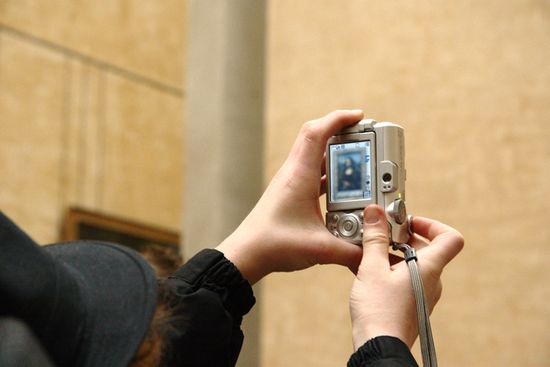
[T]he “alliance … between photography and tourism” is at the heart of what [Susan Sontag] called “the predatory side of photography.” We’re still hunter-gatherers, under this theory, bagging images like sustenance.
(Photo: from the project La Joconde by Mika Matsuzaki and Benjamin Mako Hill who took photos of people taking photos of the Mona Lisa.)
Jerry Weissman extols the virtues of speaking aloud:
Writers have long known that speaking aloud what they have written in silence helps them to shape their ideas. … Clive Thompson cites the example of writer and critic Tim Carmody, who "found himself staring at an empty page, not knowing where to begin. He had no problem talking to friends about his ideas, so Carmody booted up Dragon (voice recognition software from Nuance) talked aloud for hours, and got past the block." Carmody was experiencing the front end of a spectrum of benefits that comes from combining the written words with the spoken. At the back end of the creative process — reviewing and polishing — speaking aloud provides perspective. … Montaigne valued the process: "'The things I say,' Montaigne dictated, 'are better than those I write.'"
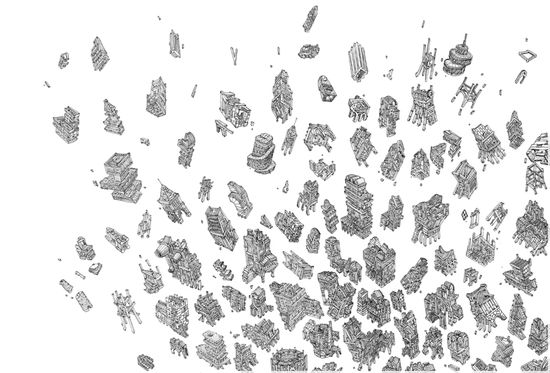
It's been fifty years since Jane Jacobs’s The Death and Life of Great American Cities was released. American Conservative rounded up experts to weigh in on her legacy. William Lind blames our broken cities on the streetcar lines that were replaced with buses:
Most people like riding streetcars, but almost no one likes riding a bus. The substitution of buses for electric streetcars drove most former streetcar riders to drive. When people took the streetcar to town — and every American city or town with 5,000 or more people once had streetcars — they also spent a lot of time on Jane Jacobs’ all-important sidewalks.
(Image: Sprawl by Vasco Mourao)
Geoffrey Pullum crusades in favor of the much-maligned stylistic choice:
[D]o the writing tutors of the world really think we should not report that a politician has been shot until we can specify the gunman? Do they honestly think it’s wrong to say that the lights are left on all night in an office building without supplying a list of the individuals who controlled the switches? We really have to get over this superstitious horror about passives. It’s gone beyond a joke.
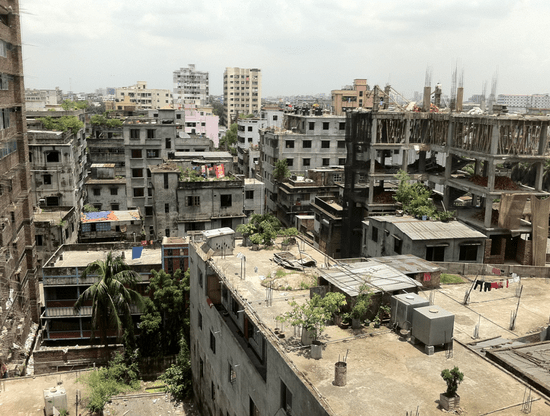
You have until noon on Tuesday to guess it. City and/or state first, then country. Please put the location in the subject heading, along with any description within the email. If no one guesses the exact location, proximity counts. Be sure to email entries to VFYWcontest@gmail.com. Winner gets a free The View From Your Window book. Have at it.
 The Dish