My friend Kevin Sessums wrote a Facebook item two days ago about his vision of light beneath a crucifix when he walked the Camino, and a truly strange experience of what he describes as a "demonic" "angel of light" the other night outside the window of his Manhattan apartment. I can almost hear the rolling of the eyes out there. But his follow-up post got to something that really helped me:
I hope I didn't freak too many of you out yesterday with my posting about angelic and demonic visions – although I did feel as if I were in the finale scene of a Boito opera. Others of you might have just thought I was getting all Shirley MacLaine on your ass. Shirley did walk the Camino as I did and wrote a book about it in which she describes having her own visions there. When I read her book before heading over to Spain for my own walk on the Camino, God knows I rolled my own eyes at some of what she wrote of envisioning. But finally, yes, God alone knows if what I described yesterday is real or not. I only know it is true.
Things can be real and not true; and they can be true and not real. And sometimes, the true becomes the real, which is how Catholics see the Mass.
I am sure plenty of Christians today and in the past (and many today) believed in the literal truth of Genesis, down to the seven days and Adam as dust and Eve as his rib. They believed it to be real and true. But it is quite obvious to me in the 21st Century that this is not real, even though it may, in a deeper sense, tell us a metaphorical truth. I know many will scoff at this as pure expedience, shiftng the goalposts of religious faith through time to avoid any accountability. But from my point of view, it makes sense.
I am not a fundamentalist. I do not believe that human beings can truly, definitively understand the ways of God with any precision, and this view is, from Job to even Jesus, uncontroversial in Christianity. But we can, at various times, glimpse the Godhead, as in the Incarnation, even as we clumsily attempt to translate that ineffable truth into imagery and language that humans can understand. In that sense all religious doctrine is wrong. It has to be. And when it seems right, it is only because we may be grasping at a partial truth, not the whole:
Now we see through a glass, darkly; then we shall see face to face.
When Jesus spoke of the Kingdom of Heaven, he used human analogies and parables. By this act, He was telling us, I believe, that though we have some ability to grasp the divine, we are ultimately limited by our physical lives and needs and emotions. And so the revelation that with greater knowledge and intelligence, we can see that Genesis is literally untrue but, through metaphor, tells 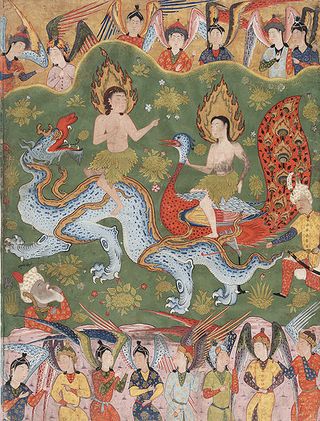 a deeper truth about us is not some strange post-hoc rationalization. It's intrinsic to the view that God is eternal but our grasp on God shifts and changes as we understand the world better and as Revelation unfolds through time.
So Genesis may no longer be real to us; but it can still be true. Is it contrary to the Big Bang, and the now-remarkable news that the universe is expanding at an accelerating rate? Yes and no. No, because its literal account is very different and empirically false. Yes, because we now know humankind emerged from earlier species around 200,000 years ago and was defined by greater intelligence and self-awareness – our consciousness expanding in the same accelerating way as the universe. I see Genesis as a myth that describes this process of becoming human, buried as it must have been in the collective conscious. It was the best they could come up with at the time.
This turns fundamentalism on its head. It does not say that there is a literal truth about everything, definitively revealed once and for all, and that we need to cling to it with white knuckles or abandon it altogether in the face of new empirical evidence. It says that the Truth is eternal, but we are not. But collectively, we have long striven to discern it almost as a defining characteristic of our species. So in each age, our guesses will be wrong, but also more attuned to what can be right. A key premise here is that reason and revelation are in the end compatible, but, on earth, we may never be able to prove it so. Hence the need for faith and reason in a constant dynamic and interaction. In the beginning was reason and reason was with God and reason was God. We need, in Pascal's words, both the use of and submission of reason.
For me, the key point is that we are all contingent beings in a long arc of human history and pre-history. But there is a direction: The knowledge and intelligence of humankind has expanded exponentially over time. Intelligence shows a slow but unremitting advance in the aggregate and at the top end, may soon, through computers, exceed anything previously known to man, and beyond. To argue therefore that religious stories told and written down thousands of years ago are bunk because they have been proven empirically untrue seems banal to me. Yes, the truths that are conveyed in this story are obviously filtered through the knowledge base at the time. So the sun and moon are designed for the earth; and the creation of everything was explained through a literal story of a figure "God" who can physically reach down to earth and mix some earth and create a human male, and then remove his rib while he is asleep and create a woman. But it does not threaten the fundamental concept of a creation, or, if you take the story as a metaphor, evolution itself. We knew these things to be true before we proved them to be real.
Atheists and fundamentalists want to argue that we cannot shift our understanding, because those who first wrote these things probably believed them to be literally true and countless Christians and Jews have done so throughout the ages. But if you believe that these ultimate things and questions, including God and the origin of our consciousness, must surpass our understanding, then the Truth exists outside of our capacity to grasp it – and we may, at different times in our species history, come up with different ways to express them, none of which, definitionally, can be actually real.
These are only hints and guesses,
Hints followed by guesses; and the rest
Is prayer, observance, discipline, thought and action.
The hint half guessed, the gift half understood, is Incarnation.
The Incarnation is where the true and the real touched. And that, much more than the doctrine of atonement or of the Resurrection, is, to my mind and soul, the crux, as it were, of Christianity.
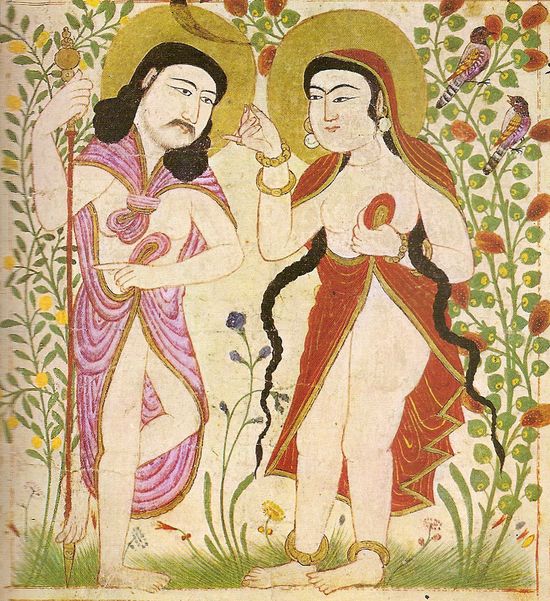
(Illustrations: Paintings by Manafi al-Hayawan, depicting Adam and Eve, from Maragh in Mongolian Iran, 1294/99, and Adam and Eve from a copy of the Falnama, Book of Omens, ascribed to Ja´far al-Sadiq ca. 1550. Via Wiki. )

 The Dish