The Daily Wrap

GT_BIRDSISRAEL_111201
Today on the Dish, Andrew addressed the lessons of "the first conservative," he continued the conversation on race and IQ, and Der Spiegel offered a frank analysis of the Republican primary. The GOP doubled down on immigration, torture, and taxes, and the public ran in the opposite direction. The Taxpayer Protection Pledge fails by its own standard, Newt's tax plan is less ambitious than Perry's, and Huntsman's salesmanship is sadly lacking. Romney struggled through a Fox News interview, Herman Cain threw his family under the bus, and in our AAA video, Andrew discussed Thatcher's particular power. 

Foreign policy is now a front in the culture war, the US is not a crusader state, and the DRC prepared for elections. Iraq squandered its oil economy, Netanyahu used Christmas as a scare tactic, and a hardcore gay leftist accused Israel of "pinkwashing." 

We wondered about the OWS movement's post-Zuccotti era, examined Elena Kagan's early voting record, and analyzed extremes in health care spending. Chris Christie took on the drug war, Alyssa Rosenberg advocated alternatives to sexist literature, and readers weighed in on the charitable donation deduction and guessed at reasons for the regulation of in-flight tech. We studied the obesity wage penalty, and tackled the sex addiction model. Old men let loose in the locker room, the market for legal services is shrinking, and the middle class is putting off retirement until after death. 

Hathos alert here, comment of the day here, correction of the day here, VFYW here, MHB here, and FOTD here

M.A. 

(Photo: Migrating gray cranes fly on November 30, 2011 over the Hula Lakes in northern Israel. The tens of thousands of cranes which break their southward migration to and from Africa from as far away as Siberia spend a few days at the lakes feeding in farmers' fields and gathering their strength for their onward journeys. An estimated 500 million birds fly over the Holy Land twice a year in their annual migrations. By Uriel Sinai/Getty Images.)

Yglesias Award Nominee

"Some conservatives were extremely uncomfortable with the invasion of Iraq under President Bush and the air support for the Libyan revolution under President Obama, and they expressed some of their discomfort in terms of authority: Whatever the prudential judgments about such wars (with which they often also disagreed), the United States is not a crusader state; it lacks, they said, logical or theological authority to undertake war for ideals or general redress of evil.

Perhaps those conservatives were right, or perhaps not. That’s an argument for another day. But, by way of analogy, consider this: If you had doubts about the high authority of the United States to engage in those military actions, are you not required—for precisely the same reasons—to have doubts about the high authority of the nation to execute its convicted murderers in the name of retributive justice? To apply the death penalty because its killers deserve to die?" – Joseph Bottum, The Public Discourse.

Douthat vs Norquist

Ross took on the Taxpayer Protection Pledge last night at AEI. Noah Kristula-Green summarizes the terms of the debate:

Norquist was clear: the pledge has been effective at getting Republicans to hold a hard line against tax increases and that the overwhelming majority of Republicans in Congress are committed to the principles of the pledge. This is true! Sure spending has not been brought far enough down, but now it’s clear that taxes are indeed off the table. Douthat countered that when you look at the record, the pledge has done nothing to actually restrain the growth of government and it does not actually protect the best interests of the taxpayers. As he stated: “There’s this nagging problem that conservatives keep cutting taxes without cutting spending, and that spending has sort of blown up into a sort of world historical challenge facing the United States.”

Douthat follows up with some praise for his opponent:

Norquist deserves some points for his consistency. He has the virtues of a monomaniac as well as the vices: Because he cares about taxes and only about taxes, he’s willing to entertain some of the hard choices that more flexible Washingtonians are eager to evade. I’m thinking of defense spending, in particular, where there is a large swathe of conservative opinion that seems convinced that we can have (if you will) Ron Paul’s domestic policy and Max Boot’s foreign policy —  a group that howled when John Boehner contemplated striking a grand bargain with Obama on taxes and howled anew when the more modest “sequester” bargain ended up threatening defense; a group that generally denies the existence of any connection between the size of the security state and the non-security public sector; a group that believes it can persuade the American people to accept drastic cuts to Medicare not for the sake of national solvency, but in order to free up money to police the Khyber Pass.

Tax Breaks For Charity, Ctd

A reader writes:

My day job is as a nonprofit fundraiser. There has been a bit of hew and cry in the sector about the potential ending of the charitable deduction. But not from a lot of fundraisers. Frankly, most good fundraisers know that donors rarely give because of the tax benefit of doing so. They give because they care about the cause, whatever that may be. Also, most donors never reach the level one has to reach to actually itemize those donations and end up taking just the standard deduction. I've seen little data (and I'm happy to be proven incorrect on this) that the charitable deduction plays a particularly large role in driving charitable donations. Passion for and commitment to a cause nearly always trump it.

Another backs him up:

I could not agree more that the charitable deduction is one of the easy pieces to remove from the tax code. Before I became a tax lawyer, I worked in fundraising, and people simply do not give to charity for tax reasons (with some exceptions at the very richest level of people who set up personal trusts and such). If a person does give to charity for tax reasons, he is losing money.

A charitable donation is worth at most about a third of its dollar value. If you give $1000 to your charity of choice, and if you itemize, you can deduct that amount from your income. So if you had $50,000 in income, on your taxes, it looks like you made $49,000. You saved paying the tax on that $1000. The tax on $50,000 income for a single person for 2011 is $8,631; on $49,000 the tax is $8,381. The difference is $250. So you paid $1000 to charity for $250 in tax savings, which means you lost $750 on the deal. If you are giving to charity for tax reasons, you are losing money.

People do time their gifts for tax reasons.  Many people give in December so they can get a deduction on that year's taxes, but that is just an issue of timing, not a reason for giving. Also, many poorer people do not take advantage of the charitable deduction because they do not itemize.

The same is true for the home mortgage interest deduction, by the way. This deduction does not affect whether you buy a house or not; it just affects how big a house you get. If you cannot afford a down payment or cannot get access to cheap credit, it does not matter how big the tax deduction is. On the other hand, if you can afford a house, you may push yourself to buy a little bigger because you know that you can deduct that cost. The people who take advantage of the HMID are by far the wealthiest Americans because they can afford down payments and have access to credit. Meanwhile, poor and middle-income taxpayers are unable to deduct rental payments that often amount to a dollar figure greater than the standard deduction. So basically renters are subsidizing buyers, and there is no real evidence that home ownership has increased because of it. There was a good paper discussing HMID reforms issued by the Urban Institute in 2010 that is worth a read (pdf).

These are two important deductions that should disappear. I just fear there is not enough political will for it.

Another zooms out:

Living in Singapore and being directly engaged with the Non-Profit community, I can't tell you how much a difference the US charity model makes – particularly when it comes to giving to charities that are "international" (i.e. the environmental groups, social groups, and other NGOs that are doing some great work around the globe.)

The Government of Singapore is at a loss when it comes to dealing with some very fundamental and threatening problems – for example, the burning of the rainforest and peatlands in Sumatra and Borneo that routinely sends a toxic haze over the island. Indonesia is unwilling to engage in discussions with Singapore directly, as what is an environmental issue for Singapore is a societal development issue for the Indonesian side (much of the clearing and burning is done by smallholder farmers and rural communities). Singapore also only permits tax deductions on charitable giving that directly benefits Singaporeans (i.e. giving to a hospital for the blind or orphanage). You can give money away to groups to stop the burning, but there's no tax incentive to do so.

If Singapore reformed its tax code to allow for international charitable giving, there's no doubt that some of the money would be spent on projects which tenuously, at best, benefit Singaporeans. But a significant amount of funding from Singaporean citizens would be available for sustainable development work (i.e. training in better land management practices, sustainable agroforestry, etc.) to help stop the burning. The lack of haze would certainly be a benefit to Singapore as a country, as would the changed perspective of Indonesians. Singaporeans would be benefiting the local Indonesians, without the meddling interference of diplomats, increasing the island's profile without any risk to the government.

Of course, the lost tax revenue probably makes this a non-starter for the most part, but it emphasizes again to me how much of a difference American charity can make when it's not explicitly driven by government interests. According to the Wall Street Journal, Americans gave nearly $9 billion to international charitable work in 2009.  In contrast, USAID's top four benefiting countries in FY2010/11 were Afghanistan, Pakistan, Haiti (earthquake), and Israel totally accounting for about $5.4 billion. Which monies do you think did the most good, and were most effectively spent? Particularly with the whole Philanthropy 2.0 movement, which ensures a maximum amount of donor oversight on funds spent?

While I would never argue that US should slash its international assistance programs (Reform? Of course. Israel is a first-world country), we should never underestimate the amount of good that Americans are doing abroad. By not only staying out of the way, but providing incentives, the US government is doing itself and the world a great favor.

More Chaos For Congo?

GT_Congo

Laura Seay presses the importance of the country's elections:

Despite the ongoing troubles in the east, the DRC is more stable today than it was five years ago. Several militants groups have laid down their arms or integrated into the national army. While most people here still live in desperate poverty, there are small signs that the economy is strengthening. Transportation infrastructure is getting vastly better thanks to assistance from the Chinese government. With assistance from the European Union, health care infrastructure and access are improving. But, if the 2011 elections leads to violence, all of these gains are at risk, as is the stability of the entire region. 

(Photo: A man killed in fighting with the Congolese armed forces lies dead after having been dragged into a field in Lubumbashi on November 28, 2011. The army and armed police were engaged in operations in the cemetery, with sporadic bursts of gunfire coming from inside, as they tried to flush out suspected elements of an armed group disrupting voting in the city. By Phil Moore/AFP/Getty Images)

Fight Art With Art

Alyssa Rosenberg critiques a recent project that called for reformulating works of art by editing out sexist endings:

The answer here is not to hope that Bella Cullen throws off her vampire husband and gets a PhD in English literature, but to provide powerful and compelling alternatives. To get all Saul Bellow in this joint, “There is only one way to defeat the enemy, and that is to write as well as one can. The best argument is an undeniably good book.” Does that mean we’ll suffer major bewildering culture fails along the way? Absolutely. But the real way to win is to join the battle of ideas, not to change the conditions in which it’s fought.

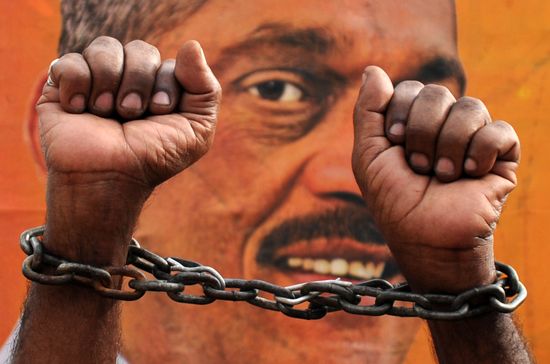
Face Of The Day

134245115

A supporter of Sri Lanka's main opposition United National Party (UNP) holds up his chained hands in front of a photograph of former army chief Darath Fonseka during a protest in Colombo on November 29, 2011. They were protesting the jailing of the former army chief Darath Fonseka, a business take over bill and the government's 2012 budget proposals. By Ishara S. Kodikara/AFP/Getty Images.

Why Do The Obese Earn Less?

John Cawley blames discrimination:

[T]he obesity wage penalty exists even in countries with national health insurance, so lower wages cannot be solely the result of employers' reaction to higher costs in the health insurance plans they sponsor. Second, there is a negative relationship between weight and wages for women even at weights that are too low to be associated with worse health. Third, experiments have found that obese individuals are less likely than healthy-weight individuals with identical credentials to receive job interviews and positive performance reviews.

His Sweet Lord, Ctd

A reader writes:

I'm a lifelong Beatles fan.  I was 13 or 14 when I got my first Beatles record, "The Beatles 1967-1970" compilation. Several months later, I bought my first George Harrison solo album, "Somewhere in England", which has George's wonderful tribute to Lennon, "All Those Years Ago."  There's another song on that album, though, that really zapped me right between the eyes.  By that time (summer '81), I was coming up on my 16th birthday, and the Roman Catholicism that my parents had steeped me in – including five years of parochial school – was beginning to wear thin.  The shell irreparably cracked when I heard "Life Itself."

It's a love song, really.  You listen to the first two verses, and it could be about a wife, girlfriend, mistress, child… no one terribly specific.  But then the middle eight of the song comes along, and he hits you with this:

"They call you Christ, Vishnu, Buddha, Jehovah,
"Our Lord
"You are, Govindam, Bismillah, Creator of All"

George was unabashedly Hindu in his spiritual practice, with a healthy sprinkling of Buddhism thrown in.  I often wonder, though, if he didn't have a slight tilt towards Bahá'í, thought:

In the Bahá'í Faith, religious history is seen to have unfolded through a series of divine messengers, each of whom established a religion that was suited to the needs of the time and the capacity of the people. These messengers have included Abraham, the Buddha, Jesus, Muhammad and others, and most recently the Báb and Bahá'u'lláh. In Bahá'í belief, each consecutive messenger prophesied of messengers to follow, and Bahá'u'lláh's life and teachings fulfilled the end-time promises of previous scriptures. Humanity is understood to be in a process of collective evolution, and the need of the present time is for the gradual establishment of peace, justice and unity on a global scale.

If I'm understanding it correctly, the boilerplate message of Bahá'í is, "Hey folks, they're all the same."  God appeared as "Buddha" because that's what was needed at the time … as Yahweh/Jehova because that's what was needed at the time … then as Jesus, Mohammed etc.  If we believe in God's existence, and if we do believe that God is all-powerful, then wouldn't communication skills be part of those boundless powers?  The ability to tailor your message to your audience, whether they be in Asia, The Middle East, or even the Americas? 

I'll leave the final word to Andrew Lloyd Webber and Tim Rice:

"If you'd come today
"You could have reached the whole nation
"Israel in 4 BC had no mass communication"

Another praises Harrison's "great song, 'Awaiting on You All'":

He sang it at the concert for Bangladesh.  He expresses love for Jesus and disses the Pope:

You don't need no passport
And you don't need no visas
You don't need to designate or to emigrate
Before you can see Jesus
If you open up your heart
You'll see he's right there
Always was and will be
He'll relieve you of your cares

And while the Pope owns 51% of General Motors
And the stock exchange is the only thing he's qualified to quote us
The Lord is awaiting on you all to awaken and see
By chanting the names of the Lord and you'll be free

More in the popular thread here, here and here.