Daveed Gartenstein-Ross and Daniel Trombly parse the US government's strategy in light of Kenya's recent invasion:
The U.S. appears to be attempting to use the Kenyan invasion, whatever its faults, to advance the strategy it has developed for Somalia, allowing Kenya to push al-Shabaab [an al-Qaeda affiliated group] back in areas other than Mogadishu (where [the African Union peacekeeping force] already has a strong presence). But there are real dangers to having the Kenyans, who will be portrayed as a "crusader" force by al-Shabaab and others, inside Somalia.
There were possible problems with the U.S. strategy in Somalia even before Kenya's invasion. Its most glaring omission has been governance, which remains non-functional. The transitional government is still not able to govern within Somalia. As long as the country lacks long-term stability, it will be difficult to prevent the reemergence of another potent insurgency — if the current one can even be quelled in the first place. Still, at least the U.S. has a strategy now, a fact that is in itself significant.
Adam Serwer reports on al-Shabaab's worrying ability to recruit Americans to fight on their side in the recent conflict.
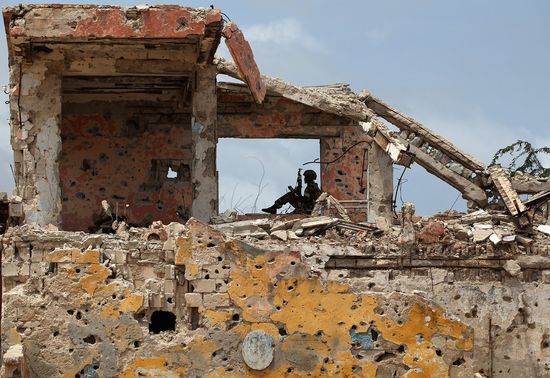
(Photo: An African Union [AMISOM] soldier looks out from war rubble on August 19, 2011 in Mogadishu, Somalia. By John Moore/Getty Images.)
 The Dish