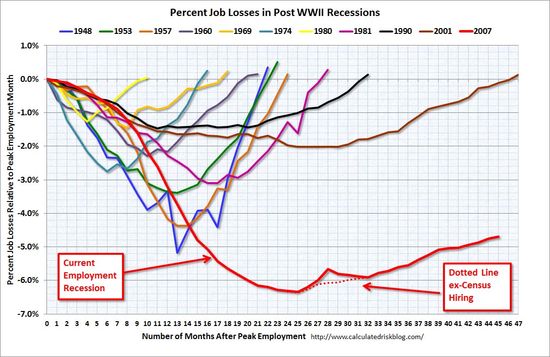
The new jobs report finds that unemployment rate dropped a hair, to 9.0%. Felix Salmon is relatively upbeat:
No one’s opening any champagne this morning: the levels here are still atrocious. But at least there’s reason for hope that the economy is still above stall speed; I, for one, am much more sanguine about the prospects for a double-dip recession than I was a couple of months ago. If the jobs situation isn’t getting worse, that means America’s still growing, and that the recession’s still over. And it’s a lot easier to accelerate a recovery than it is to turn around a decline.
In the month of October, nonfarm payroll employment rose by 80,000 jobs—less than economists expected. The report was less disappointing than might be imagined given that number, however. The initial zero-job figure from August has now been revised up to an increase of 104,000, and September's total has also been revised up, to 158,000. That pace is scarcely enough to keep up with population growth, but it's considerably better than the economy managed in the early summer.
Hiring continues at a snail's pace. The economy is adding jobs, but it is doing so relatively slowly. At this rate, it would take about 4.5 years to get the unemployment rate back down to 5%. Although the nation does not appear to be headed back into recession, it also doesn't appear poised to enter a robust recovery.
[For a] reminder of why [high unemployment] is so alarming, the Hamilton Project has released a study looking, once more, at the heavy long-term toll that unemployment is taking on American workers. The numbers are grim: Two years after losing his or her job, the average worker will earn 48 percent less than previously. Even workers who do find new jobs end up making about 17 percent less, and based on history, those lower wages will likely persist for years to come
Chart from Calculated Risk.
 The Dish
