Daniel Philpott gives a primer on the possibilities and pitfalls awaiting Arab Christians after the Arab Spring:
[I]t is understandable that they have allied with secular dictators: a pragmatism of survival. But the strategy is no longer reliable. While the present period’s flux creates danger, its complex and shifting factions also beget opportunity. “Christians could be among the most important architects of a new order in the Arab world,” the National Catholic Reporter’s John Allen wrote this past August in a powerful column on Christians in the Arab Spring. As vocal defenders of religious freedom, the region’s Christians could become a powerful and credible force not only for human dignity but also for the kind of regime in which they – and all minorities – are most likely to find protection in the new Arab order. But they need help. To be the architects that Allen envisions, Christians require solidarity from sympathetic governments, Christians outside the region, and like-minded Muslims.
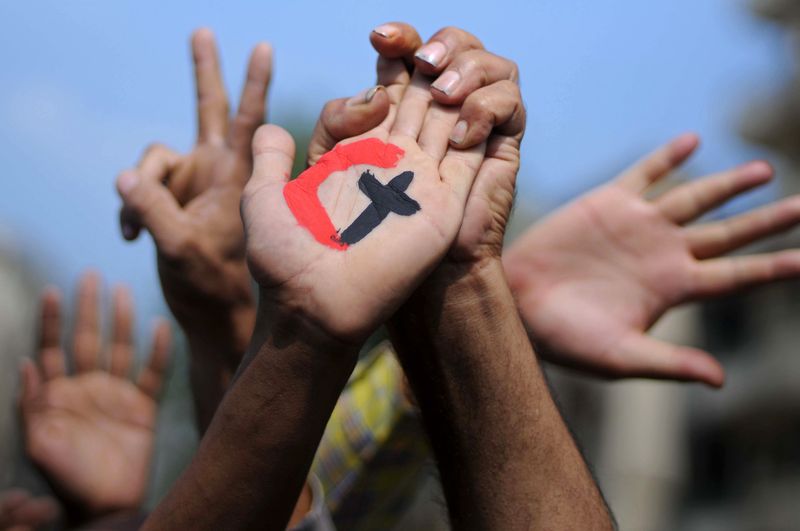
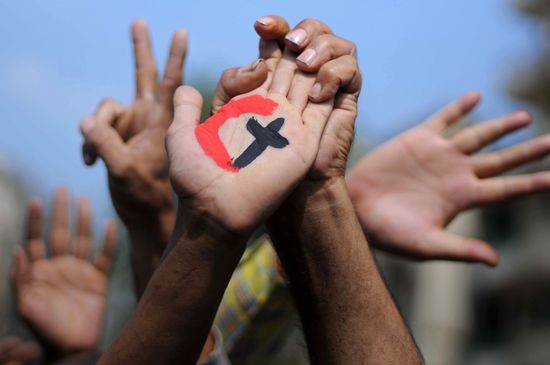
(Photo: A cross and a crescent are painted on the palm of an Egyptian demonstrator holding the hand of a fellow protester during a rally in support of national unity in Cairo's Tahrir Square on October 14, 2011, days after 25 people, mostly Coptic Christians, were killed in clashes with Egyptian security forces. By Mohammed Hossam/AFP/Getty Images.)
 The Dish