Fast Company asked ad firms to come up with ad campaigns to counter most parents' preference for baby boys. The results are here. Anya Kamenetz explains the project:
Government incentives and private-sector funding are important parts of an effort to rectify this problem. But there's also a place for branding; in countries like China, India,
and South Korea, pro-girl advertising has been added to the mix–mostly simplistic propaganda. If better executed, these ads could shape social attitudes in ways subtle and overt. "If handled correctly, the most sensitive issue can be dealt with," says Priscilla Natkins of the Ad Council, which brought the world Rosie the Riveter and Smokey the Bear. She points to recent successful U.S. campaigns about drunk driving ("Friends Don't Let Friends . . ."), autism, and seat-belt use. "When we took on our seat-belt campaign, usage was in the low-20 percents–now it's way up in the mid-80s. Advertising didn't do that alone, but we planted the seed with consumers that led to legislation."
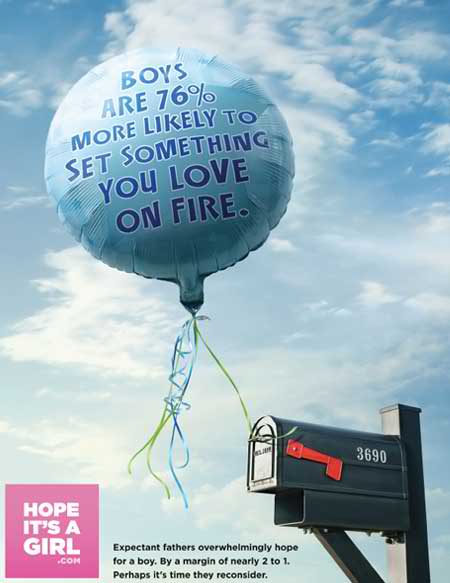
Erin Gloria Ryan still isn't convinced:
I don't care that a boy is less likely to set something I own on fire than a girl, but I do care that according to the US Justice Department, 91% of rape victims are female and 99% of rapists are men. I'm excited that changing social mores might allow her to be a powerful executive someday, but I'm not prepared to know that as soon as she's old enough to drive, she, like her mother, is going to have to learn how to carry her keys between her index and middle fingers in case someone follows her to her car. … Maybe more Americans would be convinced to prefer daughters when they're convinced that the world that waits for them isn't sort of awful.
 The Dish