Raymond Pritchett thinks a strong US presence in Asia may be crucial to keeping the peace:
What concerns me…is if China fails to mature within the liberal global order over the next few decades and simultaneously attempts to achieve primacy of the global oceans through naval power. If indeed the best and most realistic strategic outcome for East Asia is one in which the major powers are in balance, then it must also be stated that the strategic balance [Malcolm] Turnbull believes is best cannot be achieved should China achieve primacy over US Naval power, and I would go further to suggest US naval primacy is today the single condition that allows strategic balance between the major powers if/when China achieves primacy in other areas of national power like economy.
Ted Galen Carpenter is less impressed:
[T]o embrace a containment policy—especially one that is primarily bluster and symbolism—when Washington badly needs China to continue funding the seemingly endless flow of U.S. Treasury debt verges on being dim-witted. It’s never a good idea to anger one’s banker. And one can assume that Beijing is watching U.S. actions, not just the pro-forma assurances that the United States wants good relations and does not regard China as a threat. Those assurances ring increasingly hollow, and one can assume that Chinese leaders will react accordingly. That does not bode well for the future of the U.S.-China relationship.
Viktor Yadah looks at how India might get in to the mix.
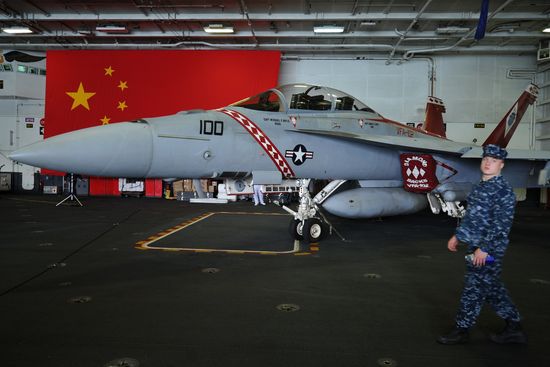
(Photo: A US navy serviceman walks past an F/A-18 Hornet warplane onboard the USS George Washington, a nuclear powered aircraft carrier, in Hong Kong on November 9, 2011. The Nimitz Class warship, which was commissioned in 1992, was in Hong Kong for a port visit. By Aaron Tam/AFP/Getty Images.)
 The Dish