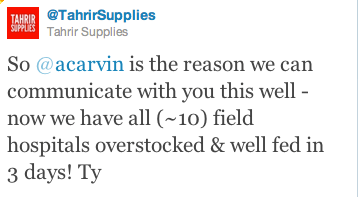
Alix Dunn spotlights Andy Carvin, the NPR social media guru who has served as an international clearinghouse for the Arab Spring:
As Carvin’s Twitter feed demonstrates, becoming an influencer on Twitter clearly makes it possible to broadcast information to large numbers, which, when coupled with smart tagging and grouping of needs and resources can also directly affect events on the ground. This week, despite all of the misinformation surrounding recent clashes in Cairo, Carvin’s attention to the @TahrirSupplies feed has made it possible for him steer information about needs and resources using his network of trusted Tweeps.
Anne-Marie Slaughter thinks people like Carvin are the harbingers of a new sort of power in world politics:
One familiar distinction is "power with" versus "power over." The power that interests [Joseph] Nye is the power that a person, group, or institution exercises over other people, groups, or institutions, getting them to do something they would not have done on their own. "Power with," on the other hand, is the power of multiple actors to get something done collaboratively. (I first heard this distinction from Harvard Law Professor Lani Guinier, but have since seen it in many places.) That certainly seems to capture the phenomenon we are witnessing in so many different places — the networked, horizontal surge and sustained application of collective will and resources. I will call it collaborative power and define it as the power of many to do together what no one can do alone. Consider the power of water. Each drop is harmless; enough drops together create a tsunami that can level a landscape.
 The Dish